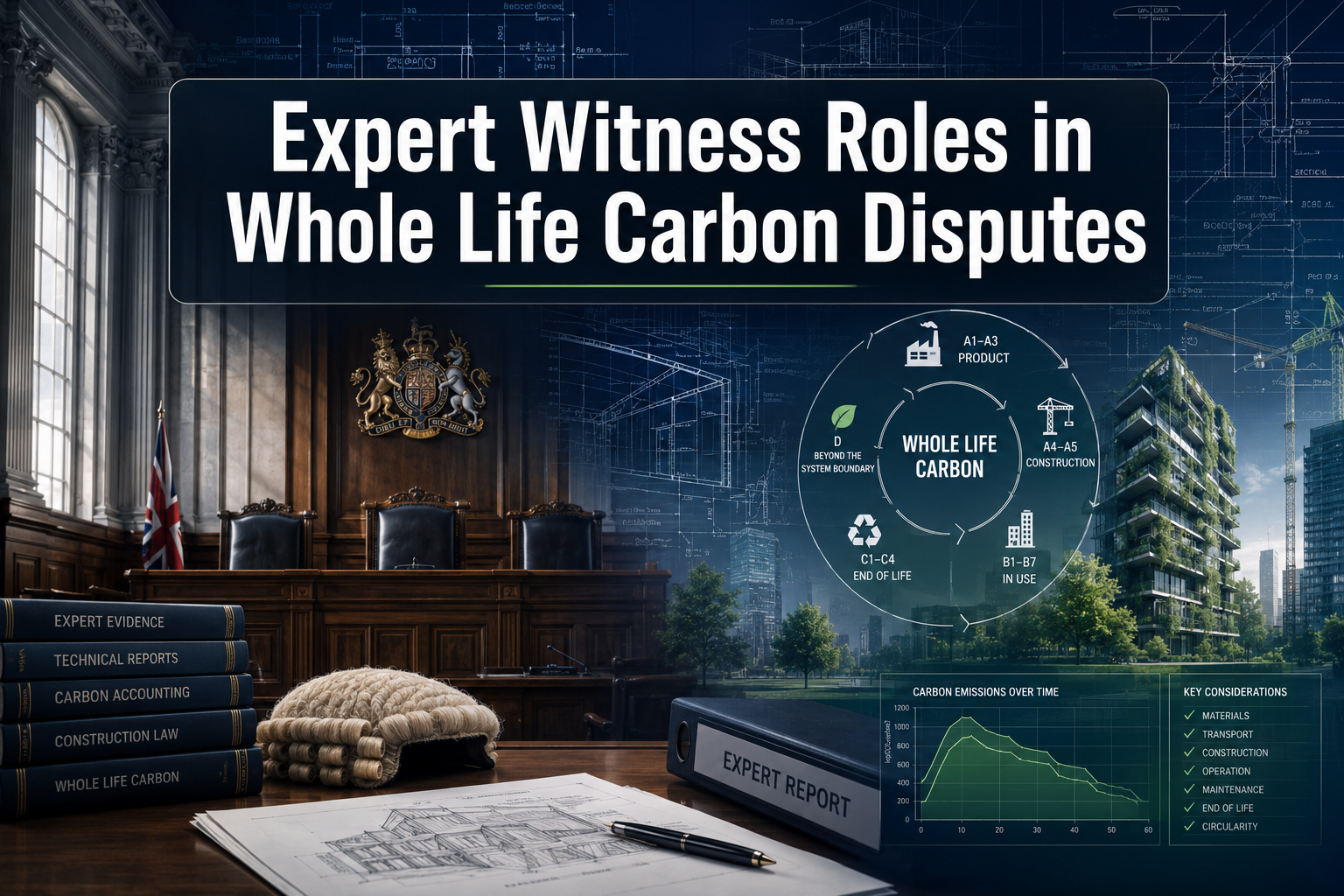
Carbon-related claims now appear in UK property litigation with enough regularity that the absence of a qualified expert witness on whole life carbon has become a material weakness in a party's case. The convergence of the RICS Whole Life Carbon Assessment (WLCA) 2nd Edition, the updated PAS 2080:2023 standard, and the anticipated 5th edition of the RICS professional standard on surveyors acting as expert witnesses has created a new evidentiary landscape. Understanding Expert Witness Roles in Whole Life Carbon Disputes: Evidence Standards Post-RICS PAS 2080 2026 Update is no longer optional for chartered surveyors, carbon consultants, or legal teams handling sustainability compliance disputes in 2026. [1]
Key Takeaways
- The RICS WLCA 2nd Edition and PAS 2080:2023 together form the primary technical framework courts expect expert witnesses to apply in whole life carbon disputes.
- RICS initiated consultation on a 5th edition expert witness standard in August 2025, with sustainability metrics and carbon methodology disclosure forming core new requirements.
- Expert reports must include comprehensive audit trails — data source registries, assumption logs, and version-controlled calculation worksheets — to withstand cross-examination.
- Multi-expert coordination is essential; carbon valuation disputes routinely involve structural engineers, MEP engineers, quantity surveyors, and valuation surveyors working in parallel.
- RICS accreditation for expert witnesses provides courts with a recognized quality signal and significantly strengthens the credibility of carbon assessment testimony. [4]
The Regulatory Framework Driving Whole Life Carbon Disputes
PAS 2080:2023 and RICS WLCA: A Complementary Architecture
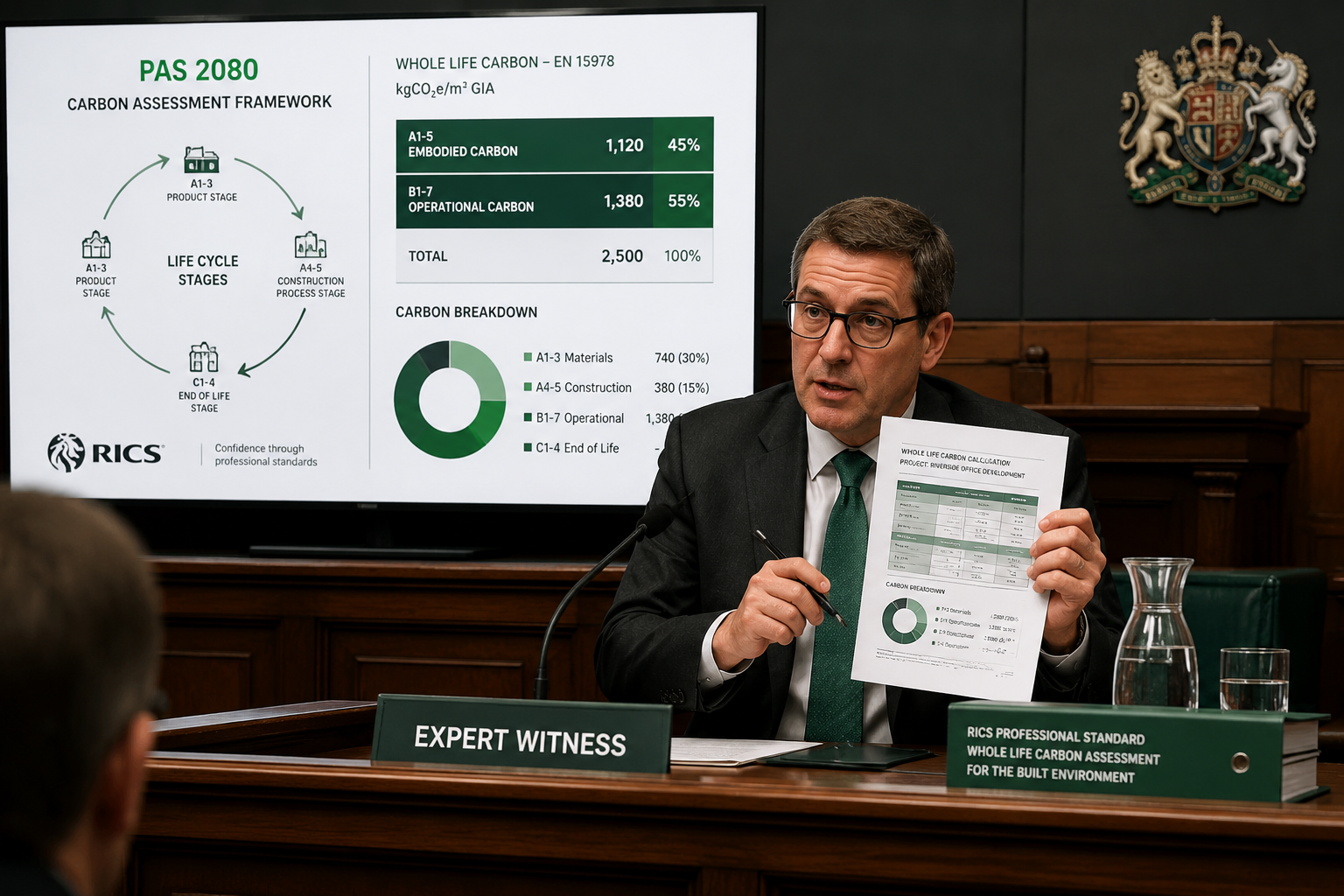
The backbone of any expert witness opinion on whole life carbon in 2026 is the dual framework provided by PAS 2080:2023 and the RICS WLCA 2nd Edition. RICS and the Institution of Civil Engineers (ICE) have formally harmonized their messaging on these standards, confirming that they operate as complementary rather than competing instruments. PAS 2080 governs carbon management across the built environment value chain, while the RICS WLCA provides the measurement methodology for quantifying lifecycle carbon emissions across buildings and infrastructure assets. [2]
For expert witnesses, this harmonization matters practically. A court will expect testimony to demonstrate fluency with both documents. An opinion grounded only in one standard, while ignoring the other, is vulnerable to challenge on the basis of incomplete methodology. The expert must be able to explain:
- How embodied carbon (Modules A1–A5, B1–B5, C1–C4, and Module D) is quantified under the WLCA framework
- How PAS 2080 assigns responsibilities across the value chain — from clients and designers to contractors and asset managers
- Where the two standards overlap and where they diverge in scope
"The RICS WLCA 2nd Edition and PAS 2080:2023 provide a robust framework for expert witnesses to translate lifecycle carbon data into defensible valuation adjustments." [7]
The RICS 5th Edition Expert Witness Standard: What Is Changing
In August 2025, RICS launched a public consultation on the 5th edition of its professional standard for surveyors acting as expert witnesses. The proposed revisions are directly relevant to carbon disputes. Key areas under consultation include:
| Proposed Change | Relevance to Carbon Disputes |
|---|---|
| Sustainability metrics in expert reports | Mandates structured carbon data presentation |
| Carbon assessment testimony requirements | Sets minimum methodology disclosure obligations |
| Digital evidence presentation standards | Governs how carbon models and datasets are submitted |
| Collaboration protocols with other experts | Formalizes joint meeting requirements |
| Disclosure obligations for carbon calculations | Requires transparency on assumptions and data sources |
These changes signal that by the time the 5th edition is finalized, courts will have a clearer benchmark against which to assess the quality of expert carbon testimony. Surveyors who are already aligning their practice with these anticipated requirements will be better positioned in litigation. [1]
For context on how chartered surveyors approach complex technical disputes more broadly, the construction disputes resolution resources available from experienced practitioners illustrate the range of technical evidence issues that arise in the built environment.
Expert Witness Roles in Whole Life Carbon Disputes: Evidence Standards Post-RICS PAS 2080 2026 Update in Practice
Structuring the Expert Report for Carbon Valuation Disputes
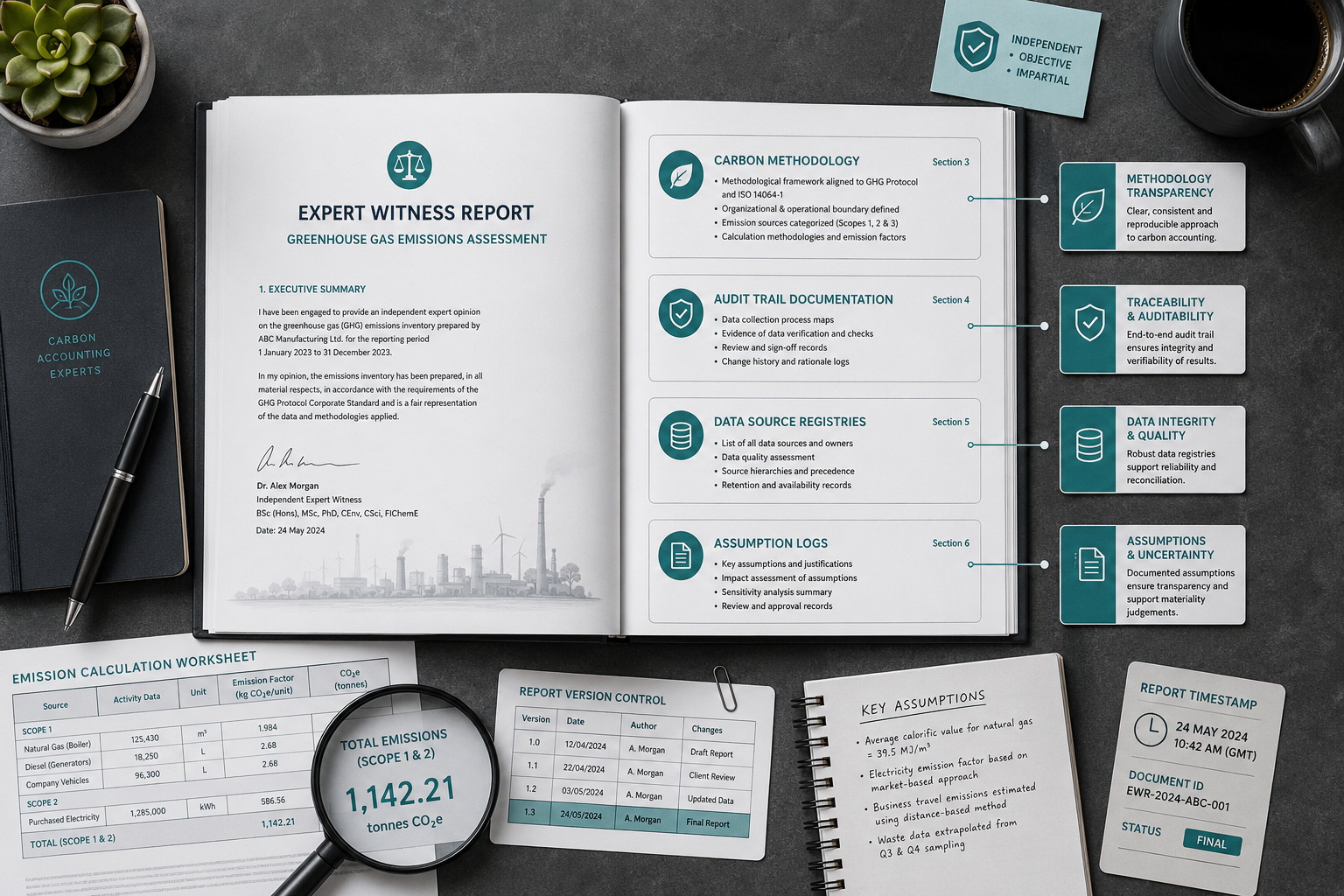
The structure of an expert report in a whole life carbon dispute must satisfy both the Civil Procedure Rules (CPR) Part 35 requirements and the technical expectations set by the RICS WLCA and PAS 2080 frameworks. An effective report follows a clear hierarchy:
- Executive Summary — A plain-language summary of the expert's opinion and the key carbon findings
- Expert's Qualifications and Instructions — Credentials, RICS accreditation status, and the precise questions the expert has been asked to address
- Property and Context Description — Asset type, construction date, use class, and relevant planning or regulatory context
- Carbon Assessment Methodology — The specific approach taken, including which lifecycle modules were assessed, data sources used, and any deviations from standard methodology
- Carbon Performance Analysis — Quantified results with comparison to benchmark figures from the RICS WLCA or PAS 2080 reference datasets
- Valuation Impact Analysis — How carbon performance translates into a measurable effect on asset value or contract compliance
- Conclusions and Opinion — A clear, unambiguous statement of the expert's view, expressed within the bounds of professional competence
- Appendices — Full calculation worksheets, data source registries, assumption logs, and version control records [1]
The valuation impact section deserves particular attention. By 2026, carbon-related value diminutions are appearing in UK property litigation, and courts require the expert to draw a credible, evidence-based link between a carbon performance shortfall and a quantifiable financial consequence. [7] This is where the RICS WLCA methodology is most directly applied — it provides the technical basis for expressing a carbon deficit in terms that a court can evaluate.
For surveyors familiar with formal valuation reporting, the disciplines involved are analogous to those applied in RICS-registered valuation reports, where methodology transparency and defensible assumptions are equally non-negotiable.
Documentation Standards and Audit Trail Requirements
Courts expect comprehensive audit trails that allow independent verification of carbon calculations. This is not merely good practice — it is an evidentiary requirement. The absence of a proper audit trail is one of the most common grounds on which opposing counsel will challenge an expert's carbon opinion. [6]
Essential documentation elements include:
- Data Source Registry — A complete list of every emissions factor, energy performance certificate, material quantity take-off, or lifecycle database entry used in the calculation
- Assumption Log — A record of every assumption made, the basis for that assumption, and the sensitivity of the final figure to changes in that assumption
- Calculation Worksheets — Step-by-step workings that allow an independent reviewer to replicate the result
- Version Control — Dated records of every iteration of the carbon model, with notes on what changed between versions
The version control requirement is particularly important in disputes where the carbon assessment was produced during the design or construction phase and is now being scrutinized retrospectively. Courts will want to understand whether the methodology applied at the time was consistent with the standards then in force, and whether any subsequent revisions to the model were made for legitimate technical reasons or in response to litigation pressure.
Ethical Obligations and Independence
RICS members serving as expert witnesses carry strict ethical obligations that are independent of the instructions given by the retaining party. These obligations include:
- Maintaining independence — The expert's duty is to the court, not to the client who pays the fee
- Demonstrating competence — Only accepting instructions within the scope of genuine expertise
- Ensuring transparency in methodology — Disclosing all material assumptions, including those that are adverse to the retaining party's case
- Accurately representing limitations — Acknowledging where the data is incomplete, where the methodology involves professional judgment, and where a different reasonable expert might reach a different conclusion
- Professional conduct in court — Maintaining composure under cross-examination and correcting any misstatement promptly [5]
The RICS Expert Witness Accreditation Service provides a formal quality signal for courts. Accredited experts have demonstrated appropriate experience, training, and commitment to quality control. [4] In carbon disputes, where the technical complexity is high and the methodology is still evolving, accreditation carries significant weight.
Coordinating Multi-Expert Evidence and Preparing for Cross-Examination

Managing Multi-Disciplinary Expert Teams in Carbon Disputes
Carbon valuation disputes rarely turn on a single technical question. A typical case might involve contested opinions on embodied carbon quantities, operational energy performance, the cost of remediation, and the resulting impact on asset value. No single expert can credibly address all of these issues, which means that coordinating a team of specialists is itself a core competence for the lead expert witness.
The disciplines typically involved include:
- Structural engineers — Responsible for material quantity take-offs and embodied carbon calculations for the structural frame
- MEP (Mechanical, Electrical, and Plumbing) engineers — Addressing operational carbon, energy system performance, and services embodied carbon
- Quantity surveyors — Providing cost data that underpins remediation valuations and carbon abatement cost estimates
- Carbon consultants — Specialists in lifecycle assessment software and database selection
- Valuation surveyors — Translating carbon performance data into market value adjustments [1]
Effective coordination requires joint expert meetings held early in the litigation timetable, a shared set of agreed assumptions (particularly on emissions factors and reference scenarios), and clear delineation of each expert's scope to avoid overlap or contradiction. Cross-referencing between reports — where each expert explicitly acknowledges the findings of the others within their own scope — strengthens the overall evidentiary package and reduces the risk of inconsistencies being exploited under cross-examination.
For surveyors who regularly handle complex technical matters, the disciplines of multi-party coordination are familiar from contexts such as party wall disputes and boundary disputes resolution, where competing expert opinions must be reconciled within a structured procedural framework.
Cross-Examination: Anticipated Challenges and Preparation Strategies
Cross-examination in a carbon dispute will typically probe three areas:
1. Methodology Questions
- Why was a particular lifecycle database selected over alternatives?
- How were gaps in primary data handled?
- What is the sensitivity of the final carbon figure to the key assumptions?
- Is the methodology consistent with PAS 2080:2023 and the RICS WLCA 2nd Edition?
2. Valuation Linkage Questions
- What market evidence supports the claimed carbon value diminution?
- How was the carbon performance shortfall translated into a specific financial figure?
- Were alternative valuation approaches considered and, if so, why were they rejected?
3. Professional Competence Questions
- Does the expert hold RICS accreditation for expert witness work?
- Has the expert completed relevant training, such as the RICS Global Certificate in Whole Life Carbon Assessment, which has upcoming cohorts starting in August and December 2026? [3]
- Has the expert previously given evidence on whole life carbon in litigation?
Preparation strategies that distinguish competent expert witnesses include:
- Rehearsing responses to anticipated challenges with the instructing legal team
- Preparing supporting exhibits — graphs, sensitivity tables, and benchmark comparisons — that can be produced during cross-examination
- Knowing the calculations intimately, so that the expert can explain any figure in the report without reference to notes
- Maintaining professional composure and avoiding adversarial language
- Acknowledging limitations honestly rather than overstating the precision of the carbon assessment
- Using plain language to explain technical concepts, recognizing that the judge may have no prior exposure to lifecycle carbon methodology [1]
The plain language requirement connects to a broader principle in expert witness practice: technical complexity is not a shield against scrutiny. An expert who cannot explain their carbon methodology in terms that a non-specialist can follow will struggle to persuade a court, regardless of the underlying technical quality of the work.
For surveyors who provide expert evidence in property-related matters, the structural survey and schedule of dilapidations disciplines offer useful analogies: in both cases, the expert must translate technical findings into commercially meaningful conclusions that withstand adversarial challenge.
Training and Competence: Staying Current with Evolving Standards
The RICS Global Certificate in Whole Life Carbon Assessment is the most directly relevant formal qualification for surveyors seeking to practice as expert witnesses in carbon disputes. The program covers the WLCA standard in depth, including principles, practical applications, and the relationship between WLCA and PAS 2080. [3] With cohorts starting in August and December 2026, surveyors who have not yet completed this training have a clear pathway to building the formal competence that courts and opposing counsel will scrutinize.
Beyond formal qualifications, staying current with evolving case law on carbon disputes, monitoring RICS guidance updates, and participating in professional development events focused on sustainability evidence standards are all part of maintaining the competence required for this area of practice.
Surveyors based across the UK — including those working with clients through chartered surveyors in Surrey or central London surveyors — will increasingly encounter carbon-related questions in valuation, dilapidations, and construction disputes as sustainability compliance becomes embedded in standard property transactions and contracts.
Conclusion
The emergence of whole life carbon as a contested issue in UK property litigation represents a structural shift in how buildings are valued, contracted, and disputed. For expert witnesses, the post-RICS PAS 2080 2026 landscape demands a combination of technical depth, methodological transparency, and procedural discipline that goes beyond what was required even three years ago.
Actionable next steps for surveyors and legal teams in 2026:
- Audit current competence against the RICS WLCA 2nd Edition and PAS 2080:2023 before accepting expert witness instructions in carbon disputes
- Enroll in the RICS Global Certificate in Whole Life Carbon Assessment — cohorts are available in August and December 2026 — to formalize training and strengthen cross-examination credibility [3]
- Implement robust documentation protocols immediately: data source registries, assumption logs, and version-controlled calculation worksheets must be standard practice, not an afterthought [6]
- Seek RICS Expert Witness Accreditation if not already held, as courts and opposing counsel will increasingly treat accreditation as a baseline expectation [4]
- Establish multi-expert coordination protocols at the outset of any carbon dispute, including joint meetings, shared assumption frameworks, and cross-referenced reports [1]
- Monitor the RICS 5th edition expert witness standard as it progresses from consultation to publication, and align practice with the new requirements on sustainability metrics and carbon methodology disclosure
The surveyors and legal practitioners who invest in these capabilities now will be best placed to provide — and to challenge — expert carbon evidence as the volume and complexity of whole life carbon disputes continues to grow through 2026 and beyond.
References
[1] Expert Witness Preparation For Whole Life Carbon Valuation Disputes Rics Pas 2080 Applications In 2026 Litigation – https://www.canterburysurveyors.com/blog/expert-witness-preparation-for-whole-life-carbon-valuation-disputes-rics-pas-2080-applications-in-2026-litigation/?utm_source=openai
[2] Rics And Ice Harmonise Messaging On Carbon Assessment And Manage – https://www.rics.org/news-insights/rics-and-ice-harmonise-messaging-on-carbon-assessment-and-manage?utm_source=openai
[3] Certificate In Whole Life Carbon Assessment Training Programme – https://www.rics.org/training-events/training-courses/certificate-in-whole-life-carbon-assessment-training-programme?utm_source=openai
[4] Expert Witness Accreditation Service – https://www.rics.org/dispute-resolution-service/panel-of-experts/expert-witness-accreditation-service?utm_source=openai
[5] Expert Witness Duties Responsibilities – https://ww3.rics.org/uk/en/journals/built-environment-journal/expert-witness-duties-responsibilities.html?utm_source=openai
[6] Expert Witness Roles In Whole Life Carbon Disputes Rics 2026 Standards For Litigation And Reporting – https://princesurveyors.co.uk/blog/expert-witness-roles-in-whole-life-carbon-disputes-rics-2026-standards-for-litigation-and-reporting/?utm_source=openai
[7] Whole Life Carbon Assessments In Expert Witness Reports Pas 20802023 Applications For Valuation Disputes – https://manchestersurveyors.com/whole-life-carbon-assessments-in-expert-witness-reports-pas-20802023-applications-for-valuation-disputes/?utm_source=openai