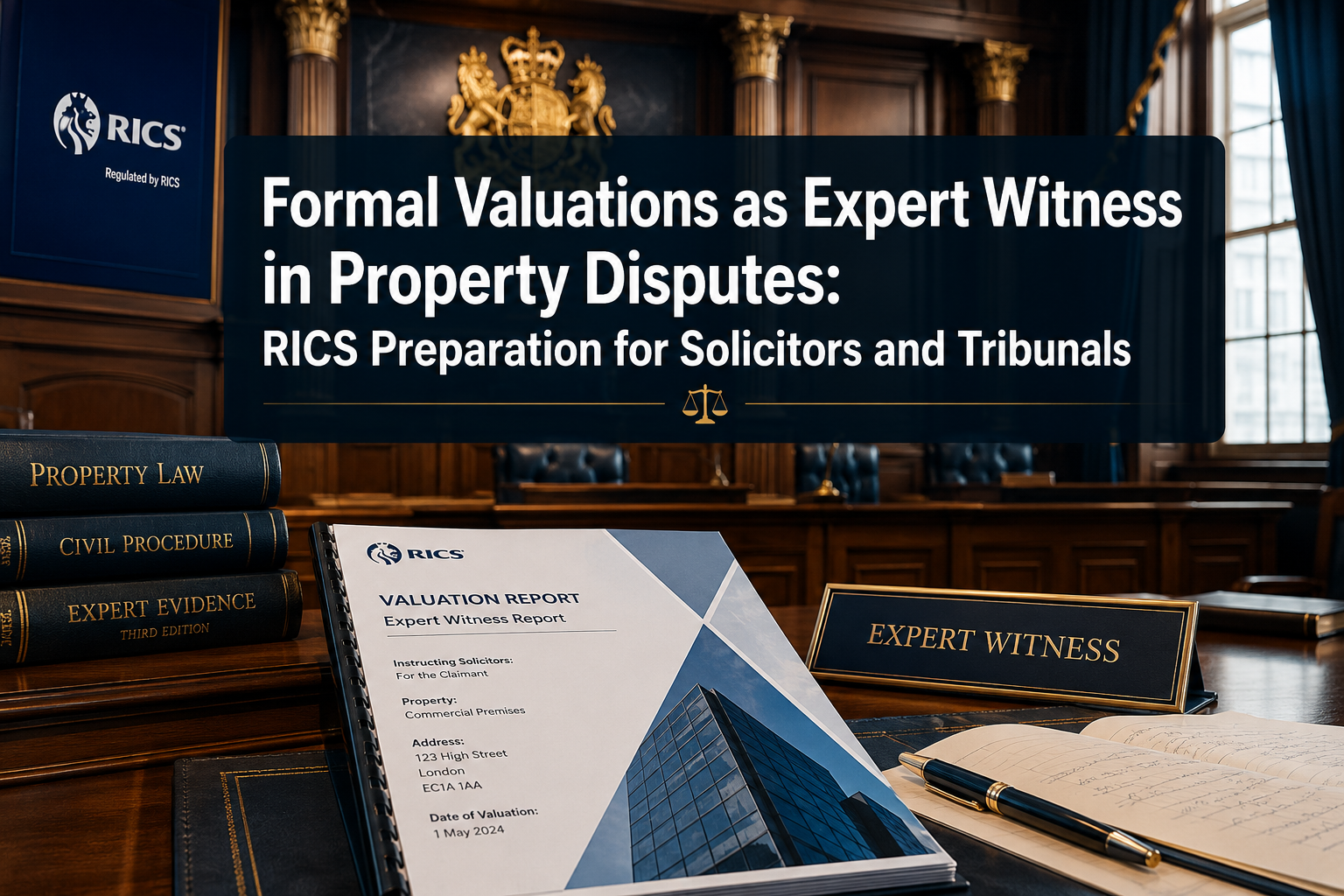

A 26% decline in buyer enquiries recorded in early 2026 has directly fuelled a surge in contested property valuations, placing RICS-accredited surveyors at the centre of an increasing number of Lands Tribunal hearings, arbitration proceedings, and court disputes [7]. When a valuation is challenged, the quality of the expert witness report — and the rigour behind its preparation — can determine the outcome of proceedings worth hundreds of thousands of pounds.
This article examines how formal valuations function within the expert witness framework, what RICS standards govern that role, and how surveyors and solicitors can collaborate effectively to produce evidence that withstands tribunal scrutiny. Whether you are a solicitor instructing an expert or a surveyor preparing to give evidence, understanding the full scope of Formal Valuations as Expert Witness in Property Disputes: RICS Preparation for Solicitors and Tribunals is essential in 2026.
Key Takeaways
- RICS professional standards require expert witnesses to be independent, impartial, and objective — their duty is to the tribunal, not the instructing party.
- The fifth edition of "Surveyors Acting as Expert Witnesses" is under consultation in 2026, introducing updates on technology use, global applicability, and fee arrangements.
- A well-structured expert witness report follows a defined format: instructions, methodology, comparable evidence, opinion, and declaration of independence.
- Solicitor-surveyor collaboration must begin early, with clear terms of engagement and agreed scope to avoid procedural challenges at tribunal.
- The RICS Expert Witness Accreditation Service (EWAS) provides a voluntary quality benchmark that strengthens credibility in contested proceedings.
The Legal Framework Governing Expert Witness Valuations
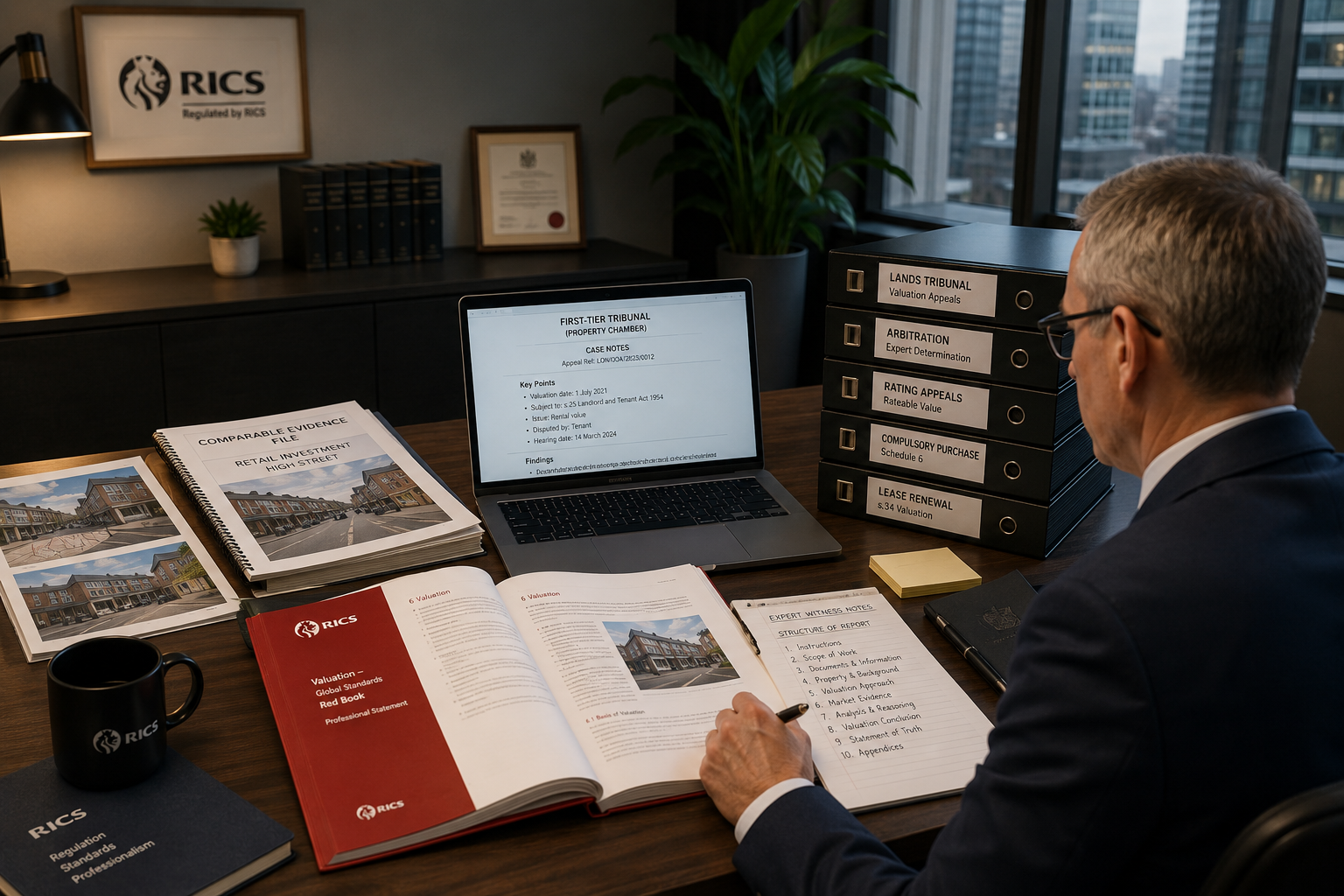
Before a surveyor can offer opinion evidence in any formal dispute, they must understand the legal and professional architecture within which they operate. In England and Wales, expert witnesses in civil proceedings are governed by Part 35 of the Civil Procedure Rules (CPR). In tribunal settings — including the Upper Tribunal (Lands Chamber) and the First-tier Tribunal (Property Chamber) — equivalent rules apply, placing the expert's primary duty firmly with the tribunal rather than the client [2].
RICS reinforces this through its professional standard, "Surveyors Acting as Expert Witnesses," which sets out mandatory obligations for all RICS members accepting expert instructions. The standard covers:
- Duty to the court or tribunal: The expert's overriding obligation is to provide independent, unbiased assistance.
- Terms of engagement: Written instructions must be clear, agreed before work begins, and retained throughout the process.
- Scope of expertise: Surveyors must only opine on matters within their demonstrable competence.
- Disclosure obligations: All material facts, including those that may be adverse to the instructing party, must be disclosed [2].
RICS also operates the Expert Witness Accreditation Service (EWAS), a voluntary scheme that sets quality standards for chartered surveyors in this role. EWAS-accredited surveyors undergo training and assessment, providing solicitors and tribunals with additional confidence in the quality of evidence presented [3].
"The expert's duty to the court overrides any obligation to the person from whom the expert has received instructions or by whom the expert is paid." — CPR Part 35.3
Conditional Fee Arrangements and Professional Integrity
A practical issue that frequently arises in solicitor-surveyor collaboration is the question of fee arrangements. In February 2023, RICS amended its guidance to clarify that expert witnesses may accept instructions from solicitors engaged on a conditional fee (no-win, no-fee) basis — provided that the expert's own fee remains unconditional. This distinction is critical: an expert whose payment depends on the outcome of the dispute cannot be considered independent [2]. Solicitors instructing experts should confirm this arrangement in writing at the outset.
Structuring the Expert Witness Report for Lands Tribunal and Arbitration
The structure of a formal valuation report prepared for Formal Valuations as Expert Witness in Property Disputes: RICS Preparation for Solicitors and Tribunals purposes is not simply a matter of professional preference — it is a procedural requirement. Poorly structured reports are routinely criticised by tribunals, and in some cases, evidence has been excluded or given reduced weight as a result.
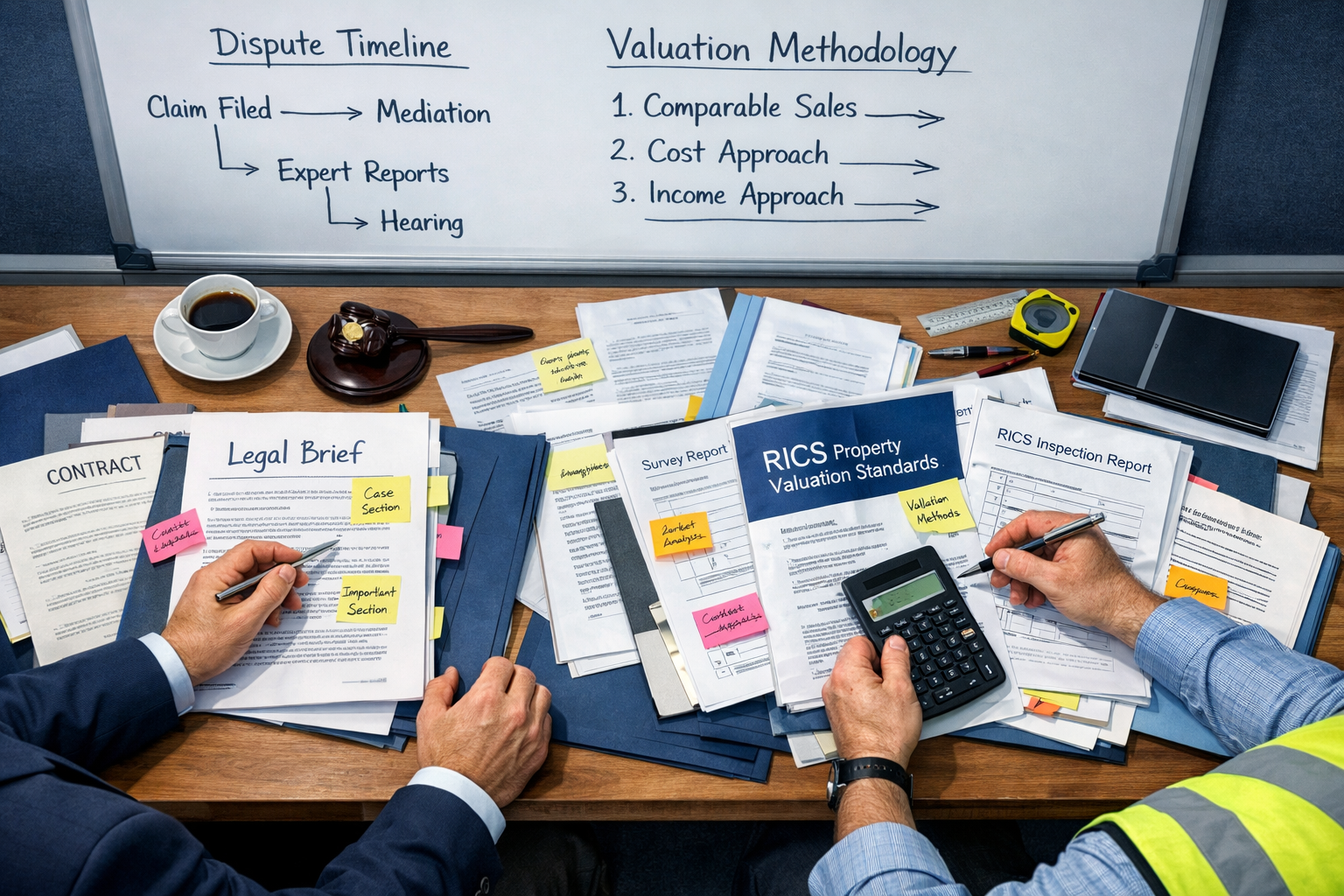
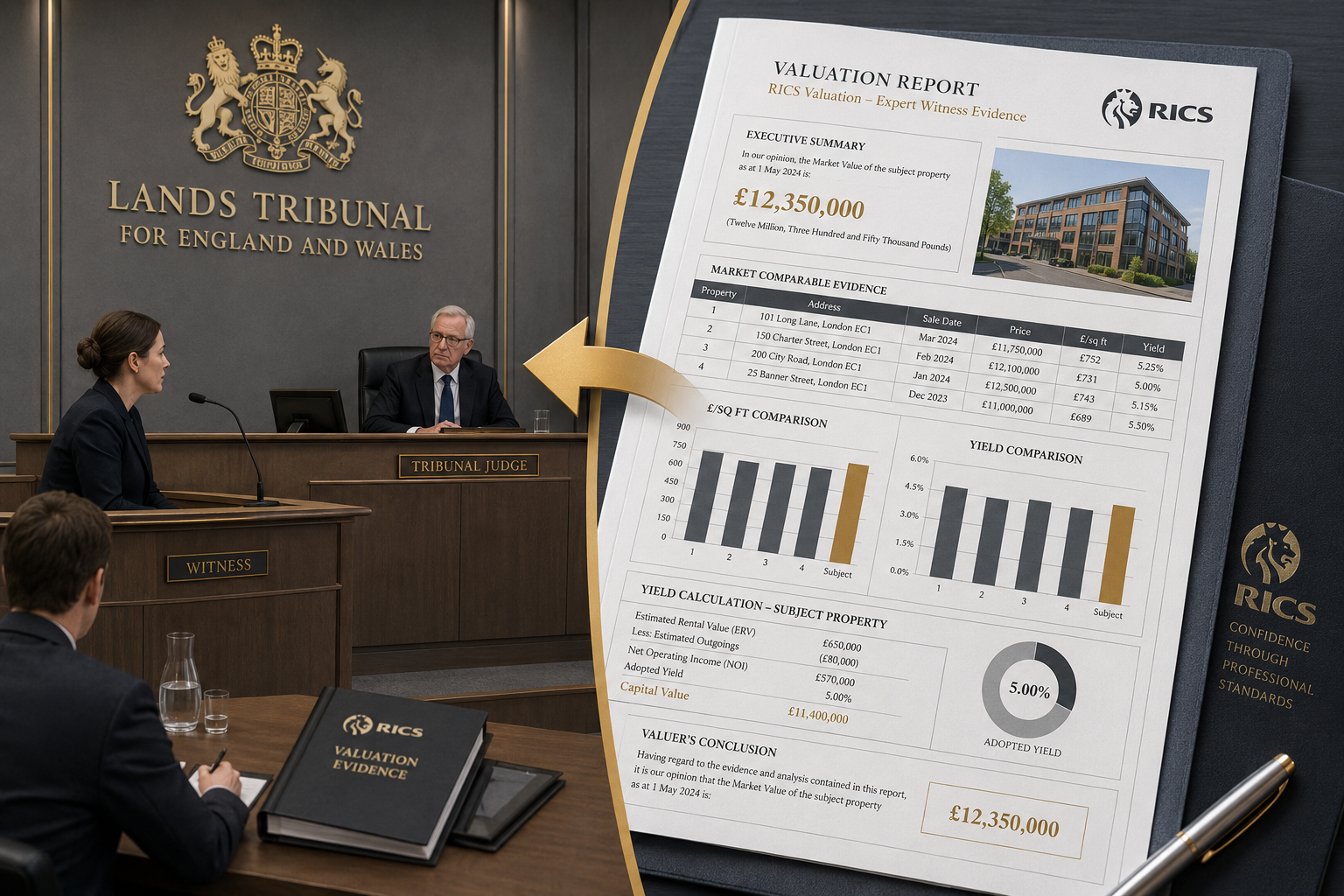
A compliant expert witness valuation report typically contains the following sections:
| Section | Purpose |
|---|---|
| Instructions and Terms of Engagement | Defines the scope, date of instruction, and agreed basis of value |
| Surveyor's Qualifications and Experience | Establishes credibility and competence |
| Description of the Subject Property | Factual account of the asset under dispute |
| Valuation Methodology | Explains the approach used (comparable, income, cost, or residual) |
| Comparable Evidence | Presents and analyses market transactions or rental evidence |
| Valuation Opinion | States the expert's concluded opinion of value |
| Matters Outside Expertise | Flags any issues beyond the surveyor's competence |
| Statement of Truth and Declaration of Independence | Confirms impartiality and compliance with CPR Part 35 or tribunal rules |
For proceedings before the Upper Tribunal (Lands Chamber), the report must also comply with the Tribunal's practice directions, which may require a specific format for the statement of truth and may impose page limits on appendices.
Gathering and Presenting Comparable Evidence
The strength of any valuation opinion rests on the quality of its comparable evidence. In a contested dispute, opposing experts will scrutinise every transaction cited. Surveyors should follow a disciplined process:
- Source primary comparables from registered title data, agency records, and court-approved databases.
- Adjust for differences in location, condition, tenure, size, and date of transaction.
- Document the adjustment rationale clearly, so the tribunal can follow the logic without relying solely on the expert's assertion.
- Avoid cherry-picking: present a balanced range of comparables, including those that may support a lower or higher value than the concluded opinion.
For valuation reports in London and the surrounding regions, comparable evidence should reflect micro-market conditions. A transaction in Fulham may not be a reliable comparable for a property in Ealing, even if the headline figures appear similar.
In matrimonial and divorce proceedings — a growing category of valuation disputes — RICS standards require particular care with evidence preparation to ensure fair and accurate assessments [6]. Solicitors handling divorce property valuations should ensure their instructed surveyor is familiar with the specific protocols applicable to Family Court proceedings.
RICS Standards in 2026: What Solicitors and Surveyors Need to Know
The professional landscape for Formal Valuations as Expert Witness in Property Disputes: RICS Preparation for Solicitors and Tribunals is evolving rapidly. In April 2026, RICS launched a six-week public consultation on the fifth edition of "Surveyors Acting as Expert Witnesses." This revision addresses several significant developments [1]:
- Global applicability: The updated standard will apply to RICS members acting as expert witnesses in jurisdictions outside England and Wales, reflecting the increasingly international nature of property disputes.
- Technology integration: The consultation addresses the use of automated valuation models (AVMs), AI-assisted comparable analysis, and digital evidence presentation in tribunal settings.
- Conditional and deferred fee arrangements: The fifth edition will provide clearer guidance on permissible fee structures, building on the 2023 amendments.
Solicitors should monitor the outcome of this consultation closely. Once the fifth edition is published, compliance will become mandatory for RICS members, and any expert witness report prepared under the previous edition may be subject to challenge if it does not reflect the updated standards [1].
The Recovering Market Context and Valuation Disputes
The UK property market in 2026 presents particular challenges for expert witnesses. Following a period of significant volatility, the market is showing signs of stabilisation — but the transition creates valuation uncertainty that is fertile ground for disputes [8]. When comparable evidence spans a period of rapid price movement, expert witnesses must exercise particular care in selecting and weighting transactions.
A February 2026 RICS survey reported a 26% decline in buyer enquiries, which has directly increased the volume of valuation disputes reaching formal proceedings [7]. Expert witnesses advising solicitors in this environment should:
- Date-stamp all comparables carefully and explain their relevance to the valuation date.
- Address market movement explicitly in the report, rather than leaving the tribunal to infer the impact.
- Consider the use of a valuation range where market uncertainty makes a single-point opinion difficult to defend.
For properties subject to Red Book valuation requirements, adherence to RICS Valuation — Global Standards (the "Red Book") is mandatory. This standard defines the basis of value, the valuation approach, and the reporting requirements, providing a robust framework that expert witnesses can reference directly in their reports.
Specific Dispute Types and Valuation Approaches
Different categories of property dispute require different valuation methodologies. The table below summarises the most common dispute types encountered in 2026 and the valuation approach typically applied:
| Dispute Type | Common Forum | Primary Valuation Approach |
|---|---|---|
| Compulsory purchase compensation | Upper Tribunal (Lands Chamber) | Comparable / before-and-after |
| Lease extension premium disputes | First-tier Tribunal | Investment / term and reversion |
| Rent review disagreements | Arbitration / expert determination | Comparable rental evidence |
| Matrimonial asset division | Family Court | Comparable / open market value |
| Dilapidations claims | County Court / arbitration | Cost-based / diminution in value |
| Capital gains tax disputes | First-tier Tribunal (Tax) | Comparable / open market value |
For lease extension valuation disputes, the Leasehold Reform, Housing and Urban Development Act 1993 prescribes specific valuation assumptions that expert witnesses must apply. Similarly, capital gains tax valuation disputes before the Tax Tribunal require the expert to apply the statutory definition of market value under the Taxation of Chargeable Gains Act 1992.
For commercial property matters, including rent review disputes and commercial dilapidation claims, the expert witness must demonstrate familiarity with the specific lease terms, the agreed assumptions, and the market evidence applicable to the relevant sector.
Solicitor-Surveyor Collaboration: Best Practice for Effective Preparation
The relationship between the instructing solicitor and the expert witness surveyor is one of the most important factors in the success of any property dispute. Poor communication, late instruction, and unclear scope are among the most common causes of inadequate expert evidence [5].
Early Instruction and Scope Agreement
Solicitors should instruct their expert as early as possible in the dispute process — ideally before proceedings are issued. Early instruction allows the surveyor to:
- Inspect the property while it remains in its relevant condition.
- Gather time-sensitive comparable evidence.
- Advise on the strength of the valuation case before significant legal costs are incurred.
- Identify any matters outside their expertise that may require additional specialists.
The terms of engagement should be agreed in writing and should specify:
- The valuation date: This is often prescribed by statute or the lease, and must be confirmed before the valuation commences.
- The basis of value: Market value, existing use value, or another defined basis as appropriate.
- The purpose of the report: Expert witness evidence for named proceedings.
- The format requirements: Including any tribunal-specific practice directions.
Joint Statements and Without-Prejudice Meetings
In most formal proceedings, the tribunal will direct opposing experts to meet and produce a joint statement identifying areas of agreement and disagreement. This process — sometimes called a "without-prejudice meeting of experts" — is a critical stage that solicitors must prepare their expert for carefully.
The joint statement should:
- Identify agreed facts (property description, tenure, relevant dates).
- Set out the areas where the experts' opinions diverge.
- Explain the reasons for any difference in valuation opinion.
- Avoid advocacy — it is not an opportunity for either expert to argue their client's case.
Solicitors should brief their expert on the procedural context of the joint meeting but must not attempt to influence the content of the joint statement. Any improper involvement risks the expert's evidence being excluded and may expose the solicitor to professional sanctions [2].
Party Wall and Boundary Disputes
A significant proportion of property disputes that reach formal proceedings involve boundary or party wall issues, where valuation evidence intersects with technical surveying matters. In these cases, the expert witness may need to address both the physical and financial dimensions of the dispute. Solicitors handling party wall disputes should consider whether a single expert can address both aspects or whether separate specialists are required.
For probate valuation disputes — which frequently arise where beneficiaries challenge the value placed on an estate property — the expert must apply the statutory valuation date and basis with precision, as errors in this area can have significant tax consequences.
Common Pitfalls and How to Avoid Them
Even experienced surveyors can undermine their expert witness reports through avoidable errors. The following are the most frequently criticised shortcomings identified in tribunal decisions:
- Advocacy rather than opinion: Reports that read as arguments for the client's position rather than independent assessments are routinely criticised and given reduced weight.
- Insufficient comparables: Relying on a single transaction, or failing to address obvious counter-comparables, weakens the evidential foundation.
- Failure to address the correct valuation date: Applying market conditions from the wrong date is a fundamental error that can invalidate the entire opinion.
- Inadequate adjustment analysis: Stating that adjustments have been made without explaining the quantum and rationale leaves the tribunal unable to assess the methodology.
- Overstating certainty: In a volatile market, expressing a single-point opinion without acknowledging the range of possible values can appear unrealistic and reduce credibility.
- Non-compliance with the declaration of independence: Omitting or incorrectly completing the statement of truth is a procedural defect that can result in the report being excluded.
RICS has issued a Regulatory Practice Alert specifically addressing expert witness standards, reinforcing that non-compliance can result in disciplinary action against the individual surveyor [9].
Conclusion
The role of formal valuations in property disputes has never been more demanding. As the UK property market navigates a period of stabilisation in 2026, and as RICS prepares to publish the fifth edition of its expert witness professional standard, both surveyors and solicitors must raise their standards of preparation to meet tribunal expectations.
Actionable next steps for solicitors:
- Instruct a RICS-accredited expert witness — ideally EWAS-accredited — at the earliest opportunity in any contested valuation matter.
- Agree written terms of engagement that specify the valuation date, basis of value, and report format before any inspection takes place.
- Brief your expert on the procedural timetable and any tribunal-specific practice directions, but respect the boundary between legal advice and independent expert opinion.
- Prepare your expert for the joint statement process and ensure they understand that their duty is to the tribunal.
Actionable next steps for surveyors:
- Review the fifth edition consultation documents as they are published and update your practice accordingly.
- Ensure every expert witness report includes a compliant statement of truth and declaration of independence.
- Build a robust comparable evidence database that covers the relevant market, valuation date, and property type.
- Consider EWAS accreditation if you intend to act as an expert witness regularly — it provides a recognised quality benchmark that strengthens your credibility in contested proceedings.
For a comprehensive overview of the valuation process and costs involved, the best London property valuation guide and guidance on RICS valuation costs provide useful reference points for both instructing parties and surveyors preparing their fee proposals.
References
[1] Expert Witness Preparation For 2026 Uk Valuation Disputes Rics Standards In A Recovering Market – https://www.canterburysurveyors.com/blog/expert-witness-preparation-for-2026-uk-valuation-disputes-rics-standards-in-a-recovering-market/
[2] Surveyors Acting As Expert Witnesses – https://www.rics.org/profession-standards/rics-standards-and-guidance/sector-standards/dispute-resolution-standards/surveyors-acting-as-expert-witnesses
[3] Expert Witness – https://www.ricsfirms.com/accreditations/expert-witness/
[4] Surveyors Expert Witness Telecoms Disputes – https://ww3.rics.org/uk/en/journals/land-journal/surveyors-expert-witness-telecoms-disputes.html
[5] Dispute Resolution Standards – https://www.rics.org/profession-standards/rics-standards-and-guidance/sector-standards/dispute-resolution-standards
[6] Rics Standards For Expert Witnesses In Matrimonial Property Disputes Valuation Protocols And Evidence Preparation – https://nottinghillsurveyors.com/blog/rics-standards-for-expert-witnesses-in-matrimonial-property-disputes-valuation-protocols-and-evidence-preparation
[7] Valuation Challenges From Rics February 2026 Survey Expert Witness Strategies For 26 Buyer Enquiry Dip Disputes – https://wimbledonsurveyors.com/valuation-challenges-from-rics-february-2026-survey-expert-witness-strategies-for-26-buyer-enquiry-dip-disputes/
[8] Expert Witness Valuations In 2026s Stabilizing Market Rics Standards For Mortgage Disputes And Property Disagreements – https://nottinghillsurveyors.com/blog/expert-witness-valuations-in-2026s-stabilizing-market-rics-standards-for-mortgage-disputes-and-property-disagreements
[9] Expert Witness Standards – https://www.rics.org/dispute-resolution-service/drs-information-hub/expert-witness-standards