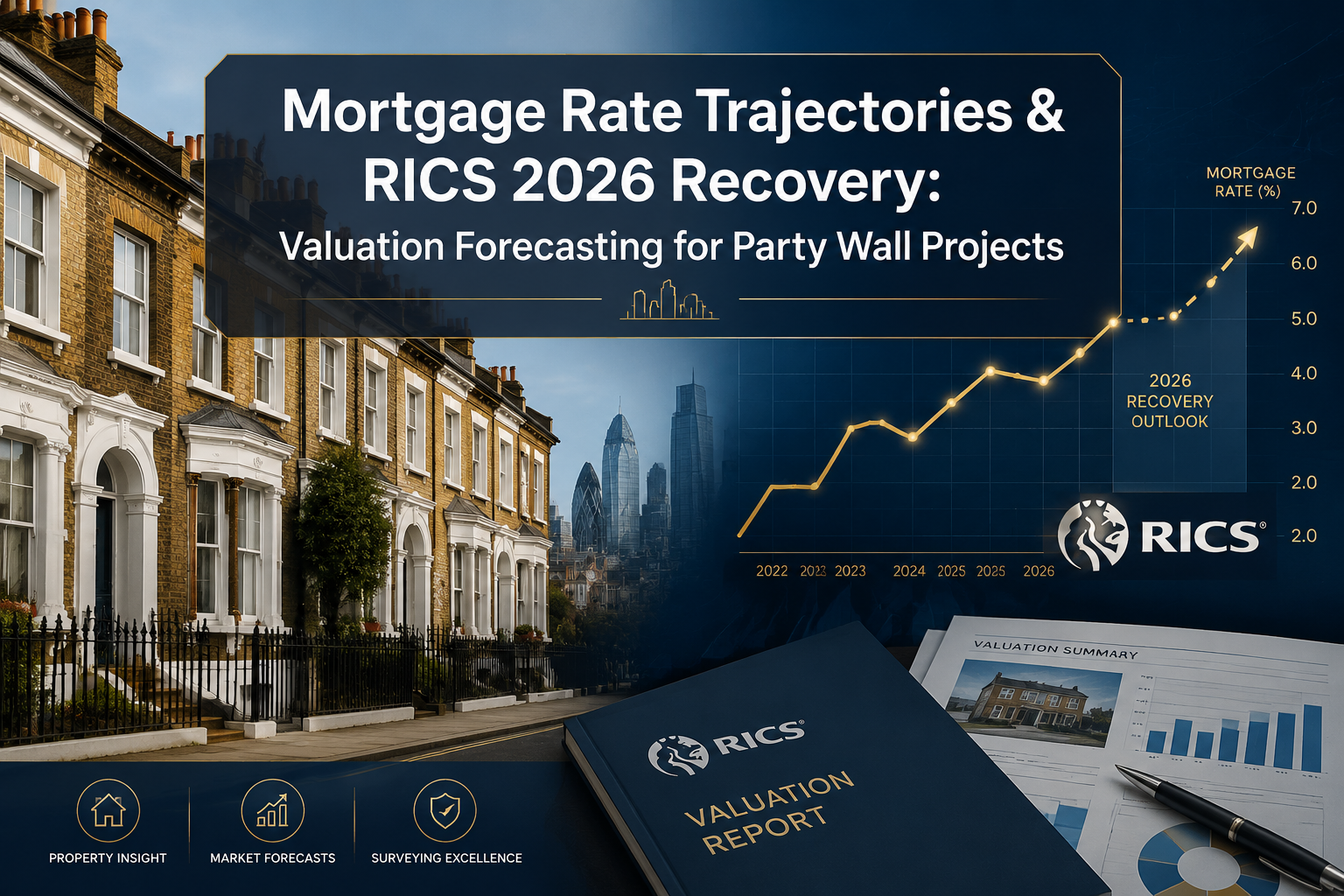
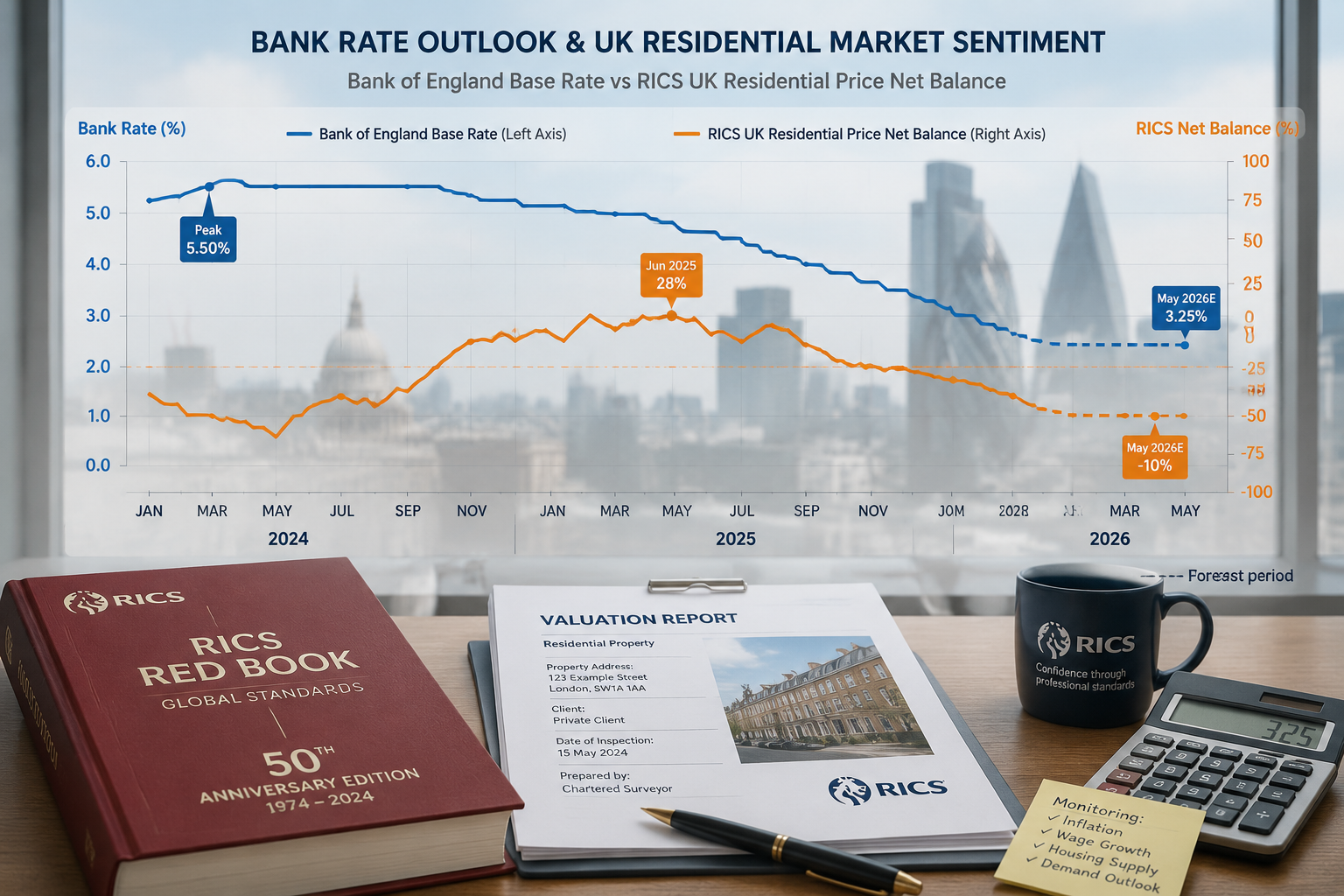
The April 2026 RICS UK Residential Market Survey recorded a net balance of -34% in house prices — the sharpest single-month decline since late 2022 — yet twelve-month sales expectations simultaneously sit at a net positive of +35% [8]. That contradiction is not a data anomaly. It reflects the precise tension at the heart of mortgage rate trajectories impacting RICS 2026 recovery: valuation forecasting for party wall projects must now navigate a market that is simultaneously contracting in the short term and building momentum for a medium-term rebound.
For surveyors, developers, and property owners commissioning party wall works, this duality creates a practical challenge. Cost forecasts embedded in party wall awards, schedules of condition, and compensation assessments are all sensitive to the underlying property values that mortgage rates directly shape. Getting those forecasts wrong — in either direction — carries legal and financial consequences.
Key Takeaways
- Mortgage rates remaining above 6% are suppressing short-term transaction volumes while twelve-month buyer sentiment points firmly upward, creating a bifurcated valuation environment for party wall projects.
- RICS data shows strong regional divergence: Scotland and Northern Ireland are outperforming London and the South East, requiring location-specific cost adjustments in party wall awards.
- The draft RICS 8th Edition Party Wall guidance introduces ESG factors and updated award templates that directly interact with valuation assumptions tied to mortgage rate conditions.
- August 2026 marks the 50th anniversary of the RICS Red Book, reinforcing the ethical and methodological standards that underpin all party wall valuations during this recovery period.
- Surveyors should model at least two rate scenarios — national stabilization and regional boom — when preparing party wall cost forecasts to future-proof awards against market volatility.
Understanding Mortgage Rate Trajectories and Their Direct Effect on Party Wall Valuations
Mortgage rates do not merely influence whether buyers can afford to purchase a home. They set the baseline from which every comparative market analysis, diminution-in-value claim, and compensatory award in a party wall context is calculated. When rates are elevated and transaction volumes fall, comparable evidence thins out, making valuations harder to defend and easier to challenge.
Zillow's 2026 housing forecast projects that mortgage rates will remain above 6% throughout the year, with existing home sales rising by approximately 4.3% to 4.26 million units [6]. Morgan Stanley's real estate outlook similarly identifies 2026 as a pivotal recovery year, citing improved access to debt, geopolitical demand for real assets as inflation hedges, and pricing discounts that are beginning to attract institutional capital back into the market [1].
For party wall practitioners, these macro signals translate into specific valuation pressures:
- Comparable scarcity: Reduced transaction volumes mean fewer recent sales to anchor valuations, increasing reliance on adjusted comparables and increasing the risk of challenge.
- Cost inflation sensitivity: Supply chain disruptions linked to geopolitical instability — particularly oil price volatility — are pushing construction costs upward, directly affecting the Schedule of Works costs embedded in party wall awards [4].
- Lender scrutiny: Secured lending valuations are under heightened review. The RICS second edition standard for multi-storey, multi-occupancy residential buildings with cladding, effective November 2026, adds another layer of compliance that affects properties where party wall works intersect with fire safety obligations [7].
How Valuation Forecasting Adapts to Rate Sensitivity
A robust valuation model for party wall projects in 2026 should incorporate at least two rate scenarios. The first is a national stabilization scenario, where the Bank of England holds rates in the 4.5%–5% range and mortgage products gradually become more accessible. The second is a regional boom scenario, where areas with strong fundamentals — Scotland, Northern Ireland, and select commuter belts — see accelerated price growth that outpaces the national trend.
Under the national stabilization scenario, valuers can apply modest upward adjustments to base comparables, reflecting the +4% three-month sales expectation net balance recorded in the January 2026 RICS survey [8]. Under the regional boom scenario, location-specific premiums of 3%–8% above the national trend may be warranted, particularly in markets where housing supply remains structurally constrained.
The table below summarizes how each scenario affects key party wall valuation inputs:
| Valuation Input | National Stabilization | Regional Boom |
|---|---|---|
| Comparable evidence quality | Moderate — thin but improving | Strong in growth regions |
| Diminution-in-value claims | Low-to-moderate risk | Higher risk in premium markets |
| Construction cost inflation | 3%–5% annual uplift | 5%–9% in supply-constrained areas |
| Award compensation levels | Baseline RICS guidance | Location-adjusted premiums |
| Lender challenge risk | Moderate | Lower in high-demand areas |
Understanding these distinctions is essential before serving a party wall notice or commissioning a party wall award in London and Surrey, where regional market conditions vary significantly even within short distances.
Regional Divergence: How RICS 2026 Recovery Signals Shape Party Wall Cost Forecasts
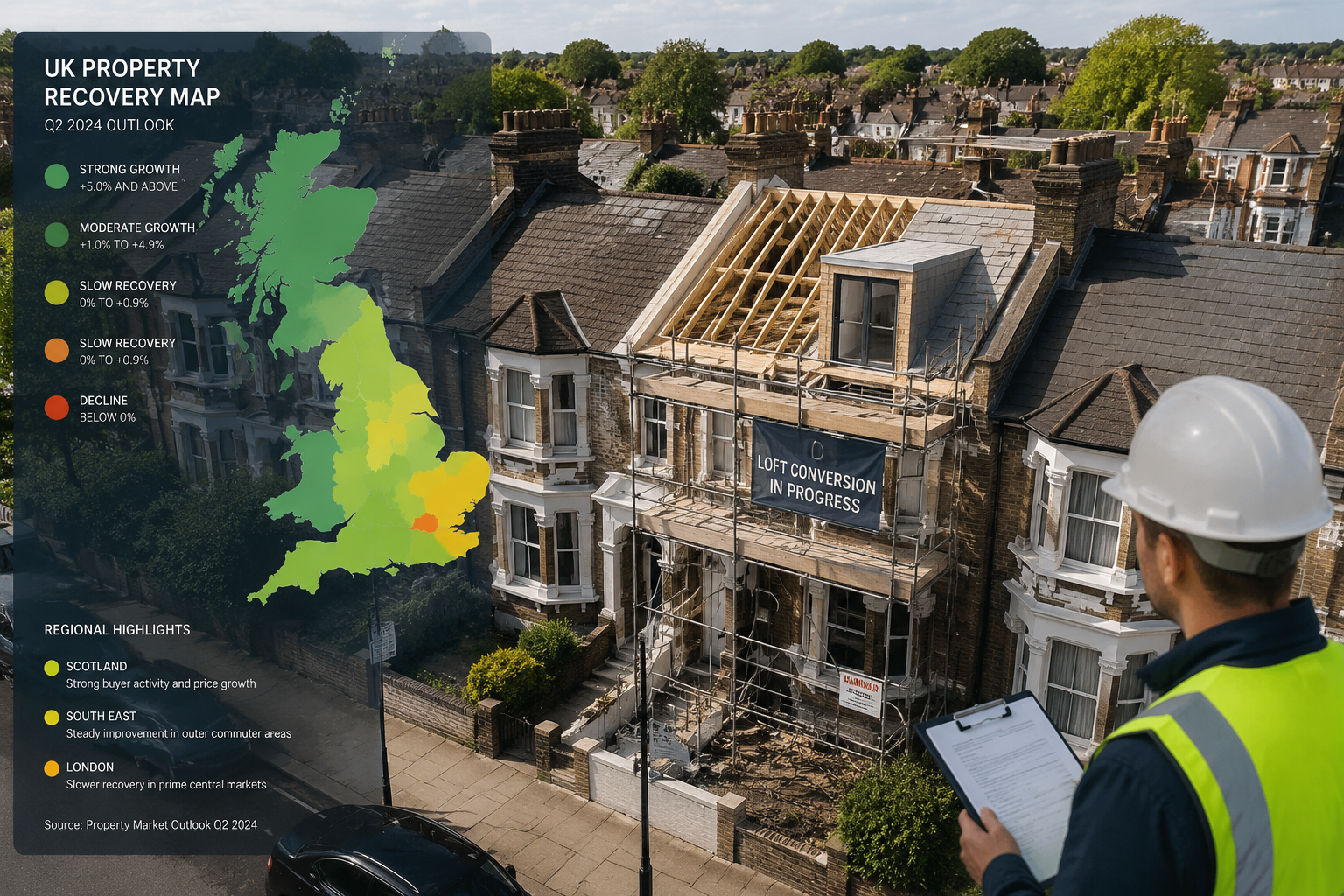
The RICS January 2026 residential survey makes clear that recovery is not uniform across the UK. Scotland and Northern Ireland are recording stronger price growth, while London and the South East are recovering more slowly, weighed down by affordability constraints and higher exposure to rate-sensitive buyer segments [8]. This regional divergence is not a temporary anomaly — it reflects structural differences in housing supply, income levels, and the proportion of mortgage-dependent buyers in each market.
For party wall surveyors, regional divergence creates a direct obligation to localize valuation assumptions. A party wall award prepared for a loft conversion project in Edinburgh carries materially different valuation parameters than one prepared for an identical project in Croydon. Applying a national average to either case introduces systematic error.
Practical Adjustments for Surveyors Operating Across Regions
London and the South East: The combination of high base prices, elevated mortgage exposure, and slower recovery means that diminution-in-value claims are more likely to be contested. Surveyors should apply conservative comparable adjustments and document their methodology with particular care. RICS registered valuers in London are well-positioned to provide the localized expertise needed to defend awards in this environment.
Scotland and Northern Ireland: Stronger price growth supports more confident upward comparable adjustments. However, surveyors must be alert to the risk of overvaluation in markets where growth is outpacing income fundamentals, which could expose awards to challenge if market conditions reverse.
Commuter belt and regional cities: These markets are experiencing the most varied outcomes. Areas with strong transport links and relative affordability — parts of the East Midlands, Yorkshire, and the South West — are showing resilience. Party wall cost forecasts in these areas benefit from a blended approach: national stabilization assumptions as the base, with a regional premium applied where local evidence supports it.
Key insight: The RICS 8th Edition Party Wall guidance consultation, which ran until June 5, 2026, explicitly acknowledges the need for procedural clarity in risk management — a direct response to the kind of regional valuation complexity that mortgage rate divergence creates [5].
The ESG Dimension in Party Wall Valuations
The draft 8th Edition RICS Party Wall guidance introduces Environmental, Social, and Governance (ESG) factors into party wall procedures for the first time [9]. This is significant for valuation forecasting because ESG-compliant properties are increasingly commanding measurable price premiums in certain markets, particularly in urban areas where buyers and lenders are placing greater weight on energy performance certificates and sustainability credentials.
For party wall projects involving loft conversions, insulation works, or excavation notices, the ESG dimension adds a new layer to cost forecasting. Works that improve a property's energy rating may generate a post-completion value uplift that partially offsets the disruption costs recorded in the award. Conversely, works that fail to meet emerging sustainability standards may attract lender scrutiny at the point of remortgage or sale.
Surveyors should begin incorporating ESG uplift estimates — even as a sensitivity range rather than a fixed figure — into their party wall valuation models now, ahead of full implementation.
Mortgage Rate Trajectories Impacting RICS 2026 Recovery: Applying Valuation Forecasting Frameworks to Party Wall Projects

The 50th anniversary of the RICS Red Book in August 2026 is a timely reminder that the principles underpinning valuation practice — ethics, objectivity, competence, and transparency — are not optional extras during periods of market volatility [3]. They are the framework that makes party wall awards defensible when mortgage rate uncertainty makes property values harder to pin down.
The RICS Global Valuation Conference scheduled for June 9, 2026, addresses exactly this challenge, with sessions covering global standards, emerging risks, sustainability, and the integration of new technologies into valuation practice [2]. For party wall surveyors, the practical takeaway from that agenda is clear: forecasting models must evolve to incorporate rate sensitivity, regional variation, and ESG factors as standard inputs rather than optional adjustments.
Building a Defensible Party Wall Valuation Model in 2026
A well-structured party wall valuation model for 2026 conditions should include the following components:
1. Baseline comparable analysis
Draw on the most recent comparable sales within a tightly defined geographic radius. In thin markets, extend the time window cautiously — no more than six months — and apply explicit adjustments for market movement over that period, referenced to the relevant RICS survey data.
2. Rate sensitivity adjustment
Apply a documented rate sensitivity factor that reflects the difference between current mortgage availability and the rate environment at the time of the most recent comparable sales. This factor should be disclosed in the award and updated if the award is challenged or revised.
3. Construction cost inflation allowance
Incorporate a forward-looking construction cost inflation allowance based on current BCIS (Building Cost Information Service) indices and supply chain conditions. For 2026, a 3%–7% annual uplift is a reasonable working range, depending on project type and location [4].
4. Regional market premium or discount
Apply a location-specific adjustment derived from the most recent RICS regional survey data. Document the source and the methodology used to derive the adjustment.
5. ESG sensitivity range
Where works have a material impact on energy performance or sustainability credentials, include a sensitivity range for post-completion value movement. This need not be a precise figure — a documented range with clear assumptions is sufficient for most party wall awards.
6. Scenario testing
Test the award against both the national stabilization and regional boom scenarios described above. If the award outcome differs materially between scenarios, document the reasons and identify the trigger conditions that would require a revision.
The updated award templates proposed in the draft 8th Edition RICS guidance are designed to accommodate this level of methodological transparency [10]. Surveyors who adopt these templates early will be better positioned to defend their awards in a market where mortgage rate volatility continues to generate valuation uncertainty.
Understanding the Interaction Between Party Wall Awards and Secured Lending
One underappreciated consequence of elevated mortgage rates is the increased scrutiny that lenders apply to properties subject to ongoing party wall works. When a lender's valuer assesses a property mid-project, the existence of an unresolved party wall dispute or an incomplete award can trigger a retention or a downward valuation adjustment that affects the borrower's loan-to-value ratio.
This interaction between party wall status and secured lending valuation is becoming more common as lenders tighten their criteria in response to rate uncertainty. Surveyors can reduce this risk by ensuring that party wall agreements are formally executed before works commence and that the award clearly documents the scope, timeline, and compensation arrangements in sufficient detail to satisfy a lender's valuer.
The RICS cost of valuation is a factor that building owners sometimes seek to minimize, but in a rate-sensitive market, the cost of an inadequate valuation — in the form of lender retentions, disputed awards, or post-completion claims — far exceeds the cost of commissioning a thorough one. Reviewing the RICS valuation cost against the risk exposure of the specific project is a worthwhile exercise before any party wall works begin.
The Surveyor Independence Imperative
The draft 8th Edition guidance reinforces a principle that is particularly important in a volatile market: a party wall surveyor's appointment is personal and statutory, requiring genuine impartiality and independence [9]. When mortgage rate pressures are creating financial stress for building owners or adjoining owners, the temptation to allow commercial relationships to influence award outcomes increases. The guidance's emphasis on independence is a direct counterweight to that pressure.
Surveyors operating under the Party Wall Act's 3-metre rule for excavation works, in particular, should be alert to the valuation implications of foundation work in markets where ground-floor property values are under pressure from mortgage rate conditions. The interaction between structural risk, valuation uncertainty, and surveyor independence is at its most acute in these cases.
Conclusion
Mortgage rate trajectories impacting RICS 2026 recovery represent a defining variable for valuation forecasting in party wall projects throughout this year and into 2027. The data is clear: short-term price pressure coexists with medium-term recovery momentum, and that coexistence demands a more sophisticated forecasting approach than static comparable analysis can provide.
Actionable next steps for surveyors and property owners:
- Adopt scenario-based forecasting now. Model party wall cost forecasts against both national stabilization and regional boom conditions before finalizing any award.
- Localize every valuation. Use the most recent RICS regional survey data to apply location-specific adjustments rather than relying on national averages.
- Incorporate ESG sensitivity ranges. Even a documented range is better than ignoring a factor that lenders and buyers are increasingly pricing into property values.
- Ensure awards are formally executed before works commence. This protects all parties from lender-related complications during the secured lending valuation process.
- Review the draft 8th Edition RICS Party Wall guidance. The updated templates and ESG provisions are designed for exactly the market conditions prevailing in 2026 — early adoption reduces procedural risk.
- Consult RICS registered valuers for complex projects. In thin or volatile markets, the quality of comparable evidence and the defensibility of the methodology matter more than ever.
The 50th anniversary of the RICS Red Book is a fitting backdrop for a year that is testing valuation professionals' commitment to its core principles. Those who apply those principles rigorously — with rate sensitivity, regional awareness, and methodological transparency — will produce party wall awards that stand up to scrutiny regardless of how mortgage rates move in the months ahead.
References
[1] Real Estate Market Outlook 2026 Recovery – https://www.morganstanley.com/insights/articles/real-estate-market-outlook-2026-recovery?utm_source=openai
[2] Global Valuation Conference 2026 – https://academy.rics.org/global-valuation-conference-2026?utm_source=openai
[3] Red Book 50 – https://www.rics.org/profession-standards/rics-standards-and-guidance/sector-standards/valuation-standards/red-book/red-book-global/red-book-50?utm_source=openai
[4] Geopolitical Volatility In April 2026 RICS Surveys Party Wall Risk Adjustments For Developer Projects – https://kingstonsurveyors.com/geopolitical-volatility-in-april-2026-rics-surveys-party-wall-risk-adjustments-for-developer-projects/?utm_source=openai
[5] Party Wall Guidance – https://www.juliewestsolicitors.co.uk/news/2026/04/13/party-wall-guidance?utm_source=openai
[6] 2026 Housing Predictions – https://www.zillow.com/research/2026-housing-predictions-35800/?utm_source=openai
[7] Valuation Of Properties In Multi-Storey Multi-Occupancy Residential Buildings With Cladding – https://www.rics.org/profession-standards/rics-standards-and-guidance/sector-standards/valuation-standards/valuation-of-properties-in-multi-storey-multi-occupancy-residential-buildings-with-cladding?utm_source=openai
[8] Leveraging RICS January 2026 Residential Survey Recovery Signals In Party Wall Project Valuations – https://wimbledonsurveyors.com/leveraging-rics-january-2026-residential-survey-recovery-signals-in-party-wall-project-valuations-2/?utm_source=openai
[9] RICS 8th Edition Party Wall Guidance Post-Consultation Changes And Immediate 2026 Implementation For Surveyors – https://www.canterburysurveyors.com/blog/rics-8th-edition-party-wall-guidance-post-consultation-changes-and-immediate-2026-implementation-for-surveyors/?utm_source=openai
[10] RICS 8th Edition Party Wall Guidance Key Updates And Practical Implications For Surveyors In 2026 – https://kingstonsurveyors.com/rics-8th-edition-party-wall-guidance-key-updates-and-practical-implications-for-surveyors-in-2026/?utm_source=openai