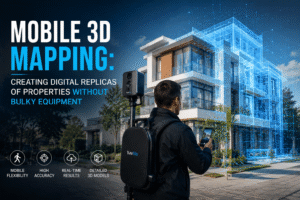

A single undetected clash between a drainage pipe and a structural beam can cost $5,000 or more in delays and change orders — and that is before accounting for the legal fallout when a neighbouring property is involved [2]. In 2026, urban construction projects involving deep excavations are under more scrutiny than ever, and the combination of Building Information Modelling (BIM) and 3D laser scanning for party wall awards is rapidly becoming the gold standard for managing that risk. This article explores how these technologies are transforming party wall surveys, reducing disputes, and producing stronger expert witness evidence in complex boundary works.
Key Takeaways 📌
- BIM and 3D laser scanning deliver millimetre-level accuracy that traditional survey methods cannot match, making them essential for deep excavation party wall awards in 2026.
- Clash detection in BIM software can resolve structural conflicts in under five minutes digitally — conflicts that would otherwise cause days of on-site delays [2].
- Cost savings of 8–15% and schedule improvements of up to 25% are achievable through progress monitoring with 3D scanning technology [1].
- A laser-scanned schedule of condition creates defensible, time-stamped evidence that protects both building owners and adjoining owners in dispute scenarios.
- The industry is shifting from reactive problem-solving to proactive Virtual Design & Construction (VDC) Coordination, fundamentally changing how party wall matters are managed [3].
Why Traditional Party Wall Surveys Fall Short in Deep Excavation Projects
For decades, party wall surveyors relied on tape measures, hand sketches, and photographic records. These methods were adequate for straightforward loft conversions or minor structural works. But in 2026, London and other major UK cities are seeing a surge in basement extensions, underground car parks, and multi-storey subterranean developments — projects that place enormous stress on adjoining structures and demand a far higher standard of evidence.
Traditional surveys have three core weaknesses in this context:
- Limited spatial accuracy — Manual measurements carry human error margins that become significant at depth.
- Static documentation — A photograph or sketch captures one moment; it cannot show progressive movement or deformation.
- Weak dispute evidence — In contested party wall matters, hand-drawn records are easily challenged in adjudication or court.
💬 "The difference between a robust party wall award and a disputed one often comes down to the quality of the pre-construction record."
When a party wall excavation notice is served for works involving deep foundations — particularly those triggering the Party Wall Act 3-metre rule — the stakes for accurate documentation are exceptionally high. A poorly evidenced schedule of condition can leave both parties exposed to protracted and expensive party wall disputes.
How BIM and 3D Laser Scanning for Party Wall Awards Transforms the Survey Process
What Is 3D Laser Scanning in This Context?
3D laser scanning (also called LiDAR scanning) fires millions of laser pulses per second at a surface and records the precise distance to each point. The result is a point cloud — a three-dimensional map of a structure with millimetre-level precision. Technologies from Trimble, FARO, and Matterport are leading this space, capturing structural, MEP (mechanical, electrical, and plumbing), and spatial data with extraordinary detail [3].
In a party wall context, this means a surveyor can capture:
- The exact geometry of an adjoining owner's foundations
- Pre-existing cracks, deflections, and deformations in shared walls
- The precise position of drainage runs, service ducts, and structural elements
- Any settlement or movement in the building envelope
Integrating Scan Data into BIM
Once the point cloud is captured, it is imported into BIM software — typically Autodesk Revit or Navisworks — and converted into an intelligent 3D model through a process called Scan-to-BIM. This model becomes a living digital twin of the site, updated throughout the construction programme [5].
For a party wall award in London and Surrey, this digital twin serves multiple critical functions:
| Function | Traditional Survey | BIM + Laser Scan |
|---|---|---|
| Spatial accuracy | ±10–20mm | ±1–2mm |
| Clash detection | Manual, reactive | Automated, proactive |
| Dispute evidence | Photos + sketches | Time-stamped 3D model |
| Progress monitoring | Site visits | Remote digital review |
| Schedule of condition | Written + photos | Interactive 3D record |
Clash Detection: From Days to Minutes ⚡
One of the most powerful benefits of BIM coordination is automated clash detection. In Navisworks, for example, identifying a pipe hitting a structural beam takes under five minutes digitally — the same problem discovered on-site during construction can cause days of delays and cost $5,000 or more in change orders alone [2].
For deep excavation projects adjacent to party walls, typical clashes include:
- Drainage runs conflicting with new pile positions
- Structural beams intersecting with existing service routes
- Waterproofing membranes conflicting with neighbouring foundation geometry
- Temporary works (sheet piling, propping) encroaching on boundary setbacks
Resolving these clashes in the model — before a single shovel breaks ground — is the core value proposition of BIM and 3D laser scanning for party wall awards in 2026 deep excavation projects.
The Role of Digital Evidence in Party Wall Awards and Dispute Resolution
Strengthening the Schedule of Condition
A party wall schedule of condition is the baseline record of an adjoining property's state before works begin. Historically, this has been a written report with photographs. In 2026, laser-scanned schedules of condition are becoming the benchmark for high-value or high-risk projects.
A laser-scanned schedule offers:
- Georeferenced crack mapping — every crack is recorded with its exact location, width, and orientation in 3D space
- Baseline deflection data — walls and floors are measured for any pre-existing lean or bow
- Time-stamped point clouds — an immutable digital record that cannot be retrospectively altered
- Comparative analysis — post-construction scans can be overlaid on the baseline to identify any new movement with sub-millimetre accuracy
This level of evidence is transformative when damage to property in a party wall situation is claimed. Instead of a subjective argument about whether a crack was pre-existing, the surveyor presents a 3D model with precise measurements taken before works commenced.
Expert Witness Evidence in Party Wall Disputes
When a party wall dispute escalates to the point where expert witness evidence is required — whether before a third surveyor or in court — the quality of the underlying data is decisive.
BIM-integrated laser scan data provides expert witnesses with:
✅ Objective, measurable evidence that withstands cross-examination
✅ Visual 3D representations that are accessible to non-technical adjudicators
✅ Chronological data layers showing the sequence of events and any structural changes
✅ Quantified movement analysis linking construction activities to specific deformation events
This shifts the expert witness role from opinion-based to data-driven — a significant advantage in contested cases.
Proactive Dispute Prevention Through VDC Coordination
The construction industry is undergoing a fundamental shift from reactive problem-solving to proactive Virtual Design & Construction (VDC) Coordination [3]. In the context of party wall matters, this means engaging BIM and laser scanning tools before the party wall notice is even served.
By modelling the proposed works in BIM against a laser-scanned record of the adjoining property, building owners and their surveyors can:
- Identify high-risk zones where excavation will come closest to neighbouring foundations
- Adjust design parameters to reduce the risk of settlement or cracking
- Demonstrate due diligence to the adjoining owner, reducing the likelihood of a dissent
- Produce a more robust party wall agreement backed by precise technical data
This proactive approach aligns directly with the spirit of the Party Wall etc. Act 1996, which exists to facilitate construction while protecting neighbouring owners — not to create adversarial disputes.
Quantifying the Benefits: What the Data Shows
The business case for BIM and 3D laser scanning in deep excavation party wall projects is compelling:
- 8–15% cost savings from improved progress monitoring and reduced rework [1]
- 25% schedule improvements through better coordination and fewer on-site conflicts [1]
- Rework costs typically represent 5–12% of total project value in conventionally managed construction — BIM coordination directly attacks this figure [2]
- Individual field clashes cost $5,000+ each in delays; a single BIM coordination session can identify and resolve dozens simultaneously [2]
- Early clash detection during design finalization enables proactive issue resolution, establishing a strong foundation for project success [3]
💬 "Projects that integrate reality capture and BIM from the outset consistently outperform those that adopt these tools reactively mid-construction." [3]
For a deep basement project in London — where construction costs can easily reach £3,000–£5,000 per square metre — even a 5% reduction in rework represents a significant financial saving. When the cost of a contested party wall dispute is added (legal fees, third surveyor appointments, potential injunctions), the ROI of investing in laser scanning and BIM from day one becomes overwhelming.
Practical Implementation: A Step-by-Step Overview
Here is how BIM and 3D laser scanning integrate into a typical party wall process for a deep excavation project:
- Pre-notice stage — Laser scan the proposed construction site and all adjoining properties within the relevant distance thresholds.
- Notice preparation — Use BIM models to prepare accurate drawings supporting the party wall notice and any party wall consent documentation.
- Schedule of condition — Produce a laser-scanned baseline record of all adjoining properties.
- Award preparation — Incorporate BIM data into the party wall award, specifying monitoring requirements and acceptable movement thresholds.
- Construction monitoring — Use periodic laser scans to track any structural movement against the baseline, triggering alerts if thresholds are approached.
- Post-completion — Final scan comparison confirms whether any changes have occurred, providing a clear basis for any remediation discussions.
Considerations for Surveyors and Building Owners in 2026
Adopting BIM and laser scanning is not without challenges. Surveyors and building owners should be aware of:
⚠️ Cost considerations — Laser scanning equipment and BIM software represent a significant upfront investment. For smaller projects, the cost-benefit analysis may not always favour full BIM integration, though scan-only services are increasingly affordable.
⚠️ Data management — Point clouds generate enormous data files. Robust IT infrastructure and cloud storage are essential for managing and sharing this data effectively.
⚠️ Competency requirements — Not all party wall surveyors are trained in BIM or laser scanning interpretation. Engaging a chartered surveyor in London with specific experience in these technologies is essential for high-value projects.
⚠️ Proportionality — The level of technology deployed should be proportionate to the project's risk profile. A straightforward loft conversion may not warrant full BIM integration; a 15-metre deep basement adjacent to a listed building almost certainly does.
For projects where the complexity warrants it, working with a party wall agreed surveyor who understands both the legal framework and the technical capabilities of these tools can significantly streamline the process and reduce the risk of escalation.
Conclusion: Actionable Next Steps for 2026 Projects
BIM and 3D laser scanning for party wall awards are no longer emerging technologies — they are rapidly becoming the expected standard for deep excavation projects in urban environments. The evidence is clear: millimetre-level accuracy, automated clash detection, and data-driven dispute resolution deliver measurable benefits in cost, schedule, and legal risk management.
Actionable Next Steps ✅
- Engage early — Commission a laser scan of the site and adjoining properties before serving party wall notices. Early data capture is the foundation of everything that follows.
- Choose the right professionals — Work with surveyors and structural engineers who have demonstrated competency in BIM and laser scanning for party wall matters.
- Specify monitoring in the award — Ensure the party wall award includes clear provisions for periodic scanning during construction, with defined movement thresholds and escalation protocols.
- Use data proactively — Share BIM models with the adjoining owner's surveyor to demonstrate transparency and reduce the likelihood of dissent or dispute.
- Document everything digitally — Replace paper-based schedules of condition with laser-scanned records for any project involving deep excavation near party walls.
The investment in these technologies pays dividends not just in cost savings, but in the confidence and clarity they bring to one of construction's most legally sensitive processes.
References
[1] 3d Laser Scanning In Party Wall Surveys Enhancing Accuracy For Deep Excavations And Boundary Works In 2026 Urban Projects – https://nottinghillsurveyors.com/blog/3d-laser-scanning-in-party-wall-surveys-enhancing-accuracy-for-deep-excavations-and-boundary-works-in-2026-urban-projects
[2] Bim Coordination Clash Detection Services – https://iscano.com/real-world-applications-laser-scanning-lidar/bim-coordination-clash-detection-services/
[3] How Reality Capture Is Reducing Rework And Cutting Costs In Construction – https://www.hunzinger.com/how-reality-capture-is-reducing-rework-and-cutting-costs-in-construction/
[4] Party Wall Surveys For Ai Data Centre Developments Rics Protocols Amid 2026 Infrastructure Demand – https://nottinghillsurveyors.com/blog/party-wall-surveys-for-ai-data-centre-developments-rics-protocols-amid-2026-infrastructure-demand
[5] A Scan To Bim Enabled Strategy For Improving – https://www.emerald.com/f/article/44/5-6/431/1347390/A-scan-to-BIM-enabled-strategy-for-improving