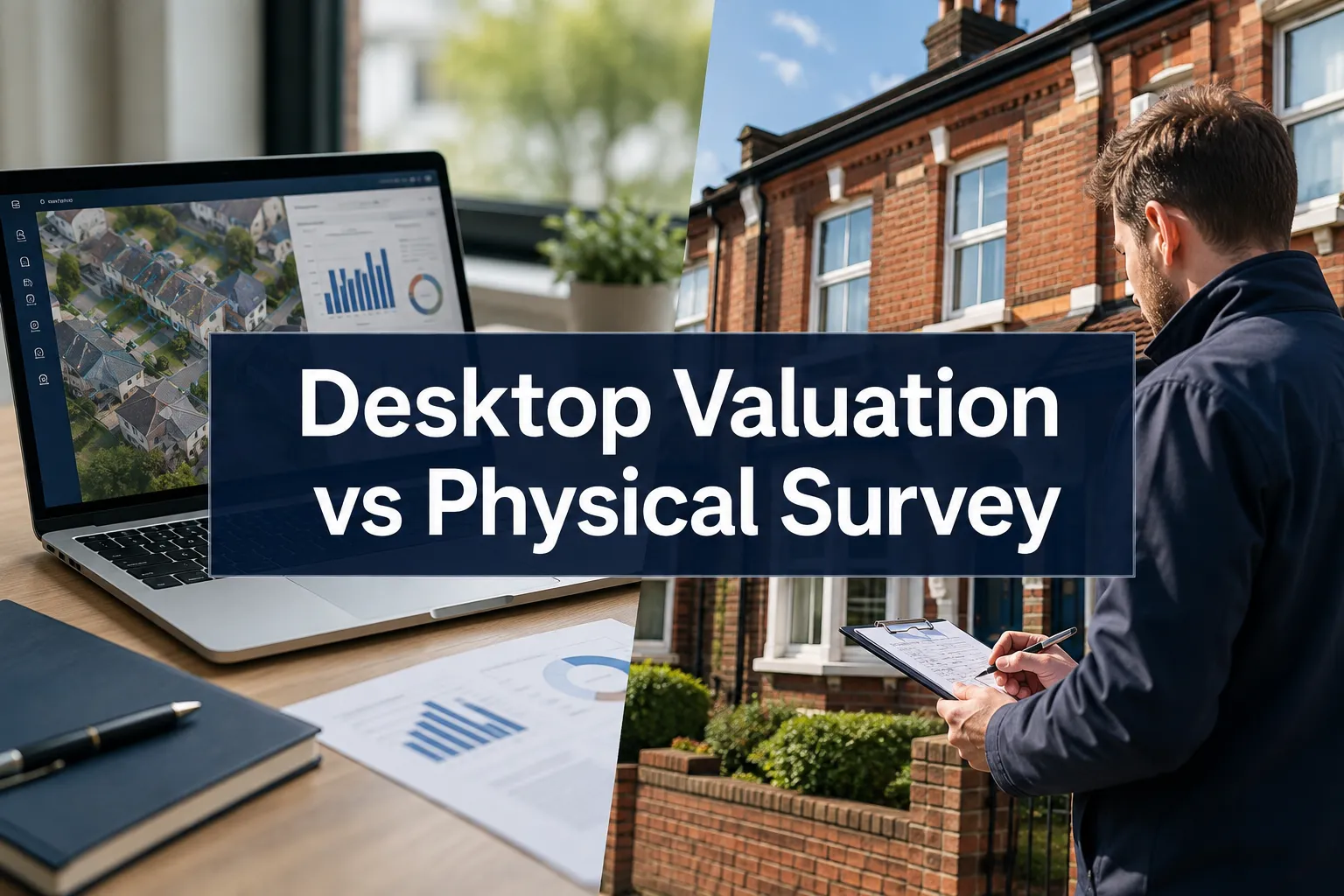
Nearly half of all UK remortgage cases in 2026 are processed without a surveyor ever setting foot in the property. That figure would have seemed implausible a decade ago, yet it now reflects a deliberate, risk-tiered system that most borrowers never see explained clearly. Understanding the logic behind desktop valuation vs physical survey decisions, and knowing exactly when UK lenders will accept remote valuations and when they won't, can save weeks of delay and prevent costly surprises at the point of application.
This article sets out the full picture: how the tiered valuation system works, which risk factors force lenders to demand a physical inspection, and what borrowers and brokers should do to prepare.
Key Takeaways
- UK lenders use a three-tier system: automated valuation models (AVMs), desktop valuations, and full physical surveys, matched to risk level.
- Desktop valuations are RICS-compliant, Red Book-standard assessments produced without a site visit, relying on comparables, data, and photography.
- Lenders typically accept desktop valuations for standard residential properties with strong comparable evidence, moderate loan-to-value ratios, and no known defects.
- Physical inspections are mandated for non-standard construction, high-value loans, heavy refurbishment, rural or complex assets, and cases where AVM confidence is low.
- Turnaround times differ sharply: AVMs return results in minutes, desktop valuations in 24-48 hours, and full physical surveys in 5-10 working days.
How the UK Lender Valuation Tier System Works
UK mortgage and secured-lending decisions depend on an accurate property valuation, but lenders do not apply a one-size-fits-all approach. Instead, most major lenders and specialist finance providers operate a tiered model that matches the depth of the valuation to the level of risk in the transaction [1][5].
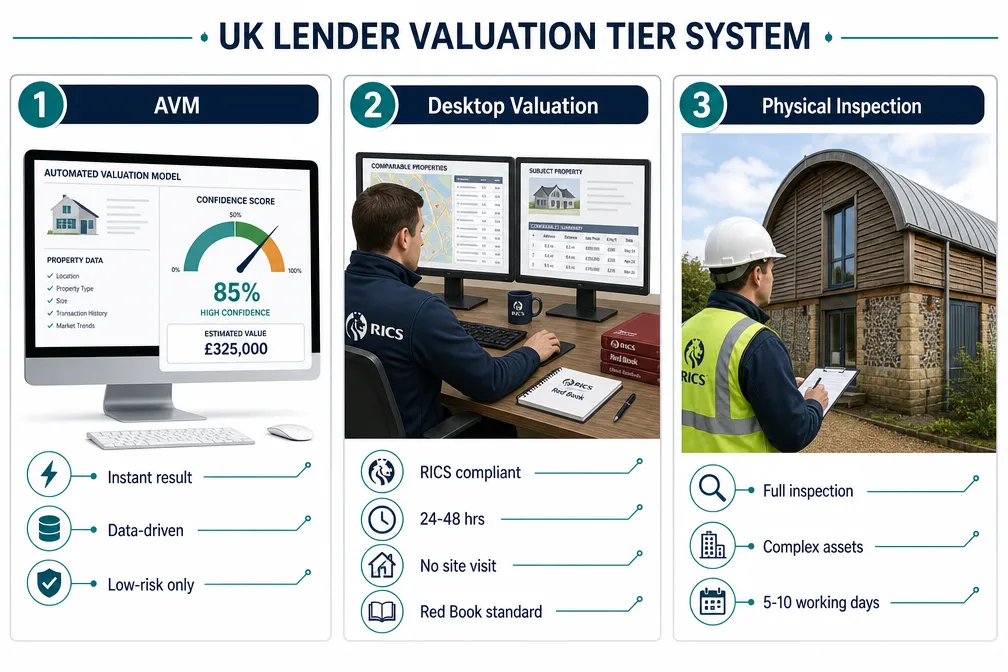
The three tiers work as follows:
Tier 1, Automated Valuation Model (AVM)
An AVM uses algorithms, land registry data, and comparable sales to generate an instant value estimate. No human surveyor is involved. Lenders typically accept AVMs for very low-risk cases: standard residential properties, low loan-to-value (LTV) ratios, and strong data coverage [5][6]. Some bridging lenders now accept AVMs on loans up to £1 million at a maximum 75% LTV, provided the AVM confidence score is high [1].
Tier 2, Desktop Valuation
A desktop valuation is carried out by a qualified RICS surveyor who assesses the property entirely from data, comparable sales evidence, Land Registry records, floor plans, photographs, and mapping tools, without visiting the site. The RICS confirms that desktop valuations are acceptable for secured lending when the no-inspection assumption is clearly stated and supported by robust comparable evidence, typically at least six market comparables [4][8]. For a detailed explanation of this format, see the complete guide to desktop house valuation.
Tier 3, Full Physical Inspection
A RICS-registered surveyor visits the property, inspects its condition, structure, and surroundings, and produces a formal valuation report. This is the most thorough and time-consuming option, but it remains the required standard for complex, high-risk, or high-value cases [5][7].
How AVM Confidence Scores Drive the Decision
A widely used model links the tier selection directly to AVM confidence scores [5][12]:
| AVM Confidence Score | Typical Lender Response |
|---|---|
| Above ~80% | AVM accepted; no further valuation needed |
| ~60-80% | Desktop valuation by RICS surveyor commissioned |
| Below ~60% | Full physical inspection required |
This scoring system means that the same property type in a data-rich urban area may qualify for a desktop valuation, while an identical property in a rural location with sparse comparable evidence triggers a physical survey, purely because the data confidence differs.
When Lenders Will Accept Desktop Valuations: The Green-Light Factors
The question at the heart of desktop valuation vs physical survey decisions is not simply "is this property standard?" It is a more precise calculation: "does the available data give a RICS surveyor enough confidence to produce a defensible Red Book valuation without visiting?" [4][8]
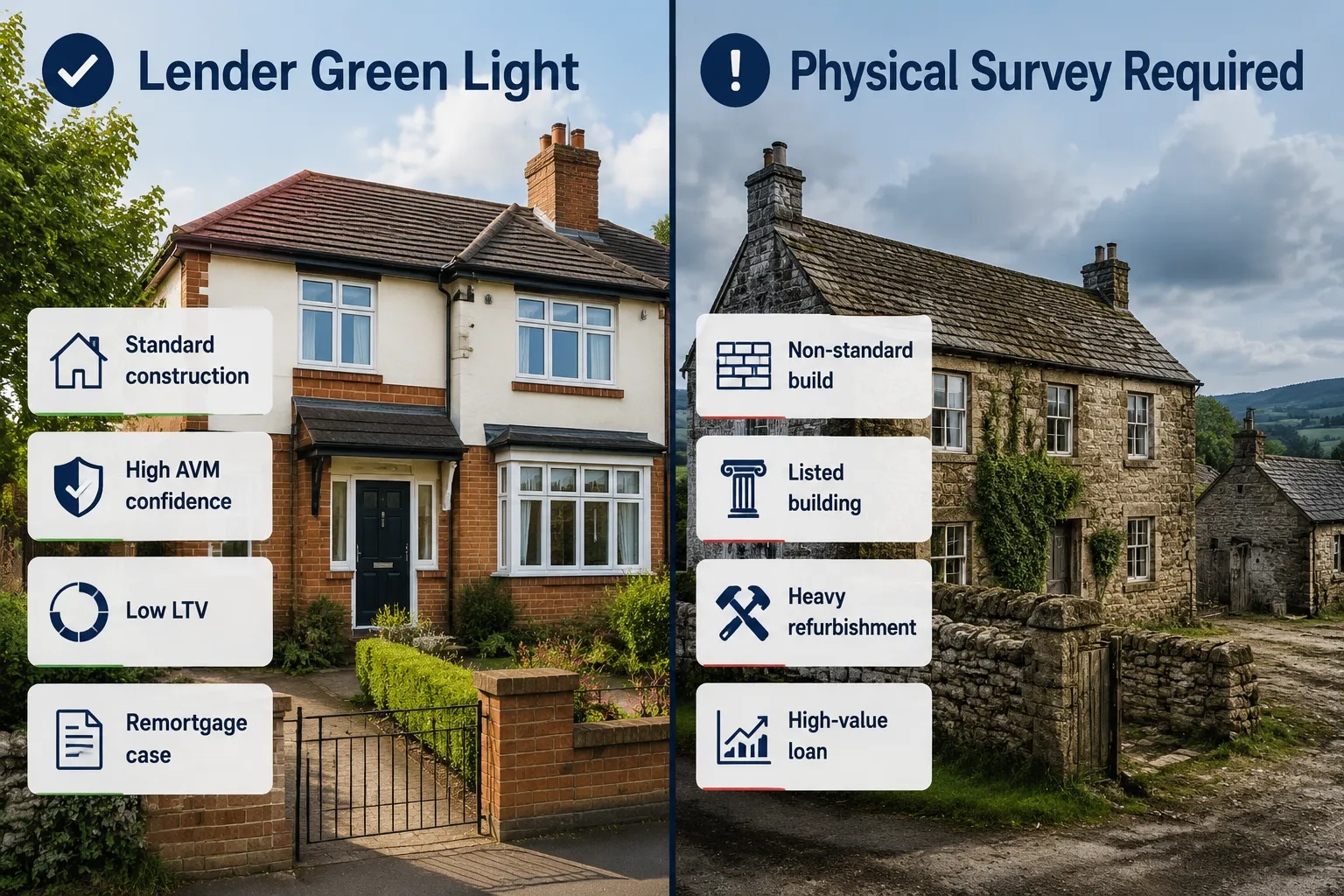
Lenders are most likely to accept a desktop valuation when the following conditions are met:
Property characteristics that support remote valuation:
- Standard construction (brick or stone walls, pitched tile or slate roof)
- Mainstream property type (terraced, semi-detached, detached house, or purpose-built flat)
- Located in an area with strong recent comparable sales data
- No known structural defects, damp, or major repair requirements
- No recent significant alterations that are unverified
Transaction and lending characteristics:
- Remortgage or capital-raising on an existing residential property [2]
- Moderate LTV, typically below 75-80% depending on lender appetite
- Loan size within the lender's desktop threshold (for second-charge products, often the £100,000-£200,000 band) [12]
- No heavy adverse credit history on the application
- Purchase, refinance, or light refurbishment bridging cases on standard residential assets [1]
In mainstream residential remortgaging, lenders frequently rely on AVMs, desktop valuations, or drive-by inspections for straightforward properties, meaning many borrowers never see a surveyor at all [2][7]. A 2026 guide from Legal & General confirms that for certain secured-lending products an independent valuer will not need to visit customers' homes, formalising desktop valuations as a product-level standard rather than an exception [11].
Turnaround time is a significant driver of this preference. AVMs return results in minutes; desktop valuations by a RICS surveyor are commonly delivered within 24-48 hours; full physical inspections often take 5-10 working days from appointment to report [6][1]. For time-sensitive transactions, bridging finance in particular, this difference is commercially significant.
"Desktop valuations are not a shortcut. They are a structured, RICS-compliant methodology that works well when the data is rich enough to support a defensible conclusion."
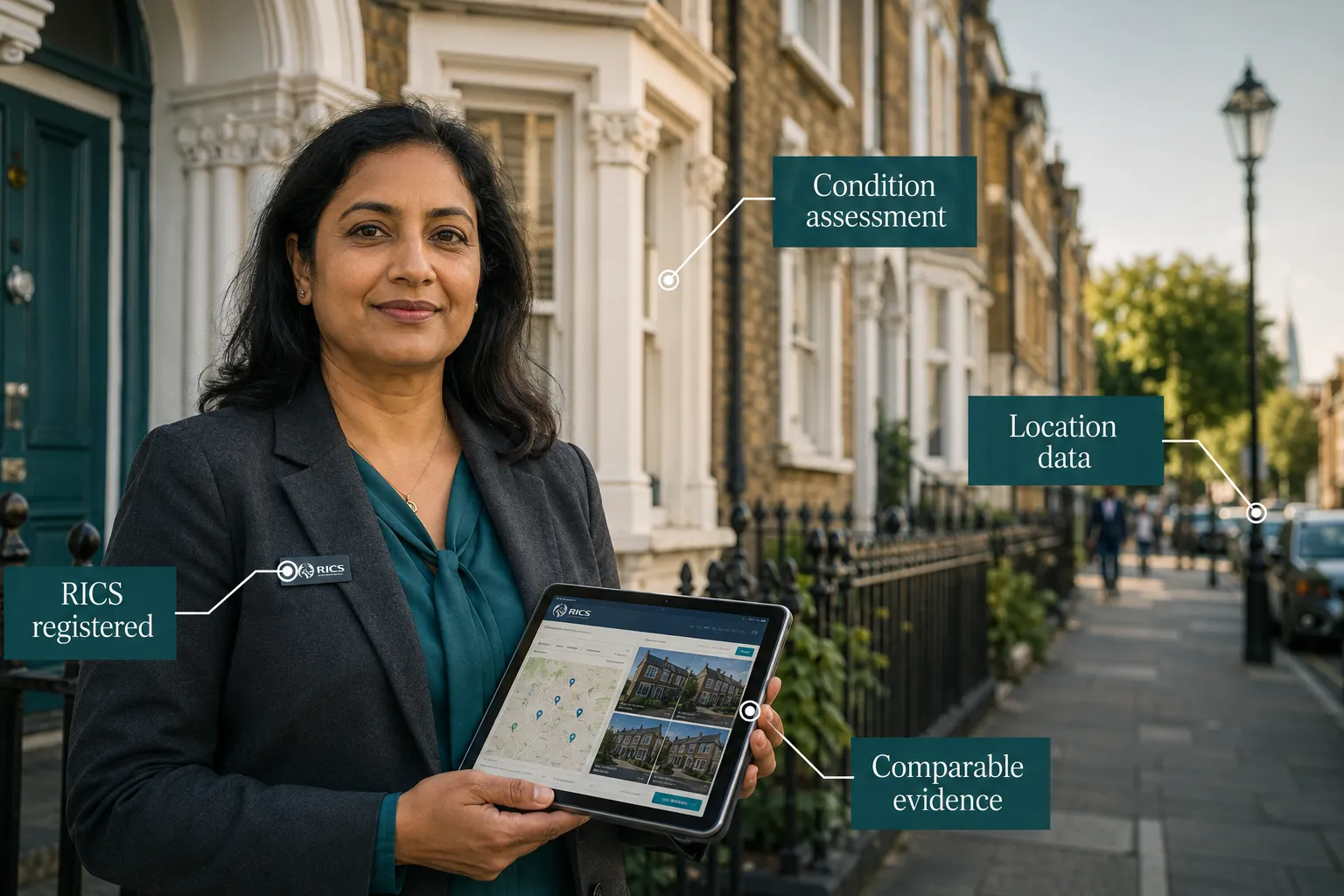
Specialist valuation firms now offer "Desktop+" and similar products explicitly framed as Red Book-standard assessments carried out from data, plans, photographs, and comparables without physical inspection [3][10]. For lenders, commissioning one of these reports from a RICS-registered valuer provides the professional accountability of a full valuation at a fraction of the time cost. For more on what Red Book compliance means in practice, see what is a Red Book valuation.
When Physical Surveys Are Non-Negotiable: The Red-Flag Triggers
The flip side of the desktop valuation vs physical survey question is understanding the risk factors that make remote assessment insufficient. Lenders, RICS standards, and specialist finance providers converge on a consistent set of triggers that mandate a physical inspection [5][7][12][13].
Non-Standard Construction
This is the single most consistent trigger for a physical inspection. Properties built with steel frame, concrete panel, timber frame, prefabricated components, thatched roofing, or any unusual structural system cannot be reliably valued from data alone. The condition of the structure, the quality of the materials, and any deterioration are simply not visible in comparable sales data or photographs [5][12].
If there is any uncertainty about a property's construction type, a physical survey is the appropriate route. For properties where structural concerns are already known, a structural survey in London provides the depth of assessment a lender will require.
Listed Buildings and Conservation Area Properties
Listed buildings carry legal restrictions on alteration and repair that directly affect value and saleability. A desktop valuation cannot assess compliance with listing conditions, the condition of original features, or the cost implications of required maintenance. Physical inspection is standard practice for all listed property lending.
High-Value Loans
For second-charge and secured loans, desktop valuations are typically used for loans in the £100,000-£200,000 band. Loans above approximately £200,000, all buy-to-let second charges, and any case involving adverse credit usually trigger a physical valuation [12]. In bridging finance, even lenders who accept AVMs at lower loan sizes will require physical inspections for higher-complexity or higher-value deals [6][1].
Heavy Refurbishment and Development Projects
Bridging lenders use desktop and data-driven valuations to accelerate lower-risk transactions, but physical surveys remain standard for heavy refurbishment projects [6][13]. The reason is straightforward: the "as-is" and "gross development value" figures that underpin a refurbishment bridging loan require a surveyor to assess the current condition of the building, the scope of works, and the realistic end value, none of which can be reliably determined remotely.
Rural and Sparse-Data Locations
Rural properties, agricultural buildings, and assets in areas with few recent comparable sales present an immediate data problem. Without sufficient comparables, a RICS surveyor cannot produce a defensible desktop valuation. The AVM confidence score will typically fall below the threshold that triggers a physical inspection, regardless of the property's construction type [5][6].
Known or Suspected Defects
If a prior survey, an AVM flag, or the borrower's own disclosure indicates potential structural issues, such as subsidence, significant cracking, damp, or roof problems, a physical inspection is required before any lending decision. For properties where cracking is a concern, understanding when cracks in walls warrant professional attention is an important first step. Lenders will not accept a desktop valuation where defects may materially affect value or security.
Mixed-Use and Commercial Assets
Mixed-use properties, commercial premises, and assets with non-residential elements fall outside the standard residential desktop valuation framework. These cases require a physical inspection and typically a specialist commercial valuation. For complex London assets, a commercial valuation in London from a RICS-registered firm provides the required standard.
The Evolving Landscape: Desktop Valuations in Bridging and Specialist Finance
The bridging finance sector has moved furthest and fastest in adopting remote valuation methods. In May 2026, United Trust Bank's bridging division launched a dedicated desktop valuation option positioned between AVMs and full physical inspections, available for standard residential purchases, refinances, light refurbishment projects, and capital raising [1]. This formalises a trend that had been developing across the specialist lending market throughout 2025 and into 2026.
By mid-2026, many bridging lenders are using desktop, data-driven, or hybrid AI-supported valuations to accelerate lower-risk transactions [6][13]. The pattern is consistent: remote methods for standard, data-rich, lower-LTV cases; physical inspections for anything complex, high-value, or structurally uncertain.
Industry analysis expects desktop and hybrid remote valuation models to keep expanding for mainstream residential and bridging lending, with physical inspections increasingly concentrated on high-value, complex, or risk-sensitive cases [13][6][2]. This is framed across the industry as an efficiency improvement rather than a wholesale replacement of traditional surveys.
For borrowers seeking desktop valuation services in London, the key is working with a RICS-registered firm that can confirm whether the specific property and transaction meet the criteria for remote assessment, and escalate to a physical inspection where they do not.
Practical Guidance: Choosing the Right Valuation Route
Understanding the desktop valuation vs physical survey framework helps borrowers, brokers, and property professionals make faster, better-informed decisions. The following checklist summarises the key decision points:
Consider a desktop valuation if:
- The property is standard construction in a well-documented urban or suburban area
- The transaction is a remortgage, refinance, or light bridging case
- The LTV is moderate and the loan size falls within the lender's desktop threshold
- There are no known defects, structural concerns, or unusual features
- Speed is a priority and the lender's criteria permit remote assessment
Proceed directly to a physical survey if:
- The property is non-standard construction, listed, or in a sparse-data rural location
- The loan size or LTV exceeds the lender's desktop threshold
- There are known or suspected structural defects, damp, or significant disrepair
- The transaction involves heavy refurbishment, development, or mixed-use elements
- The AVM confidence score is low or the lender's criteria explicitly require a site visit
For property professionals handling valuations for tax or regulatory purposes, such as ATED returns or capital gains calculations, the appropriate valuation standard may differ from the secured-lending context. See the guidance on ATED valuation for HMRC returns and capital gains tax valuation for those specific requirements.
Conclusion
The debate around desktop valuation vs physical survey is not about which method is better in absolute terms. It is about matching the depth of assessment to the level of risk in the transaction. UK lenders have developed a sophisticated, data-driven framework that makes this matching systematic: AVMs for the cleanest cases, desktop valuations for moderate-risk standard properties, and full physical inspections where complexity, value, or uncertainty demand it.
For borrowers and brokers, the actionable steps are clear:
- Assess the property type and construction before assuming a desktop valuation will be accepted. Non-standard builds, listed properties, and rural assets almost always require a physical inspection.
- Check the lender's specific criteria for the product and loan size in question. Thresholds vary between lenders and product types.
- Commission a RICS-registered desktop valuation from a qualified firm when the property and transaction meet the criteria, this will typically be faster and less disruptive than a full inspection.
- Do not attempt to substitute a desktop valuation for a physical survey where risk factors are present. Lenders will identify the mismatch, and the resulting delay will cost more time than the physical inspection would have.
- Seek specialist advice early for complex cases, bridging finance, mixed-use assets, or properties with known defects, to determine the correct valuation route before the application is submitted.
The expansion of desktop valuations in 2026 is a genuine efficiency gain for straightforward transactions. The physical survey has not been replaced; it has been reserved for the cases where it genuinely matters most.
References
[1] United Trust Bank Bridging Launches Desktop Valuation Option And Enhanced Avm Criteria – mortgagesolutions.co.uk
[2] Do You Always Need A Fresh Valuation When Remortgaging – manormortgagesdirect.com
[3] Launching A Menu Of Options For Remote Valuations – arnoldandbaldwin.co.uk
[4] Desktop Valuation – community.rics.org
[5] What Is A Mortgage Valuation – samconveyancing.co.uk
[6] Avm Bridging Loans – auracapital.co.uk
[7] Mortgage Valuations 101 Desktop Drive By Fullwhat Lenders Use And Why – willowprivatefinance.co.uk
[8] Valuation Standards – rics.org
[9] mpamag – mpamag.com
[10] Rics Red Book Valuation Explained 2026 – lmpropertysourcing.co.uk