
Mandatory biodiversity net gain requirements now attach a measurable ecological price tag to land, and the 2026 planning reforms have made quantifying that price tag a specialist legal discipline in its own right. Expert Witness Valuations for Properties with Biodiversity Net Gain Obligations: 2026 Planning Reform Impacts sits at the intersection of environmental law, RICS methodology, and dispute resolution — a space that has grown dramatically as BNG obligations reshape how development land is priced, challenged, and defended before tribunals and courts.
Key Takeaways
- The 2026 planning reforms introduce major BNG threshold changes, including a new 0.2-hectare small-site exemption that removes roughly 50% of residential permissions from BNG scope.
- Mandatory BNG for Nationally Significant Infrastructure Projects (NSIPs) begins on 2 November 2026, requiring biodiversity gain plans within Development Consent Order applications.
- Expert witness valuers must now quantify the financial impact of BNG obligations using RICS-compliant methodologies when disputes arise over development uplift, planning permissions, and land value.
- The biodiversity gain hierarchy is being relaxed for minor developments, allowing offsite gains to be treated equally with onsite enhancements — a shift that directly affects how valuers model residual land value.
- Brownfield exemption consultations are ongoing, meaning valuations tied to urban regeneration sites carry added uncertainty that expert witnesses must address explicitly in their reports.
What Biodiversity Net Gain Obligations Actually Mean for Property Value
Biodiversity net gain (BNG) is the requirement that development leaves biodiversity in a measurably better state than it was before. Under the Environment Act 2021, a mandatory 10% net gain target applies to most planning permissions in England. What has changed in 2026 is the scope, the exemptions, and the infrastructure categories now brought into the regime — all of which alter the financial assumptions that underpin land valuations.
Why does this matter for valuers? Because BNG obligations are a cost. They reduce the residual land value available to a developer after accounting for build costs, profit margin, and now ecological compliance expenditure. When that residual value is disputed — in planning appeals, compulsory purchase proceedings, matrimonial asset splits, or tax assessments — an expert witness valuer must be able to isolate and quantify the BNG burden with precision.
The key valuation factors that a RICS-registered expert must now consider include:
- The cost of achieving onsite habitat creation or enhancement
- The cost of purchasing biodiversity units from an offsite provider or statutory biodiversity credit scheme
- The 30-year legal covenant securing habitat management, and its impact on land encumbrance
- Any reduction in developable area caused by habitat retention requirements
- The premium or discount applied to land already carrying a biodiversity gain plan
A site that carries a robust, pre-approved biodiversity gain plan may actually command a modest premium in certain markets, because it reduces planning risk for a purchaser. Conversely, a site where BNG compliance is uncertain or costly will carry a measurable discount. Expert witnesses are increasingly called upon to put precise figures on both scenarios.
The 2026 Reform Landscape: What Has Changed and Why It Matters
Small Site Exemptions and the 0.2-Hectare Threshold
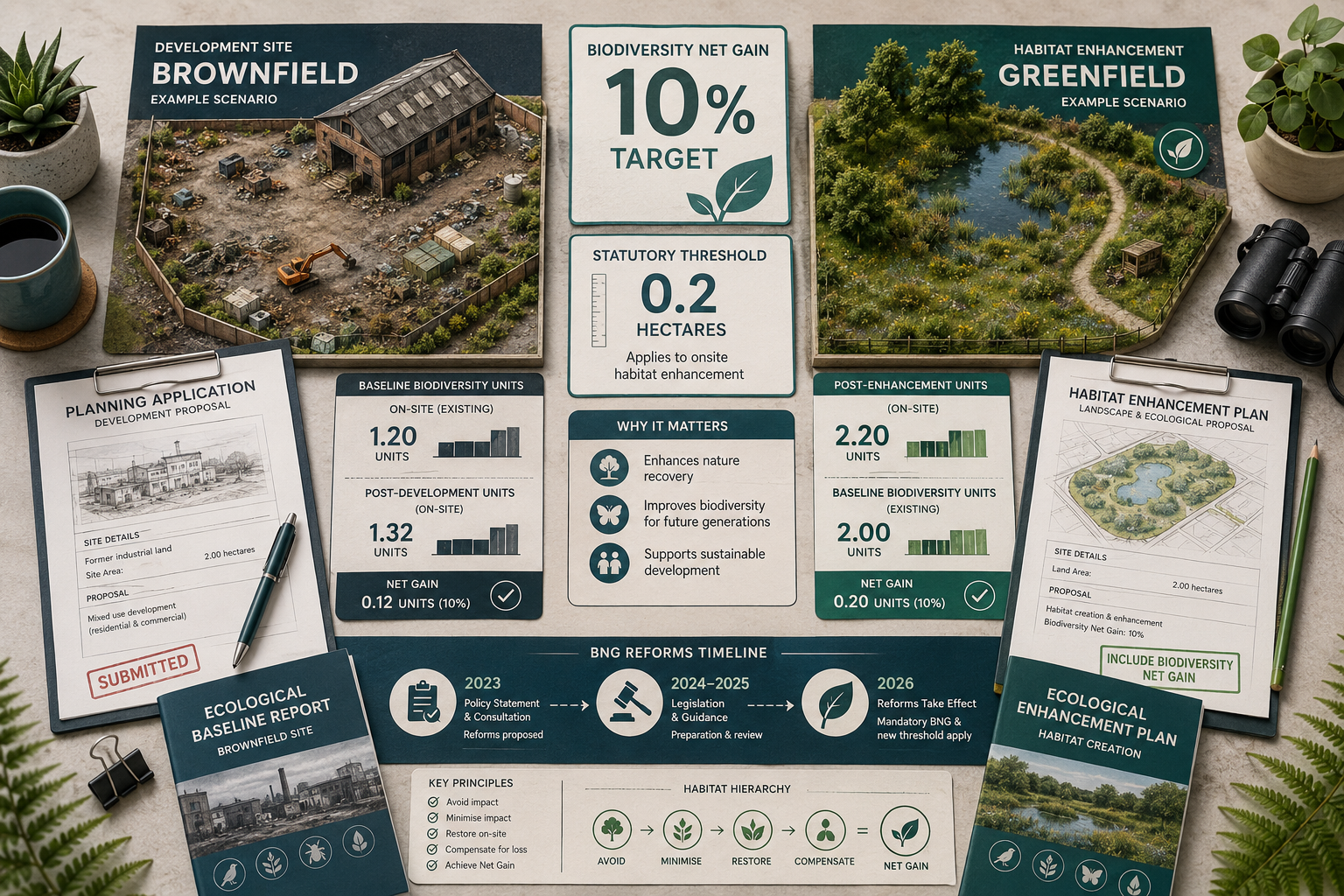
The most immediately impactful 2026 change is the introduction of a formal exemption for developments on sites of 0.2 hectares or less. From 31 July 2026, these sites are removed from mandatory BNG requirements entirely [2]. This single reform is expected to exclude approximately 50% of residential planning permissions that were previously in scope — a dramatic reduction in the population of properties carrying BNG obligations.
For expert witnesses, this creates a clear before-and-after valuation question. Properties that were valued with a BNG cost built into the residual land calculation prior to July 2026 may now require retrospective adjustment. Retrospective property valuations in London and beyond will need to account for the date at which the obligation attached — or ceased to attach — to the land.
The removal of the self-build and custom-build exemption runs alongside this change [2]. Many self-build projects will fall under the 0.2-hectare threshold anyway, but those that do not will now face BNG obligations for the first time. This is a niche but important area for expert witnesses advising in inheritance or matrimonial disputes involving self-build properties.
Temporary Development and the Extended Exemption
The exemption for temporary developments has been extended from two years to five years [3]. This matters for expert witnesses working on valuations of sites used for construction compounds, temporary car parks, or event infrastructure. A five-year temporary use now sits outside the BNG regime, which can materially affect the valuation of land being assessed for compulsory purchase or lease purposes.
Nationally Significant Infrastructure Projects: A New Frontier
The most structurally significant 2026 reform is the extension of mandatory BNG to Nationally Significant Infrastructure Projects. From 2 November 2026, NSIP applications must include a biodiversity gain plan as part of their Development Consent Order submission, targeting a 10% net gain [1]. This brings energy projects, major road schemes, airports, and large-scale utilities into the BNG framework for the first time.
NSIP promoters must work with qualified ecologists to calculate biodiversity units using the statutory metric, and habitats counted towards biodiversity value must be secured for 30 years [4]. Habitats that are temporarily impacted and fully reinstated are classified as non-significant and do not require legal agreements [4] — a distinction that expert witnesses must understand precisely when assessing the residual value of land affected by infrastructure corridors.
Brownfield Exemptions: An Unresolved Variable
The government has launched a public consultation on whether brownfield residential schemes should be exempt from BNG requirements entirely [4]. This is an ongoing process, and the outcome is not yet confirmed. For expert witnesses, this creates a category of valuation where the BNG cost may or may not apply — a genuine uncertainty that must be disclosed and addressed in any expert report touching urban regeneration land.
A prudent approach is to present valuations on a dual basis: one scenario assuming BNG applies, one assuming the brownfield exemption is granted. The difference between those two figures represents the value at risk from regulatory uncertainty, and courts and tribunals expect expert witnesses to address this transparently.
Relaxation of the Biodiversity Gain Hierarchy for Minor Developments
For minor developments, the strict hierarchy that previously required onsite habitat enhancement to be exhausted before offsite measures could be used has been relaxed [3]. Offsite biodiversity gains are now treated on equal footing with onsite creation. This is significant for valuations because offsite biodiversity units can be purchased at a known market price, making the BNG cost more predictable and easier to model in a residual valuation.
When offsite units are available at a transparent price, the expert witness can apply a straightforward deduction to gross development value. When onsite habitat creation is required instead, the cost is more variable and site-specific, requiring detailed ecological and construction cost input.
Expert Witness Valuations for Properties with Biodiversity Net Gain Obligations: RICS Methodologies and Court Standards
The Role of the Expert Witness in BNG Disputes
An expert witness in a BNG-related valuation dispute is not an advocate. Their duty is to the court or tribunal, and their report must be independent, objective, and capable of withstanding cross-examination. RICS registered valuers in London and across England are increasingly instructed in this capacity as BNG disputes work their way through the planning appeal system, the Upper Tribunal (Lands Chamber), and civil courts.
The types of dispute where expert witness BNG valuations arise include:
| Dispute Type | BNG Valuation Issue |
|---|---|
| Planning appeal | Whether BNG cost justifies refusal or viability exception |
| Compulsory purchase | Quantifying BNG obligation as a deduction from compensation |
| Matrimonial proceedings | Establishing net value of development land in asset split |
| Capital gains tax assessment | Establishing market value at date of disposal |
| Boundary and ransom strip disputes | Quantifying development uplift where BNG applies |
For capital gains tax valuations involving development land, HMRC will expect the expert to demonstrate that BNG costs have been properly accounted for in the market value assessment. Failing to do so risks an understated gain and potential penalties.
Residual Valuation: The Core Methodology
The residual method of valuation is the primary tool for development land. It works by deducting all costs from the gross development value to arrive at the residual land value. BNG costs now form a distinct line item in this calculation.
A simplified residual model with BNG costs:
- Gross Development Value (GDV): estimated sale value of completed development
- Less: construction costs
- Less: professional fees and finance costs
- Less: developer's profit
- Less: BNG compliance costs (onsite habitat creation, management endowment, or offsite unit purchase)
- Equals: Residual Land Value
The BNG compliance cost can range from negligible (for a site already rich in biodiversity where a 10% gain is easily achieved) to substantial (for a site requiring extensive habitat creation or expensive offsite unit purchases). Expert witnesses must obtain ecological survey data, metric calculations, and habitat management cost schedules to support their BNG cost figure.
Comparable Evidence and Market Transactions
Where comparable land transactions exist involving sites with and without BNG obligations, these provide direct market evidence of the BNG discount. The expert witness must analyse these comparables carefully, adjusting for differences in location, planning status, development type, and the specific nature of the BNG obligation.
Valuation reports in London prepared for litigation purposes must set out the comparable evidence in full, explain any adjustments made, and state clearly how the BNG cost has been isolated from other value influences. Courts expect this level of transparency.
Single Joint Expert vs. Party-Appointed Expert
In many planning and property disputes, the court will direct the parties to appoint a single joint expert (SJE) rather than each instructing their own valuer. In more complex BNG cases — particularly those involving NSIPs or high-value development land — party-appointed experts with concurrent evidence ("hot-tubbing") is more common.
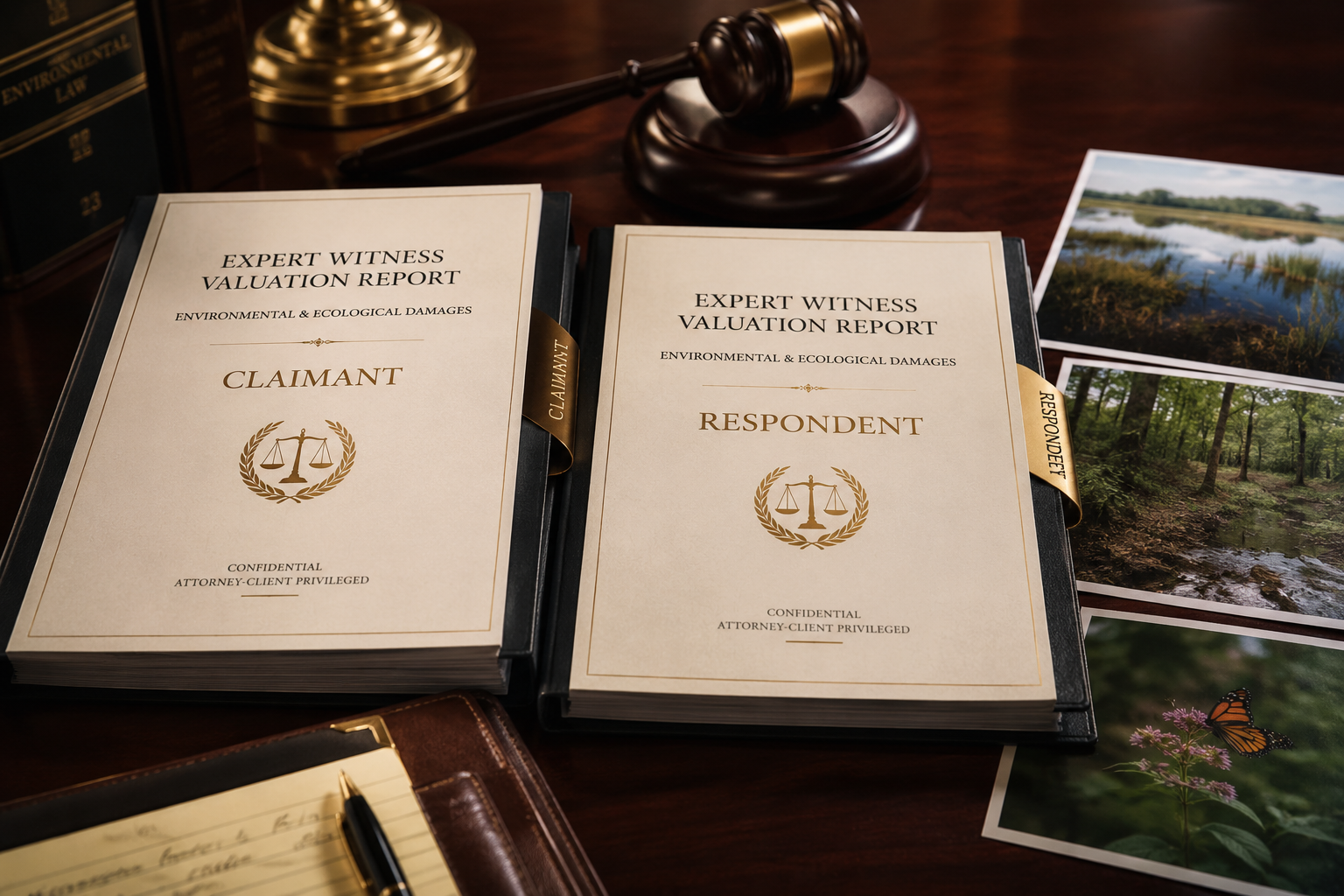
Where Expert Witness Valuations for Properties with Biodiversity Net Gain Obligations: 2026 Planning Reform Impacts are contested between party-appointed experts, the points of disagreement typically centre on:
- The assumed cost of offsite biodiversity units
- The feasibility and cost of onsite habitat creation
- The appropriate discount rate for the 30-year habitat management liability
- Whether the brownfield exemption consultation outcome should be reflected in the valuation
Practical Guidance for Instructing Parties and Their Legal Teams
What to Look for in a BNG Expert Witness Valuer
Not every RICS valuer has the specialist knowledge to address BNG obligations competently in a litigation context. Legal teams should seek valuers who can demonstrate:
- Familiarity with the statutory biodiversity metric and how it translates ecological data into unit values
- Experience with residual valuation for development land across residential, commercial, and infrastructure sectors
- Understanding of the 2026 reform changes, including the NSIP extension, small-site exemptions, and brownfield consultation
- Ability to work with ecologists to obtain and interpret habitat condition assessments
- Court experience and compliance with Civil Procedure Rules Part 35 or equivalent tribunal rules
For commercial property valuations involving BNG, additional complexity arises from the interaction between ecological obligations and lease structures, particularly where a long-term habitat management covenant affects the landlord's ability to redevelop or alter the site.
Timing and the Importance of Instruction Date
The 2026 reforms have created a series of effective dates that are legally significant:
- 31 July 2026: Small-site exemption (0.2 ha or less) takes effect [2]
- 2 November 2026: Mandatory BNG for NSIPs commences [1]
- Ongoing: Brownfield exemption consultation — outcome pending [4]
When instructing an expert witness, legal teams must specify the relevant valuation date precisely. A valuation as at 1 July 2026 carries different BNG assumptions than one as at 1 August 2026, because the small-site exemption changes the regulatory landscape between those two dates.
Documentation the Expert Will Need
An expert witness preparing a BNG valuation report will typically require:
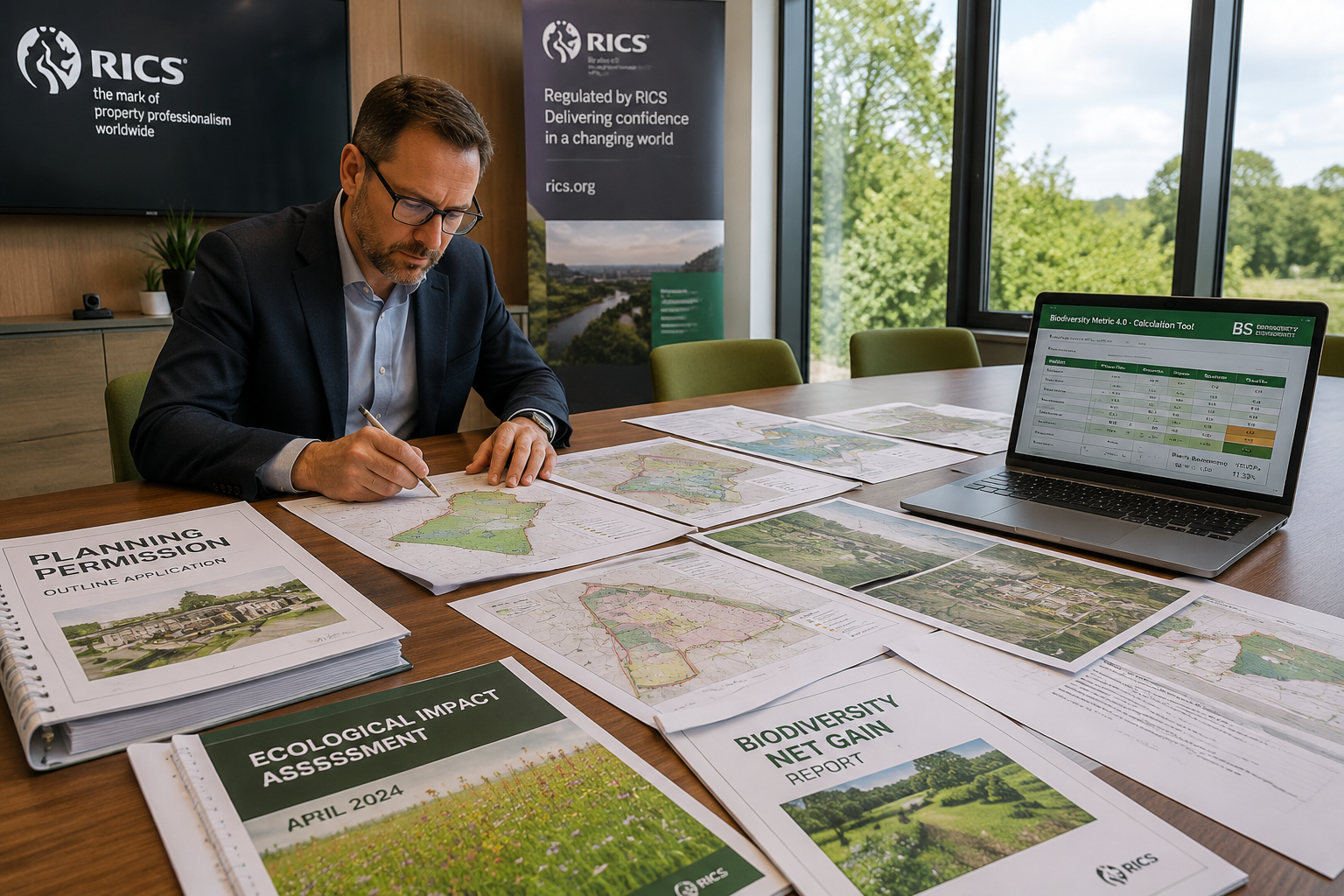
- Planning application documents and any ecological impact assessments
- Biodiversity metric calculations prepared by the applicant's ecologist
- Habitat management plan and associated cost schedules
- Any biodiversity gain plan submitted to or approved by the local planning authority
- Comparable land transactions in the area
- Evidence of offsite biodiversity unit prices from local nature recovery networks or the statutory credit scheme
For properties where valuation reports are needed for tax or regulatory purposes, the expert should also obtain any correspondence between the developer and the local planning authority regarding BNG compliance.
Conclusion
The 2026 planning reforms have fundamentally altered the BNG landscape, and Expert Witness Valuations for Properties with Biodiversity Net Gain Obligations: 2026 Planning Reform Impacts have become a distinct and demanding specialism within property dispute resolution. The introduction of mandatory BNG for NSIPs, the new 0.2-hectare small-site exemption, the relaxation of the biodiversity gain hierarchy for minor developments, and the ongoing brownfield exemption consultation all create valuation variables that must be addressed with precision in any expert report.
Actionable next steps for those involved in BNG-related property disputes:
- Instruct a RICS-registered valuer with demonstrable BNG expertise and litigation experience at the earliest stage of a dispute — before positions harden.
- Establish the precise valuation date and confirm which 2026 reforms were in force at that date, as the regulatory position changed materially across the year.
- Obtain a full ecological survey and biodiversity metric calculation before commissioning the valuation report — the expert cannot model BNG costs without this data.
- Where brownfield land is involved, present the valuation on a dual-scenario basis to address the unresolved exemption consultation.
- Ensure the expert report complies fully with CPR Part 35 or the relevant tribunal's expert evidence rules, including a clear statement of the expert's duty to the court.
- Engage RICS registered valuers who can collaborate effectively with ecologists, legal counsel, and planning consultants to produce a coherent, defensible valuation.
The intersection of ecological law and property valuation will only deepen as BNG obligations mature and case law develops. Those who invest in specialist expertise now will be far better positioned when disputes reach the tribunal or courtroom.
References
[1] BNG For NSIPs Government Response Confirms Go Live On 2 November 2026 – https://www.hsfkramer.com/notes/energy-and-infra-consenting/2026-posts/bng-for-nsips-government-response-confirms-go-live-on-2-november-2026
[2] Biodiversity Net Gain April 2026 Reform Small Sites Brownfield Exemptions – https://biodiversitysurveyors.com/blog/biodiversity-net-gain-april-2026-reform-small-sites-brownfield-exemptions
[3] Biodiversity Net Gain Changes 2026 – https://www.biodiverseconsulting.co.uk/post/biodiversity-net-gain-changes-2026
[4] Biodiversity Net Gain Three Key Policy Updates – https://gowlingwlg.com/en-ae/insights-resources/articles/2026/biodiversity-net-gain-three-key-policy-updates