Roughly one in three loft conversion disputes that reach formal surveyor appointment in England involves a disagreement over joist insertions into a shared wall — yet most building owners only discover this risk after they have already served their party wall notice. Party Wall Awards for Loft Conversions: Enforcing Security Deposits and Cross-Over Joists in 2026 Projects sit at the intersection of construction law, structural engineering, and neighbour relations, and getting any one element wrong can result in an injunction that halts work entirely. This guide breaks down every key stage: from drafting a robust award to enforcing deposit conditions and managing the structural realities of cross-over joists.
Key Takeaways
- A Party Wall Award is a legally binding document that governs how loft conversion works affecting a shared wall must be carried out, including joist insertions and beam pocket formation.
- Security deposits are not explicitly required by the Party Wall etc. Act 1996, but surveyors routinely include them in awards to protect adjoining owners from uncompensated damage.
- Cross-over joists must use only half the thickness of the party wall; encroaching beyond this boundary is both a structural risk and a legal violation.
- Notices must be served at least two months before work begins; failing to do so can expose building owners to injunctions and costly delays.
- A thorough Schedule of Condition, prepared before work starts, is the single most important document for resolving damage claims fairly.
What Is a Party Wall Award and Why Loft Conversions Trigger Them
A Party Wall Award — sometimes called a party wall agreement — is a formal, legally binding determination produced by one or more appointed surveyors under the Party Wall etc. Act 1996. It sets out the rights and obligations of both the building owner (the person carrying out work) and the adjoining owner (the neighbour) before, during, and after construction.
Loft conversions are among the most common triggers for party wall procedures in urban areas. This is because they almost always involve at least one of the notifiable works listed in the Act:
- Section 2 works: Cutting into, raising, or underpinning a party wall or party structure.
- Section 6 works: Excavating within three or six metres of an adjoining structure (less common in loft conversions, but relevant if a rear extension is combined with the loft).
For a detailed overview of how the Act applies to loft projects, see this guide on party wall matters for loft conversions.
When a neighbour dissents to a party wall notice — or simply fails to respond within 14 days — a dispute is deemed to exist in law, and surveyors must be appointed to produce an award [5]. The award then governs every aspect of the notifiable works, including the critical structural elements of cross-over joist installation.
When Is a Party Wall Notice Required for a Loft Conversion?
Not every loft conversion requires a party wall notice. Detached homes typically do not need one unless a boundary wall or shared structure is affected [7]. However, semi-detached and terraced properties almost always do, because:
- New floor joists are frequently built into or supported by the party wall.
- The party wall may need to be raised or thickened.
- Beam pockets must be cut into the shared masonry.
Building owners must serve notice at least two months before work begins [3]. Serving notice late is one of the most common procedural errors and can expose the building owner to an injunction [4]. Budget an additional one to two months beyond the statutory period to allow for surveyor appointment and award drafting.
Cross-Over Joists: The Structural and Legal Essentials
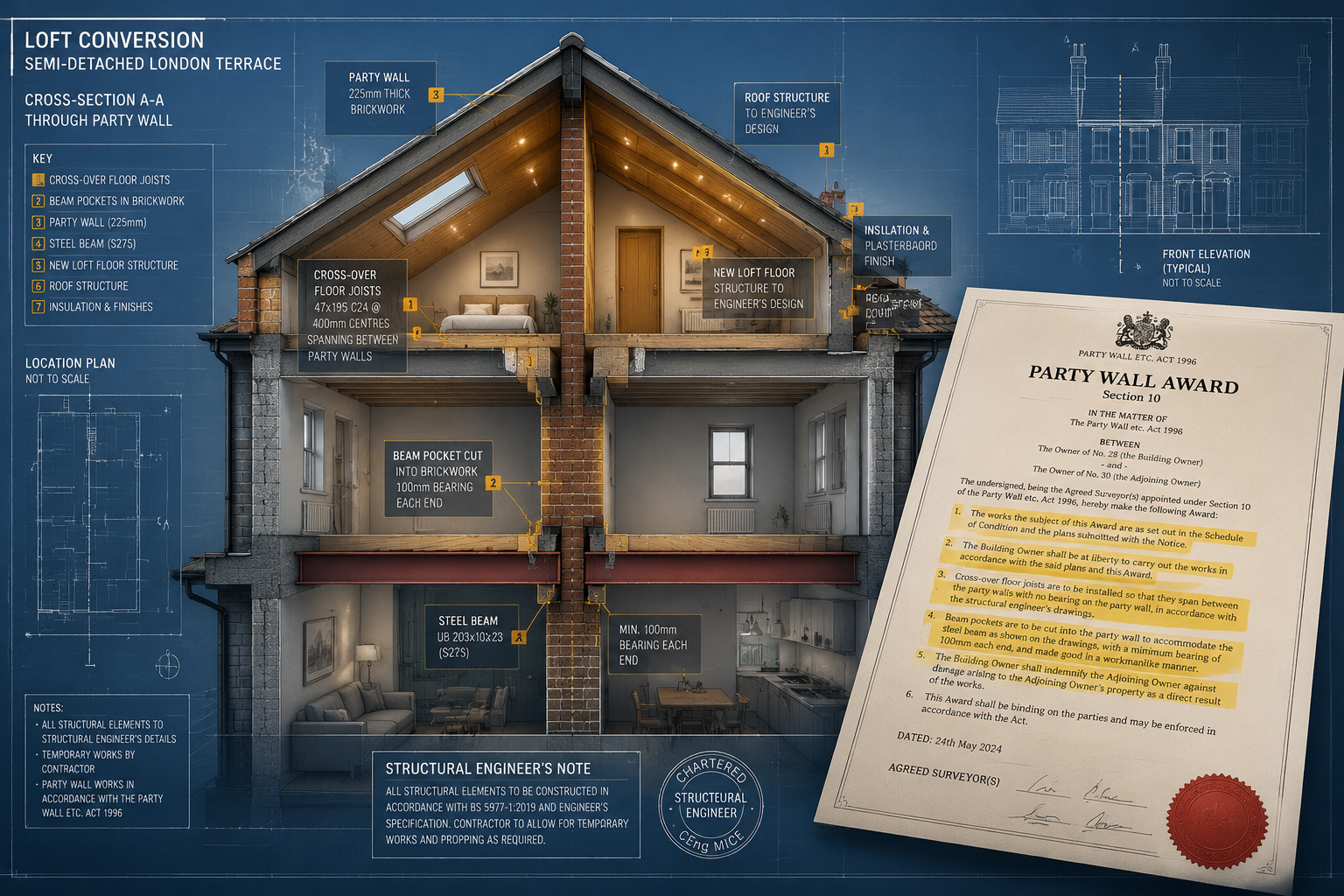
Cross-over joists — also called cross joists or new floor joists — are the structural timbers installed during a loft conversion to create a loadbearing floor at loft level. They are typically positioned between or alongside existing ceiling joists and must transfer their loads safely to the surrounding structure.
How Cross-Over Joists Interact With the Party Wall
When a cross-over joist bears onto a party wall, the law is precise: only half the thickness of the party wall may be used [2]. This rule exists for two reasons:
- Structural integrity: Encroaching beyond the midpoint risks undermining the adjoining owner's half of the wall.
- Property rights: The adjoining owner owns the other half. Using more than your share without consent is a trespass.
In practice, this means beam pockets — the recesses cut into the masonry to receive joist ends — must be carefully dimensioned. A structural engineer must calculate the bearing length required and confirm it does not exceed the permitted depth [3].
Beam Pocket Formation: Best Practice in 2026
The method used to cut beam pockets is as important as their dimensions. Vibration from power tools can cause cracking in the adjoining owner's plasterwork and, in older properties, can loosen pointing or damage historic masonry. The accepted best practice — and a condition routinely written into party wall awards — is to use non-vibrational hand tools when forming beam pockets [3].
A well-drafted award will specify:
| Requirement | Detail |
|---|---|
| Tool type | Non-vibrational hand tools only for pocket formation |
| Joist bearing depth | Maximum 50% of party wall thickness |
| Mortar reinstatement | Lime mortar to match existing, applied within 24 hours |
| Dust protection | Dust sheets on adjoining owner's side before cutting begins |
| Notification | Adjoining owner given 48 hours' notice before cutting starts |
Structural calculations must be prepared by a qualified structural engineer and reviewed by the party wall surveyor before any award is finalised [3]. If calculations are inadequate, the surveyor has authority to require revisions before permitting works to proceed.
For properties where party wall insulation is also being upgraded as part of the loft project, see the guidance on party wall insulation requirements, as sound insulation between habitable rooms is a separate building regulation obligation that must be met alongside party wall compliance [2].
Security Deposits in Party Wall Awards for Loft Conversions: Enforcing Them Effectively
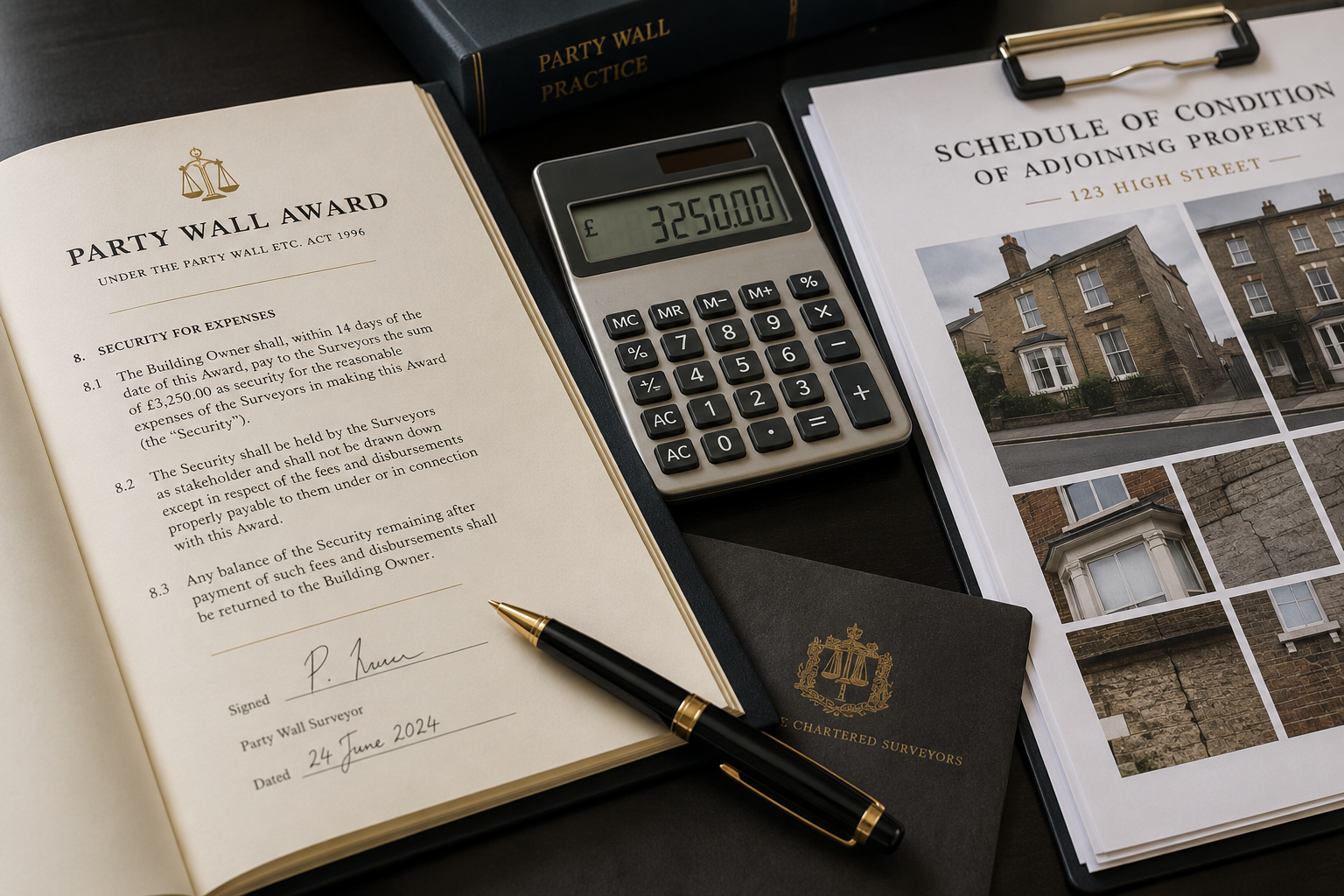
The Party Wall etc. Act 1996 does not explicitly mention security deposits. There is no statutory provision requiring one. However, surveyors have well-established authority to include security deposit conditions within a party wall award, and in 2026 projects this practice is increasingly standard for loft conversions involving significant structural works [1].
Why Surveyors Include Security Deposits
A security deposit protects the adjoining owner if the building owner causes damage during construction and then fails — or refuses — to pay for repairs. Without a deposit, the adjoining owner's only remedy is civil litigation, which is slow and expensive.
The deposit amount is set by the appointed surveyor(s) based on:
- The scope and complexity of the works.
- The assessed risk of damage to the adjoining property.
- The condition of the adjoining property as recorded in the Schedule of Condition.
- The estimated cost of likely remediation works.
Typical deposit amounts for loft conversions in London range from £1,000 to £5,000, though more complex projects on older or structurally sensitive properties can attract higher figures [1].
How Security Deposits Are Held and Released
A well-drafted award will specify:
- Who holds the deposit: Usually a solicitor's client account or a jointly controlled account.
- Trigger conditions for drawdown: What constitutes damage sufficient to access the deposit.
- Release conditions: The deposit is returned to the building owner once works are complete and a post-works inspection confirms no outstanding damage.
- Dispute resolution: If the parties disagree on whether damage occurred, the appointed surveyor makes a further determination.
"The security deposit clause is only as strong as the Schedule of Condition that underpins it. Without a detailed pre-works record, it is almost impossible to prove that any crack or defect was caused by the loft conversion rather than pre-existing." — Standard industry guidance from party wall practitioners.
The Schedule of Condition: The Deposit's Foundation
The Schedule of Condition is a photographic and written record of the adjoining property's state before works begin. It is prepared by the surveyor and forms an annexure to the party wall award. Every room adjacent to or above the party wall should be documented, including:
- Existing cracks in plasterwork (measured and photographed).
- Condition of ceilings, cornices, and architraves.
- State of external brickwork on the shared wall.
- Any pre-existing settlement or structural movement.
Without this document, enforcing a security deposit becomes a matter of word against word. With it, the surveyor can make a clear, evidence-based determination if damage is claimed after works complete.
For properties in London where party wall disputes have already arisen, the process for resolution is explained in detail in this guide on party wall disputes.
Drafting a Robust Party Wall Award: Key Clauses for 2026 Projects
A party wall award is only as effective as its drafting. Vague or incomplete awards leave gaps that building owners exploit — sometimes unintentionally — and that adjoining owners cannot enforce without returning to the surveyors for a further award.
Essential Clauses for Loft Conversion Awards
1. Permitted works description
The award must precisely describe what works are authorised. For cross-over joist installation, this means specifying joist dimensions, bearing depths, pocket locations, and the method of formation.
2. Working hours
Standard awards restrict noisy works to Monday to Friday, 8am to 5pm, with no works on Sundays or bank holidays. Loft conversions often involve early-morning deliveries and crane operations; these should be addressed specifically.
3. Security deposit clause
As discussed above, this must specify the amount, the holding mechanism, drawdown triggers, and release conditions [1].
4. Notification obligations
The building owner must give the adjoining owner a minimum of 48 hours' written notice before commencing any works that directly affect the party wall. This is particularly important for beam pocket cutting.
5. Access rights
The Act grants surveyors and the building owner's contractors a right of access to the adjoining property for inspection purposes. The award should set out how this right is exercised, including notice requirements.
6. Damage remediation
The award must state that any damage caused to the adjoining property will be made good by the building owner at their own cost, using materials that match the existing finishes.
7. Structural engineer sign-off
A condition requiring written confirmation from the structural engineer that cross-over joists have been installed in accordance with the approved calculations before any further structural works proceed.
For a broader understanding of what a party wall agreement covers and how it is structured, see this resource on party wall agreements.

Common Mistakes That Lead to Injunctions and Disputes
Party wall procedures for loft conversions fail at predictable points. Understanding these failure modes helps building owners and their surveyors avoid them in 2026 projects.
Serving Notice Too Late
The two-month statutory notice period is not a guideline — it is a legal requirement [5]. Building owners who serve notice late and then begin works before the period expires are committing an unlawful act. Adjoining owners can apply to the courts for an injunction to halt works, and courts have granted these even when works are already substantially complete. The cost of an injunction — including legal fees, delay costs, and potential demolition and reinstatement — can far exceed the cost of simply serving notice on time [4].
Relying on Builders Rather Than Surveyors
A builder may have extensive experience with loft conversions but has no authority to advise on party wall law. Common builder errors include:
- Assuring building owners that no notice is needed.
- Using incorrect or outdated notice templates.
- Misrepresenting the scope of notifiable works.
These errors can invalidate the notice process entirely [4]. Always engage a qualified party wall surveyor before serving any notice.
Inadequate Structural Calculations
If structural calculations are not prepared before the award is finalised, the surveyor cannot properly assess the impact of cross-over joists on the party wall. This creates risk for both parties: the building owner may install joists that are structurally inadequate, and the adjoining owner has no documented basis for challenging works that later cause damage [3].
Failing to Agree the Schedule of Condition
Some building owners resist a detailed Schedule of Condition because they fear it will delay the project. In practice, a thorough schedule protects the building owner as much as the adjoining owner — it provides clear evidence that any damage claimed after works is pre-existing rather than construction-related.
For answers to frequently asked questions about party wall procedures, the party wall act questions resource covers many of the scenarios that arise in loft conversion projects.
Costs, Timelines, and Practical Planning for 2026
Surveyor Fees
Party wall surveyor fees for loft conversions typically range from £500 to £2,000 or more, depending on project complexity [6]. When adjoining owners appoint their own surveyors separately (rather than agreeing to a single agreed surveyor), the building owner is generally responsible for both sets of fees.
For a full breakdown of what drives party wall surveyor costs, see the guide on party wall surveyor costs.
Realistic Timeline for a 2026 Loft Conversion
| Stage | Minimum Time |
|---|---|
| Serve party wall notice | At least 2 months before works |
| Neighbour response period | 14 days from service |
| Surveyor appointment (if dissent) | Immediate after dissent |
| Award drafting and agreement | 4 to 8 weeks typically |
| Schedule of Condition preparation | 1 to 2 weeks |
| Total pre-works period | 3 to 4 months minimum |
Building owners who fail to account for this timeline in their project programme routinely find themselves either serving notices late or pressuring surveyors to rush award drafting — both of which increase dispute risk.
Detached Properties
Detached homes generally fall outside the party wall regime for loft conversions unless a boundary wall or shared structure is directly affected [7]. However, if a detached property's loft conversion involves excavation near a neighbour's foundations, the party wall excavation notice rules under Section 6 of the Act may still apply.
Conclusion
Party Wall Awards for Loft Conversions: Enforcing Security Deposits and Cross-Over Joists in 2026 Projects demand careful preparation, precise drafting, and a clear understanding of both the legal framework and the structural realities of joist installation. The consequences of getting it wrong — injunctions, neighbour disputes, and uncompensated damage claims — are far more costly than the investment in proper party wall procedure from the outset.
Actionable next steps for building owners planning a loft conversion in 2026:
- Engage a qualified party wall surveyor before serving any notice — not after.
- Commission structural calculations early so they can be reviewed as part of the award drafting process.
- Serve the two-month party wall notice on time, using the correct statutory template.
- Insist on a detailed Schedule of Condition before any works begin on or near the party wall.
- Ensure the award includes a clearly worded security deposit clause with specific holding and release conditions.
- Brief contractors on the non-vibrational hand tool requirement for beam pocket formation before they start on site.
- Keep written records of all notifications given to the adjoining owner during the construction phase.
For those navigating a live dispute or seeking guidance on a specific scenario, the party wall disputes service provides expert support across London and the surrounding regions.
References
[1] A Clear Guide To Typical Party Wall Award Terms For Lofts – https://www.simplesurvey.co.uk/uncategorised/a-clear-guide-to-typical-party-wall-award-terms-for-lofts/
[2] New Internal Elements – https://www.gov.wales/building-regulations-loft-conversions/new-internal-elements
[3] Loft Conversion – https://www.partywall-expert.com/loft-conversion/
[4] partywallspecialists – https://partywallspecialists.com/?p=24124
[5] Loft Conversions Party Wall – https://echelonpartywall.co.uk/loft-conversions-party-wall/
[6] Party Wall Agreement For Loft Conversion – https://visionloftconversions.co.uk/party-wall-agreement-for-loft-conversion/
[7] Party Wall Agreement – https://www.greenmatch.co.uk/loft-conversion/rules-regulations/party-wall-agreement