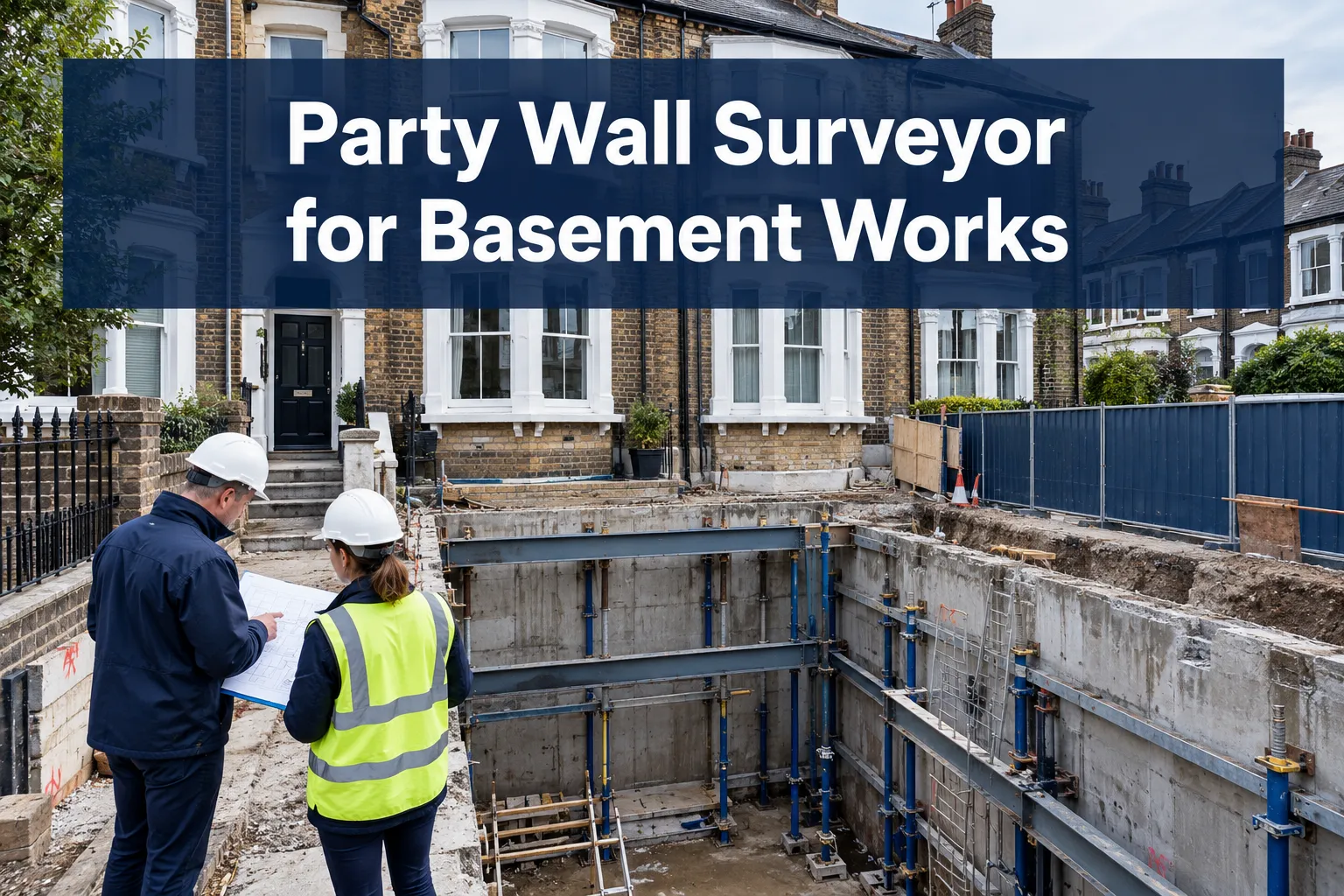
Basement conversions in London and other dense UK cities now account for a significant share of planning applications, yet the party wall process for below-ground works remains one of the most misunderstood areas of property law. Engaging a party wall surveyor for basement works, notices, temporary works, excavation risk and neighbour protection is not optional: the Party Wall etc. Act 1996 makes it a legal requirement in most cases, and the consequences of getting it wrong can include injunctions, costly remediation and lasting neighbour disputes.
This article sets out exactly what the Act requires for basement projects, where the risks concentrate, and how a properly conducted party wall process protects everyone involved.
Key Takeaways
- Basement excavations almost always trigger the Party Wall etc. Act 1996, usually under Section 6 (the 3 m and 6 m rules) and often under Section 2 as well.
- Notice must be served at least one month before work starts for most basement operations; failure to serve notice does not make the work lawful.
- A party wall surveyor's role goes well beyond paperwork, the Award must address temporary works, propping, monitoring and access.
- Neighbours cannot simply block basement works, but they are entitled to full procedural protection and a schedule of condition before any excavation begins.
- The trend since 2024 is for Awards to become more detailed on ground movement controls, vibration limits and communication protocols.
Why Basement Works Demand Specialist Party Wall Advice
Most homeowners are familiar with party wall notices for loft conversions or rear extensions. Basement projects are different in character. Excavation goes downward, toward the foundations of adjoining properties, and the risk of loss of support, the legal concept at the heart of Section 6, is far more acute than in above-ground alterations.
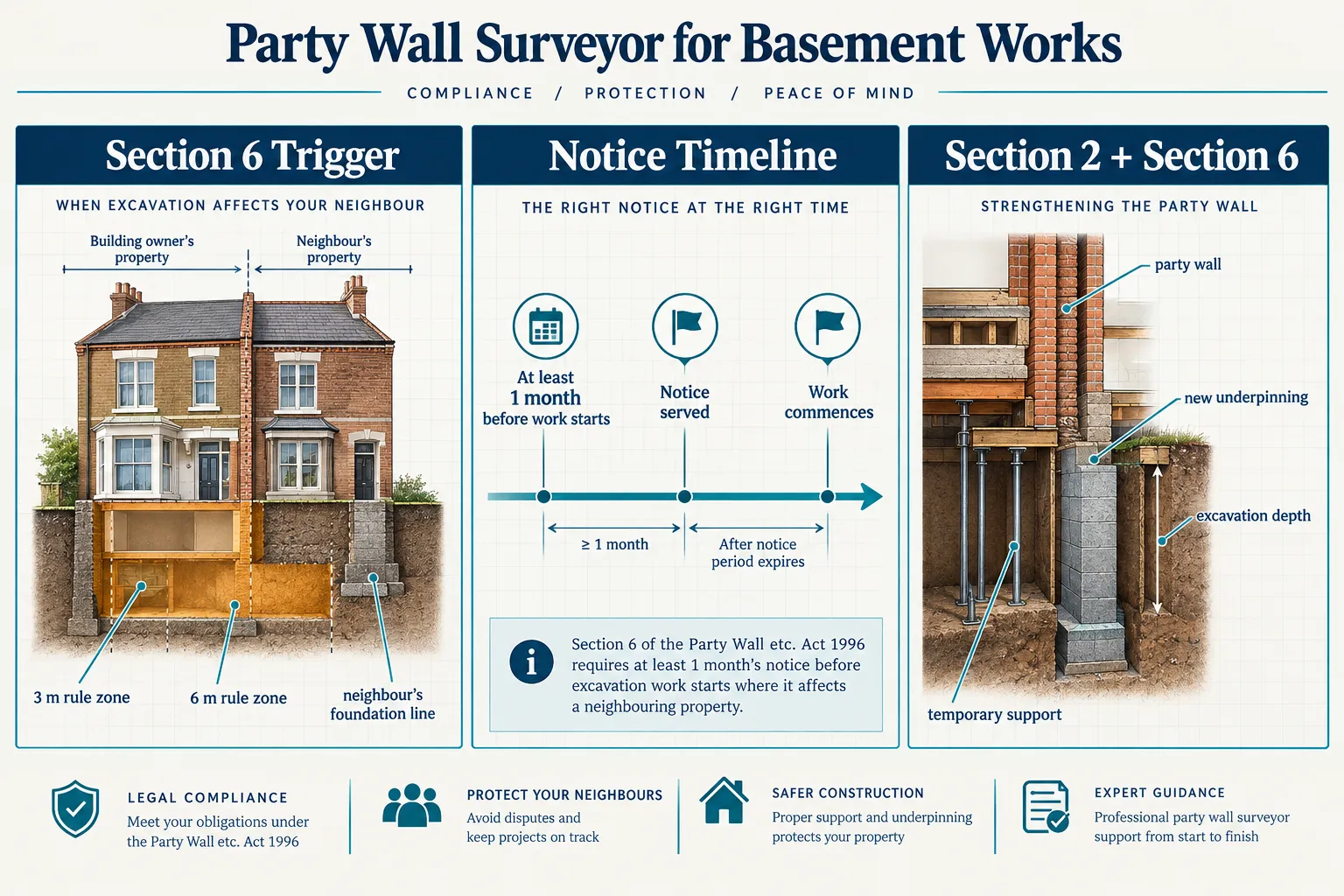
The Party Wall etc. Act 1996 was drafted partly to address exactly this kind of risk. The Act creates a statutory framework that sits alongside planning permission and building regulations; obtaining one does not discharge the obligations under the other [1]. A homeowner who digs a basement without serving the correct notices may face an injunction stopping the works mid-excavation, an expensive and disruptive outcome that a short notice period would have avoided [2].
For a fuller picture of how party wall legislation operates across different project types, the party wall legislation tag covers the breadth of the Act's reach.
The Three Sections Most Relevant to Basement Projects
| Act Section | What It Covers | Typical Basement Trigger |
|---|---|---|
| Section 1 | New walls on or astride the boundary | Rarely triggered for basements alone |
| Section 2 | Works to an existing party wall or structure | Underpinning, cutting into party wall for beams |
| Section 6 | Excavation near neighbouring foundations | Almost always triggered; 3 m and 6 m rules apply |
Section 6 is the provision most homeowners miss. It applies whenever an owner proposes to excavate within 3 m of a neighbour's structure and the excavation will go deeper than the neighbour's foundations, or within 6 m where the excavation line, if extended downward at 45 degrees, would cut through the neighbour's foundation level [3]. In practice, almost every full-depth basement in a terraced or semi-detached house triggers Section 6 on at least one side [9].
Notices, Timelines and What Happens When a Neighbour Disputes
Serving the Correct Notice
A Section 6 notice must be served at least one month before the proposed start date [1]. The notice must include drawings showing the proposed depth and location of the excavation. If the works also involve cutting into or underpinning the party wall itself, common where a basement is being extended under a shared wall, a separate Section 2 notice with a two-month notice period applies [3].
Serving the wrong notice, or serving it without adequate plans, restarts the clock. Surveyors regularly see projects delayed by weeks because the building owner's initial notice lacked the required depth sections or was addressed to the wrong party.
Who counts as an adjoining owner? The Act defines this broadly. Freeholders, long leaseholders (generally those with more than one year remaining) and mortgagees in possession all qualify [1]. In a converted Victorian terrace this can mean serving notices on multiple parties for a single basement.
The Response Window and Dispute Mechanism
Once a notice is served, the adjoining owner has 14 days to respond in writing [1]. Three outcomes are possible:
- Consent, the adjoining owner agrees in writing. Works may proceed, but a schedule of condition should still be prepared.
- Counter-notice, rarely applicable to Section 6 excavations but can arise under Section 2.
- Dispute (including silence after 14 days), a dispute is deemed to have arisen and surveyors must be appointed [2].
A deemed dispute does not mean the works cannot proceed. It means the matter passes to the surveyor process, which results in a Party Wall Award setting out the terms under which the works may be carried out [4].
For an explanation of what happens when a neighbour refuses to engage, see can a neighbour refuse a party wall agreement.
Agreed Surveyor or Two Surveyors?
Both parties may appoint a single party wall agreed surveyor to act impartially for both, which reduces cost and time. Alternatively, each party appoints their own surveyor and those two appoint a third surveyor in case of disagreement. The building owner pays the surveyor fees in almost all cases [1].
For a detailed breakdown of what surveyor fees look like across the UK, see party wall surveyor fees: typical costs across the UK and how awards affect your budget.
Excavation Risk, Temporary Works and What the Award Must Cover
Why Basement Excavation Risk Is Different
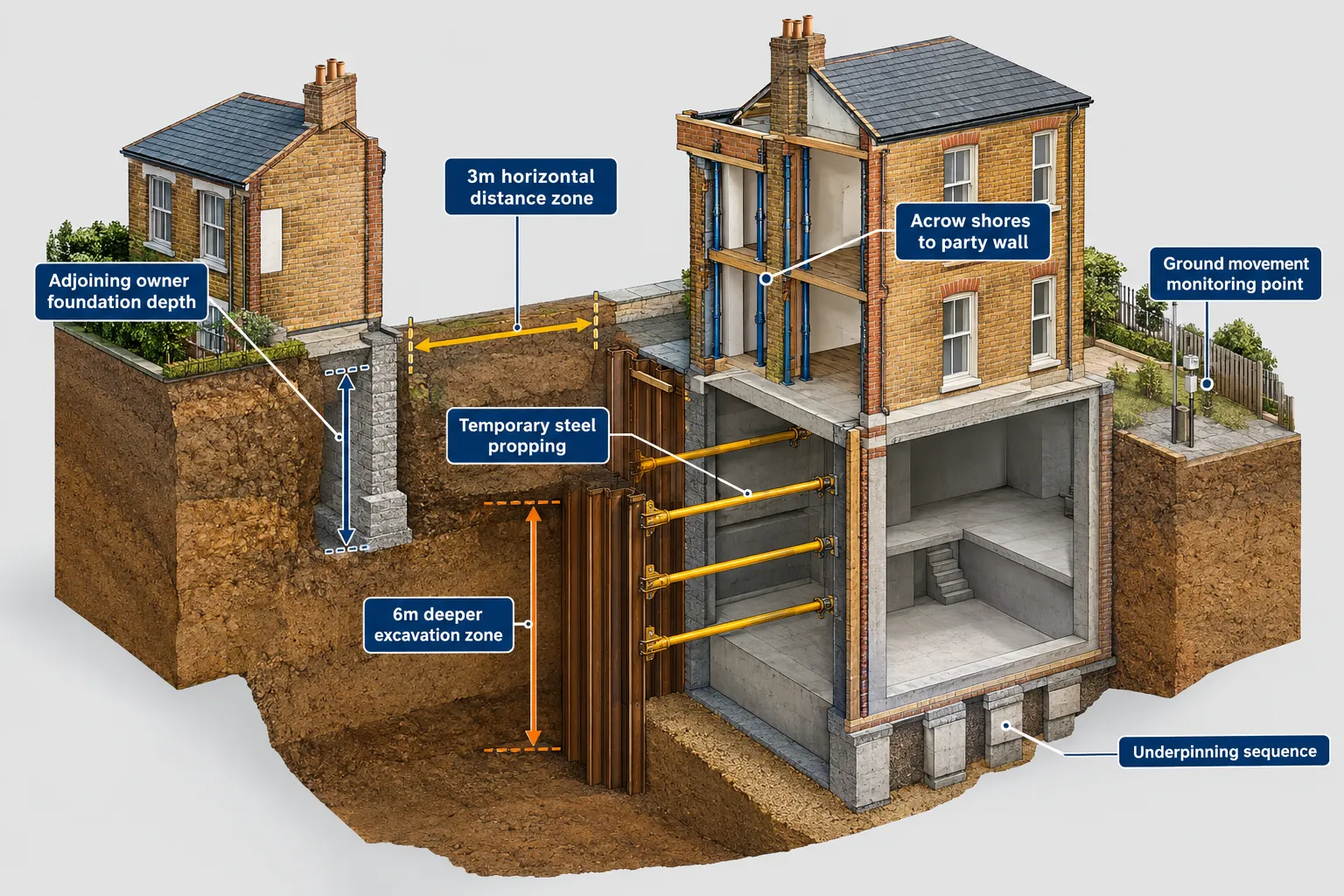
Removing soil adjacent to a neighbour's foundation removes lateral support. Even where the excavation does not technically undercut the neighbour's foundations, ground movement, settlement, heave or vibration, can cause cracking to walls, floors and finishes in the adjoining property. The risk is heightened in London's clay soils, which shrink and swell with moisture content, and in areas with older, shallower foundations [4].
The Act imposes a duty on the building owner not to cause unnecessary inconvenience and to make good any damage caused [1]. In practice, the Award is the instrument that translates this duty into specific, enforceable obligations.
Temporary Works as Core Award Content
Until relatively recently, some Awards for basement projects dealt with temporary works only in passing. Since 2024, the industry trend has moved firmly toward treating propping, shoring and ground support as core Award content rather than an afterthought. A well-drafted Award for a basement project should address:
- Method statement, the sequence of excavation, the type of temporary support (acrow props, king post walls, contiguous piled walls) and the timing of each stage.
- Temporary propping to the party wall, where the basement extends under or adjacent to a shared wall, the Award should specify the propping arrangement and who is responsible for maintaining it.
- Vibration and noise limits, particularly relevant where percussive piling or breaking-out of existing foundations is involved.
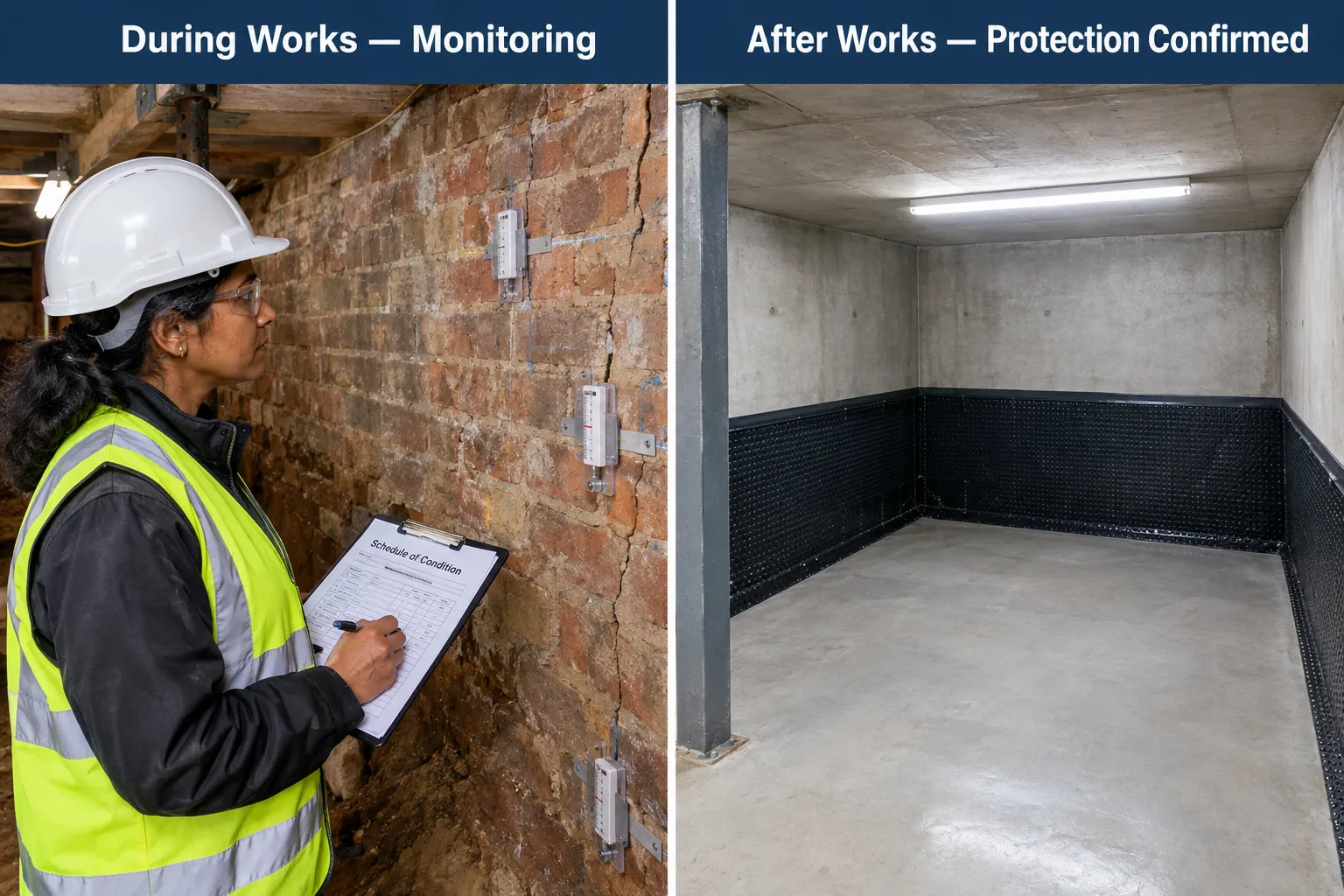
- Ground movement monitoring, crack monitors, precise levelling datums or digital tilt sensors fixed to the adjoining structure, with agreed trigger levels that halt works if exceeded.
- Access provisions, the surveyor may need to inspect the adjoining property during works; the Award should specify notice periods and frequency.
- Reinstatement obligations, what happens if damage occurs, including the process for agreeing remedial works.
A surveyor who does not address these points in a basement Award is not serving either party well. The adjoining owner is left without enforceable protection; the building owner is left exposed to an open-ended liability claim.
The Schedule of Condition
Before any excavation begins, a detailed schedule of condition of the adjoining property should be prepared, ideally with photographs, video and written notes covering walls, ceilings, floors and drainage [7]. This is not strictly required by the Act but is standard practice and is almost always included as a requirement within the Award. Without it, any claim that a crack was caused by the basement works becomes a matter of assertion rather than evidence [8].
For projects involving structural works to the party wall itself, a structural survey in London of the adjoining property may be warranted before the schedule is finalised.
Neighbour Protection: Rights, Remedies and Practical Safeguards
What the Adjoining Owner Is Entitled To
The Act gives adjoining owners a set of substantive rights, not merely a right to be notified [1]:
- The right to appoint their own surveyor at the building owner's expense.
- The right to require the building owner to provide security for expenses if there is a reasonable concern about the building owner's ability to pay for remediation.
- The right to have a schedule of condition prepared before works start.
- The right to compensation for damage caused by the works.
- The right to have the Award set out the working hours and methods to be used.
These rights are exercised through the surveyor process. An adjoining owner who simply objects without engaging the process has no mechanism to stop the works; the correct response is to appoint a surveyor and engage with the Award [2].
When Works Start Without Notice
If a building owner begins excavation without serving any notice, the adjoining owner can apply to the county court for an injunction [1]. This is a serious step and courts have granted injunctions in these circumstances. The building owner may also face an order to open up completed works for inspection, which in a basement context can be extremely costly.
If a neighbour has already started work without serving notice, the neighbour started work without a party wall agreement guidance sets out the practical steps available.
Monitoring During Works
Ground movement monitoring is the most direct form of neighbour protection during active excavation. The surveyor should specify:
- The type of monitor (crack gauge, precise level point, tilt meter).
- The frequency of readings (typically weekly during active excavation, monthly thereafter).
- The trigger levels at which the contractor must stop and notify the surveyor.
- Who holds the monitoring data and how it is shared.
Local authority guidance in boroughs such as Kensington and Chelsea places particular emphasis on ground movement controls for basement works, reflecting the density of adjoining properties and the age of the existing building stock [4].
Common Points of Dispute
| Issue | Building Owner Position | Adjoining Owner Position |
|---|---|---|
| Working hours | Maximum flexibility for programme | Restricted to core hours, no weekends |
| Monitoring frequency | Monthly readings sufficient | Weekly or continuous during excavation |
| Access for inspection | 48 hours' notice | Right of access on reasonable notice |
| Security for expenses | Not warranted | Required given project scale |
| Reinstatement standard | Like-for-like repair | Full restoration to pre-works condition |
A competent surveyor navigates these positions and produces an Award that is fair, enforceable and proportionate to the actual risk of the project.
Practical Steps for Building Owners Planning a Basement
- Appoint a party wall surveyor early, before finalising the basement design, so the surveyor can advise on notice requirements and potential Award conditions that may affect the construction method.
- Commission a structural engineer's method statement, the surveyor will need this to draft meaningful Award conditions on temporary works.
- Identify all adjoining owners, check the title register and any leases; do not assume only the immediate neighbour is affected.
- Serve notices with adequate drawings, depth sections, foundation details and proposed excavation lines must be included.
- Allow the full notice period, do not start work before the notice period expires and the Award is issued.
- Prepare the schedule of condition, agree this with the adjoining owner's surveyor before the first excavation.
- Maintain records throughout, keep monitoring data, site diaries and photographs; these are the building owner's defence against unfounded claims.
For owners in South West London, party wall surveyors in South West London can advise on local practice and borough-specific requirements. For North London projects, party wall surveyors in North London covers the relevant geographic area.
FAQ: Party Wall Surveyor for Basement Works
Does planning permission replace the need for party wall notices?
No. Planning permission and the Party Wall etc. Act 1996 are entirely separate regimes. A planning consent does not discharge any obligation under the Act [1].
What if my basement does not go below my neighbour's foundations?
Section 6 applies if the excavation is within 3 m of the neighbour's structure and goes deeper than their foundations, or within 6 m where the 45-degree line is breached [9]. If neither condition is met, Section 6 does not apply, but Section 2 may still apply if the works affect the party wall itself.
Can I use an agreed surveyor for a basement project?
Yes, provided both parties genuinely consent to the arrangement and the surveyor is experienced in basement works. Given the complexity of basement Awards, both parties should satisfy themselves that the agreed surveyor has relevant experience [2].
What does a party wall Award cost for a basement project?
Fees vary by project complexity and location. A basement Award in London typically costs more than a standard loft conversion Award because of the additional method statement review, monitoring provisions and schedule of condition work involved. See party wall surveyor fees across the UK for current benchmarks.
What happens if damage occurs despite the Award?
The adjoining owner should notify the building owner's surveyor immediately. The Award will set out the process for agreeing remedial works. If the parties cannot agree, the matter returns to the surveyors and, if necessary, the third surveyor [1].
How long does the party wall process take for a basement?
Allow a minimum of six to eight weeks from first instruction to an issued Award on a straightforward basement project. Complex projects, particularly those involving underpinning or works on both sides of a property, can take longer [8].
Is a schedule of condition legally required?
The Act does not make it mandatory, but the Award almost always requires one. Proceeding without one leaves both parties in a worse evidential position if a dispute about damage arises later [7].
Conclusion
Basement projects carry a level of structural and legal complexity that makes the party wall process more demanding than for most other domestic works. The risks, loss of support, ground movement, damage to adjoining foundations, are real and can be costly to remediate if not managed from the outset.
The right approach is to appoint an experienced party wall surveyor before the design is finalised, serve notices with proper drawings, and ensure the resulting Award addresses temporary works, monitoring and access in specific, enforceable terms. Adjoining owners should appoint their own surveyor promptly and engage constructively with the process rather than simply objecting.
For anyone planning a basement in 2026, the practical next steps are: identify all adjoining owners, commission a structural engineer's method statement, and instruct a party wall surveyor with demonstrable basement experience as early as possible. The cost of doing this properly is modest compared with the cost of an injunction, a mid-excavation dispute or an unresolved damage claim.
For further questions on the party wall process, the party wall Act questions resource covers a wide range of common scenarios.
References
[1] The Party Wall Etc Act 1996 Explanatory Booklet – gov.uk
[2] Party Walls – rics.org
[3] Work Tell Your Neighbour About – gov.uk
[4] Party Walls – rbkc.gov.uk
[7] My Neighbour Is Doing Work – partywall.info
[8] The Party Wall Act Explained – fandt.com
[9] Party Wall Section 6 Explained The 3m 6m Excavation Rules – ansteyhorne.co.uk