A reported 40% surge in party wall disputes in 2026 has pushed the issue firmly onto the radar of homeowners, developers, and property professionals across England and Wales [1][2]. Rising construction activity, a wave of basement and loft conversion projects, and tighter urban development are all contributing to a climate where neighbour conflicts over shared walls are becoming more frequent, more expensive, and harder to resolve without professional help.
The Party Wall etc. Act 1996 has not changed. What has changed is the expectation around compliance, the sophistication of disputes, and the professional standards that surveyors are now held to [4][10]. Understanding why party wall disputes are up in 2026 and how early surveyor involvement and correct notices prevent costly neighbour conflicts is no longer optional knowledge for anyone planning building work near a shared boundary.
Key Takeaways
- Party wall disputes have reportedly risen by around 40% in 2026, driven by increased construction activity and complex excavation works.
- Serving the correct notice at the right time is the single most effective way to prevent a dispute from escalating.
- Early surveyor involvement, ideally before a notice is even served, is now promoted as best practice under updated RICS guidance.
- A party wall award issued by surveyors is far faster and cheaper than court litigation.
- Absent or defective notices expose building owners to injunctions, compensation claims, and significant delays.
Why Party Wall Disputes Are Up in 2026
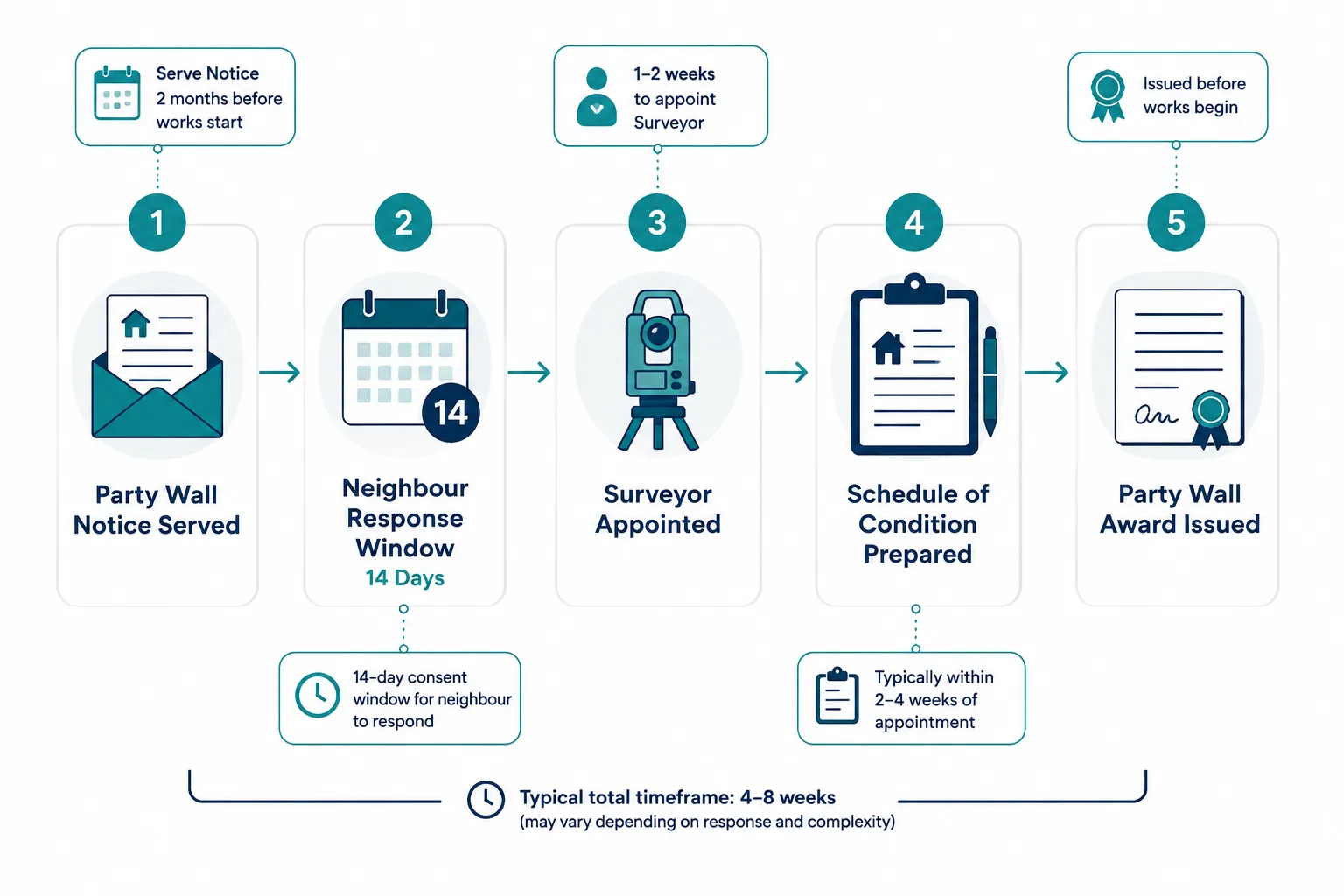
The construction landscape in 2026 has created near-perfect conditions for neighbour conflict. Homeowners are extending upward with loft conversions, digging down for basement rooms, and retrofitting insulation into shared walls. Each of these activities can trigger obligations under the Party Wall etc. Act 1996, and many building owners are either unaware of those obligations or choose to ignore them [7].
Excavation and basement works have emerged as a leading source of disputes this year. Works that go deeper than the foundations of a neighbouring property, or within three metres of those foundations, require a formal notice under Section 6 of the Act. The 3-metre rule under the Party Wall Act is frequently misunderstood, with many owners assuming that only works touching the wall itself require notification.
Build-to-rent (BTR) developers and larger residential schemes are also driving a systemic increase in disputes. These operators now manage party wall compliance at portfolio level, but their scale means that any procedural error affects multiple adjoining owners simultaneously [2]. Consumer awareness has also risen, meaning more adjoining owners are challenging defective notices or demanding formal awards where previously they might have stayed silent.
Key drivers of the 2026 dispute surge:
- Increased loft conversions and rear extensions in dense urban areas
- Growth in basement and sub-structure excavation projects
- Retrofit and insulation works affecting shared walls
- Greater consumer awareness of party wall rights
- Build-to-rent development at scale
"The increase in disputes is not primarily a legal problem, it is a communication and procedure problem. Most conflicts could be prevented by a single early conversation and a correctly served notice."
What the Party Wall Act Actually Requires
Understanding the Act is the foundation of dispute prevention. The Party Wall etc. Act 1996 covers three distinct categories of work:
| Section | Work Type | Notice Required |
|---|---|---|
| Section 1 | New wall on or at the boundary | Party Structure Notice |
| Section 2 | Works to an existing party wall or structure | Party Structure Notice |
| Section 6 | Excavation within 3m or 6m of a neighbour's foundations | Notice of Adjacent Excavation |
Each notice type has specific timing requirements. A Party Structure Notice under Section 2 must be served at least two months before work begins. A Section 6 notice requires at least one month's notice. Failure to serve the correct notice, or serving it too late, does not make the work illegal outright, but it exposes the building owner to injunctions, forced stoppage of works, and compensation claims [6][8].
For anyone unsure whether their project triggers these requirements, the starting point is understanding whether a party wall agreement is needed and when the Act applies. Many homeowners are surprised to find that even internal works, such as party wall insulation, can engage the Act if they affect a shared structure.
What Happens When No Notice Is Served
Proceeding without a notice is one of the most costly mistakes a building owner can make. The adjoining owner can apply to the county court for an injunction to stop the works. Courts have consistently granted these injunctions even where works are partially complete, leaving building owners facing expensive delays and legal costs [3].
If damage occurs to the adjoining property and no notice was served, the building owner loses the procedural protections the Act provides. They face direct liability in tort, without the structured compensation framework that a party wall award would have provided. The consequences of no party wall notice being served are severe and well-documented.
How Early Surveyor Involvement Prevents Costly Conflicts
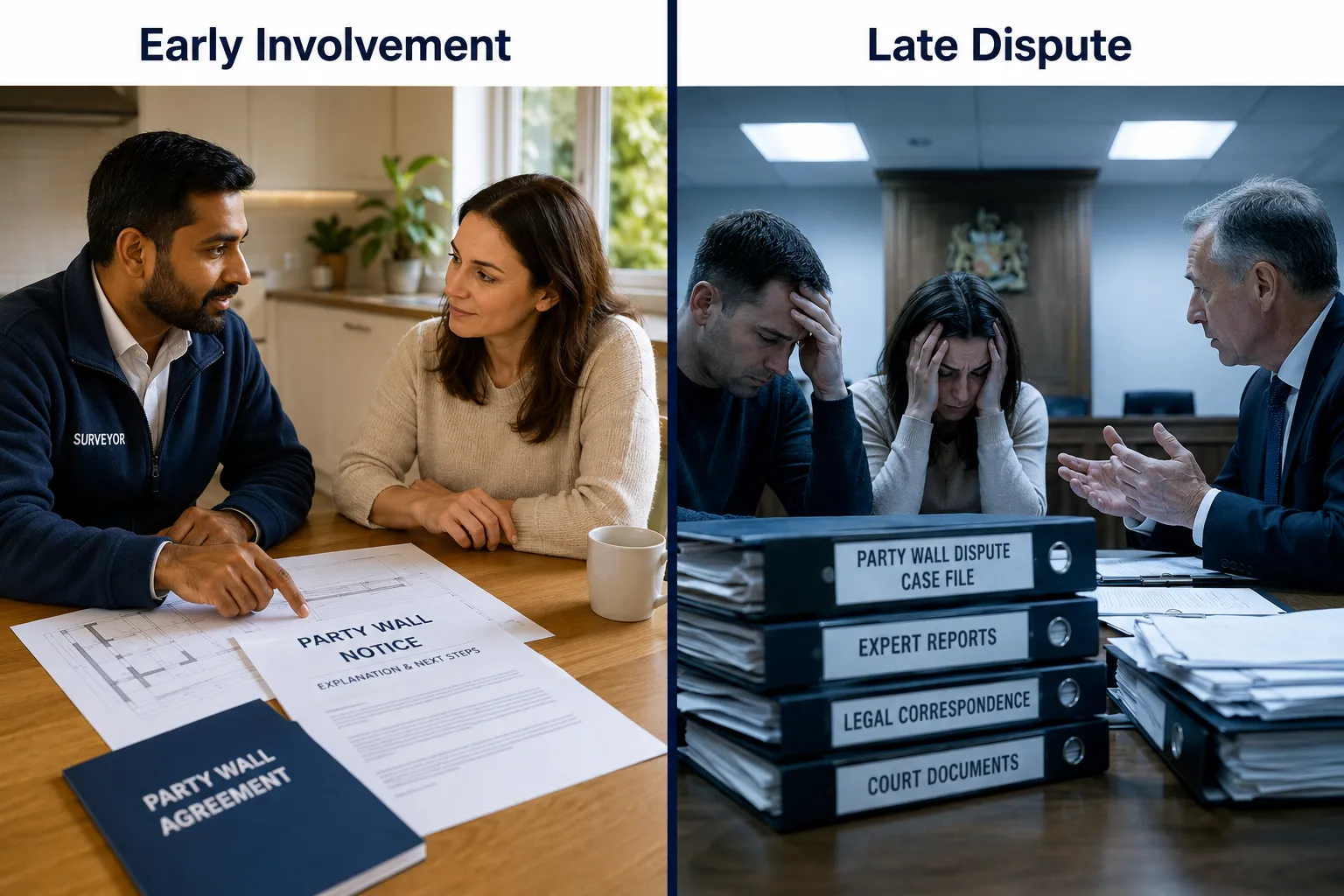
The updated RICS 8th Edition party wall guidance, which sets the professional standard for surveyors in 2026, explicitly promotes early surveyor involvement as best practice [4][5]. This represents a meaningful shift from a reactive model, where surveyors were brought in only after a dispute arose, to a proactive model where they help prevent disputes from forming in the first place.
What early involvement looks like in practice:
- Pre-notice consultation with the building owner to identify all notifiable works
- Review of drawings and structural engineer's reports before notices are drafted
- Informal communication with the adjoining owner before formal notices are served
- Preparation of a party wall schedule of condition before works begin
- Agreement on an agreed surveyor appointment where both parties are willing
The agreed surveyor route is particularly relevant in 2026. Where both the building owner and adjoining owner consent, a single surveyor can act for both parties, reducing costs and timescales significantly. This approach is detailed in the complete guide to streamlining party wall procedures with an agreed surveyor.
The Role of Informal Pre-Notice Consultation
For retrofit and energy efficiency works in 2026, informal pre-notice consultation has become strongly recommended practice [2]. Many retrofit projects involve works to shared walls that the adjoining owner has not anticipated. A brief, informal conversation before a formal notice arrives can transform a potential dispute into a cooperative process.
This does not replace the formal notice. It supplements it. The legal protections of the Act only apply once a valid notice has been served and the statutory process has been followed. Informal agreement alone provides no protection if something goes wrong during construction.
Surveyor-Led Awards vs Court Litigation
When a dispute does arise, the Act provides a structured resolution mechanism through the appointment of surveyors and the making of a party wall award. This process is almost always faster and cheaper than court litigation [3][10].
A party wall award sets out:
- The works permitted and the method of carrying them out
- Hours of working and access arrangements
- Security for expenses, where appropriate
- Compensation for any loss or inconvenience
Appeals against a party wall award must be made to the county court within 14 days of the award being served. This strict window means that parties who fail to act quickly lose their right to challenge the award entirely [10]. The party wall award process in London and Surrey follows this framework precisely.
Serving Correct Notices: A Practical Guide for 2026
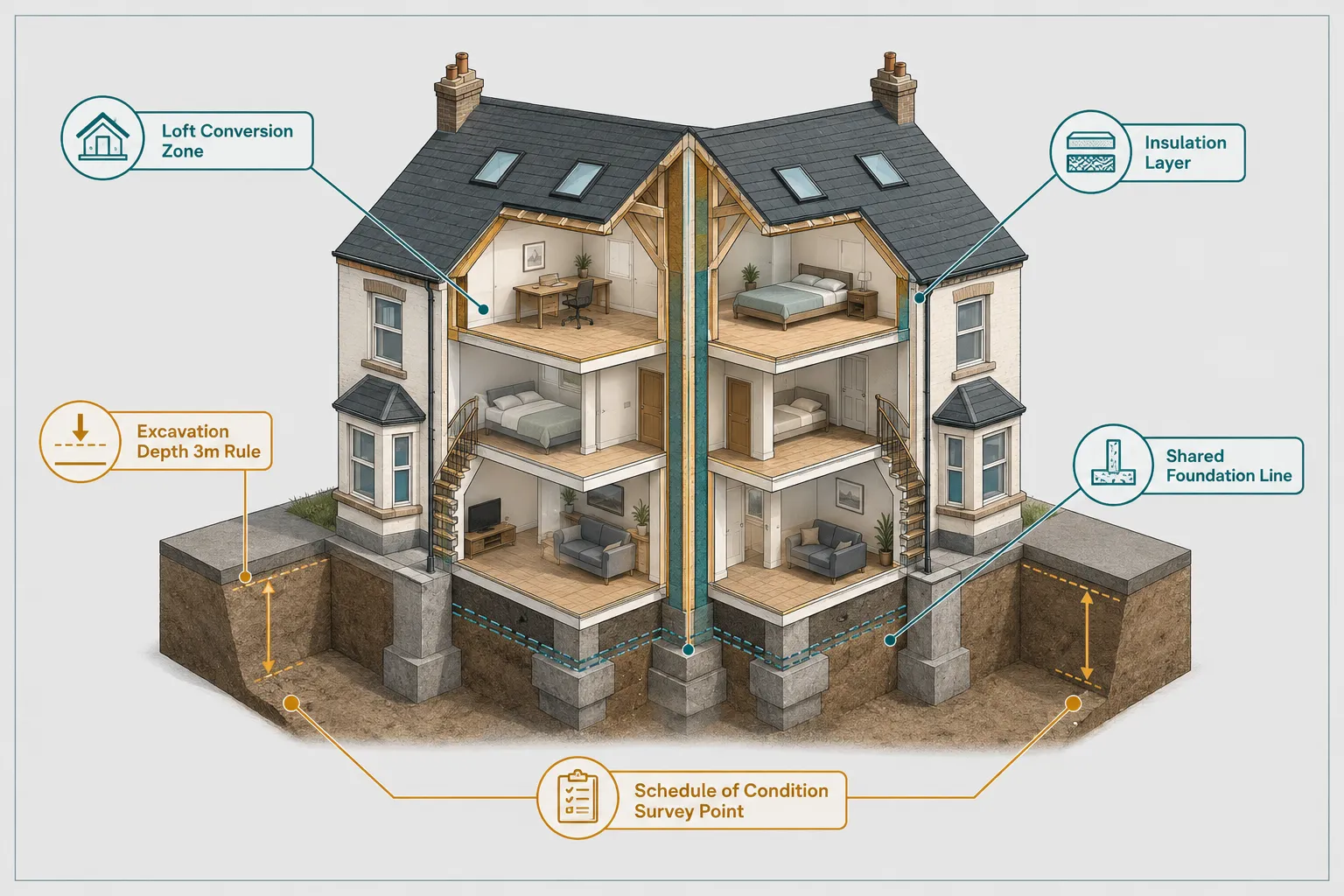
Correct notice service remains the central mechanism for avoiding disputes. A defective notice, one that is served too late, on the wrong person, or without the required information, is treated as no notice at all. The adjoining owner can then dispute the works on procedural grounds alone, regardless of the merits of the underlying project [6][8].
What a Valid Notice Must Include
- Full name and address of the building owner
- Description of the proposed works, with sufficient detail
- The date on which works are proposed to begin
- A statement of the adjoining owner's rights under the Act
- For Section 6 notices: plans and sections showing the depth and location of excavation
The adjoining owner then has 14 days to respond in writing. They can consent, which allows works to proceed without a formal award. They can dissent, which triggers the appointment of surveyors. Or they can do nothing, in which case a dispute is deemed to have arisen automatically after 14 days [8].
Common Notice Errors to Avoid
| Error | Consequence |
|---|---|
| Notice served too late | Works cannot start on planned date |
| Wrong section used | Notice invalid; process must restart |
| Incomplete description of works | Adjoining owner can challenge validity |
| Notice served on tenant not freeholder | Invalid; freeholder is the adjoining owner |
| No plans attached for Section 6 works | Notice defective |
For loft conversions with party wall implications, the notice must clearly describe any works to the party wall itself, including the insertion of beams, raising of the wall, or any cutting into the shared structure. Vague descriptions are a frequent source of challenge.
What Adjoining Owners Should Do
Adjoining owners who discover that a neighbour has started work without serving a notice are not without options. The Act provides recourse, and a surveyor can be appointed to protect their interests even after works have begun. The practical steps for what to do when a neighbour is carrying out party wall work without notice are well established and should be followed promptly.
Mediation, Communication, and 2026 Practice Trends
The professional community in 2026 has increasingly embraced mediation-style techniques alongside the formal statutory process [1][2]. Surveyors are now expected to facilitate communication between parties, not merely adjudicate on technical matters. The RICS guidance reinforces this, positioning the surveyor as a neutral professional whose primary obligation is to the Act itself, not to the party who appointed them [4][10].
This shift matters because many disputes are not fundamentally about the law. They are about trust, communication, and the fear of damage to a home. A surveyor who engages early, explains the process clearly, and addresses concerns proactively can resolve in days what might otherwise take months.
Practical communication steps that reduce dispute risk:
- Introduce the project to the adjoining owner before serving formal notices
- Provide a plain-English summary of what the works involve and how long they will take
- Offer to arrange a joint inspection of the adjoining property before works start
- Agree on a single point of contact for queries during the construction period
- Share the schedule of condition report with the adjoining owner
Conclusion
Party wall disputes are up in 2026, and the trend shows no sign of reversing while construction activity remains high and urban density continues to increase. The good news is that the vast majority of disputes are preventable. The Party Wall etc. Act 1996 provides a clear, well-tested framework. The professional standards set by RICS in 2026 provide practical guidance on how to apply that framework effectively [4][5][10].
Actionable next steps for building owners:
- Identify all notifiable works before finalising your project programme
- Engage a qualified party wall surveyor at least three months before planned works begin
- Serve the correct notice type, to the correct person, with the correct information and timing
- Consider the agreed surveyor route where relations with the adjoining owner are cooperative
- Commission a schedule of condition before any works start to protect against unfounded damage claims
For adjoining owners:
- Respond to any party wall notice within 14 days, silence triggers a dispute automatically
- Seek independent surveyor advice before consenting to or dissenting from a notice
- If works have already started without notice, contact a party wall surveyor immediately
The cost of getting this right is modest. The cost of getting it wrong, injunctions, legal fees, damaged relationships, and construction delays, can run into tens of thousands of pounds. Early, professional, and properly documented engagement with the party wall process is not a bureaucratic burden. It is the most effective form of dispute insurance available.
References
[1] Podcast Insights Resolving Party Wall Issues With Surveyors Before They Escalate In 2026 – princesurveyors.co.uk
[2] Handling Party Wall Disputes In 2026 Retrofit Projects Rics Standards And Award Essentials Post Quality Summit – partywallsurveyorlondon.uk
[3] Expert Witness Roles In Party Wall Disputes Leveraging 2026 Survey Tech For Courtroom Success – partywallsurveyorlondon.uk
[4] Rics 8th Edition Party Wall Guidance – hudsonpartywallsurveyors.co.uk
[5] Rics 8th Edition Party Wall Guidance Building Safety Levy London 2026 What Every Building Owner Must Know – princesurveyors.co.uk
[6] Party Walls – rics.org
[7] London Party Wall Extensions 2026 Rules Disputes And Neighbour Rights Explained – princesurveyors.co.uk
[8] Rics Consumer Guide Party Walls – ricsfirms.com
[9] Boundary Disputes – qredible.co.uk
[10] Party Wall Legislation And Procedure – rics.org