
A net balance of −4% on construction workloads in Q2 2026, up from −12% just three months earlier, tells a precise story: the UK construction sector is still contracting, but the floor appears to be in [1][4]. For homeowners, investors and developers deciding whether to proceed with a new build or refurbishment right now, that statistical nuance matters enormously. A market that is past its worst but not yet recovering is exactly the environment in which cutting corners on due diligence carries the highest risk. Building surveys in a cooling but stabilising UK construction market: risk-checking new builds and refurbishments in mid-2026 is therefore not just a professional formality, it is a financially critical decision.
Key Takeaways
- UK construction workloads remain in negative territory in mid-2026 but are improving, with the RICS net balance rising from −12% in Q1 to −4% in Q2 2026.
- Material cost inflation, Building Safety Regulator delays and contractor distress are live delivery risks that building surveys must now explicitly address.
- New-build quality issues remain widespread, with 93.7% of buyers reporting defects after moving in, making independent snagging surveys essential.
- The Building Safety Act 2022 extends limitation periods to 15 years (forward-looking) and 30 years (retrospective), raising the legal stakes for both new builds and refurbishments.
- A Level 3 building survey remains the most comprehensive risk-checking tool available to buyers and developers in the current market.
Understanding the Mid-2026 Construction Market Landscape
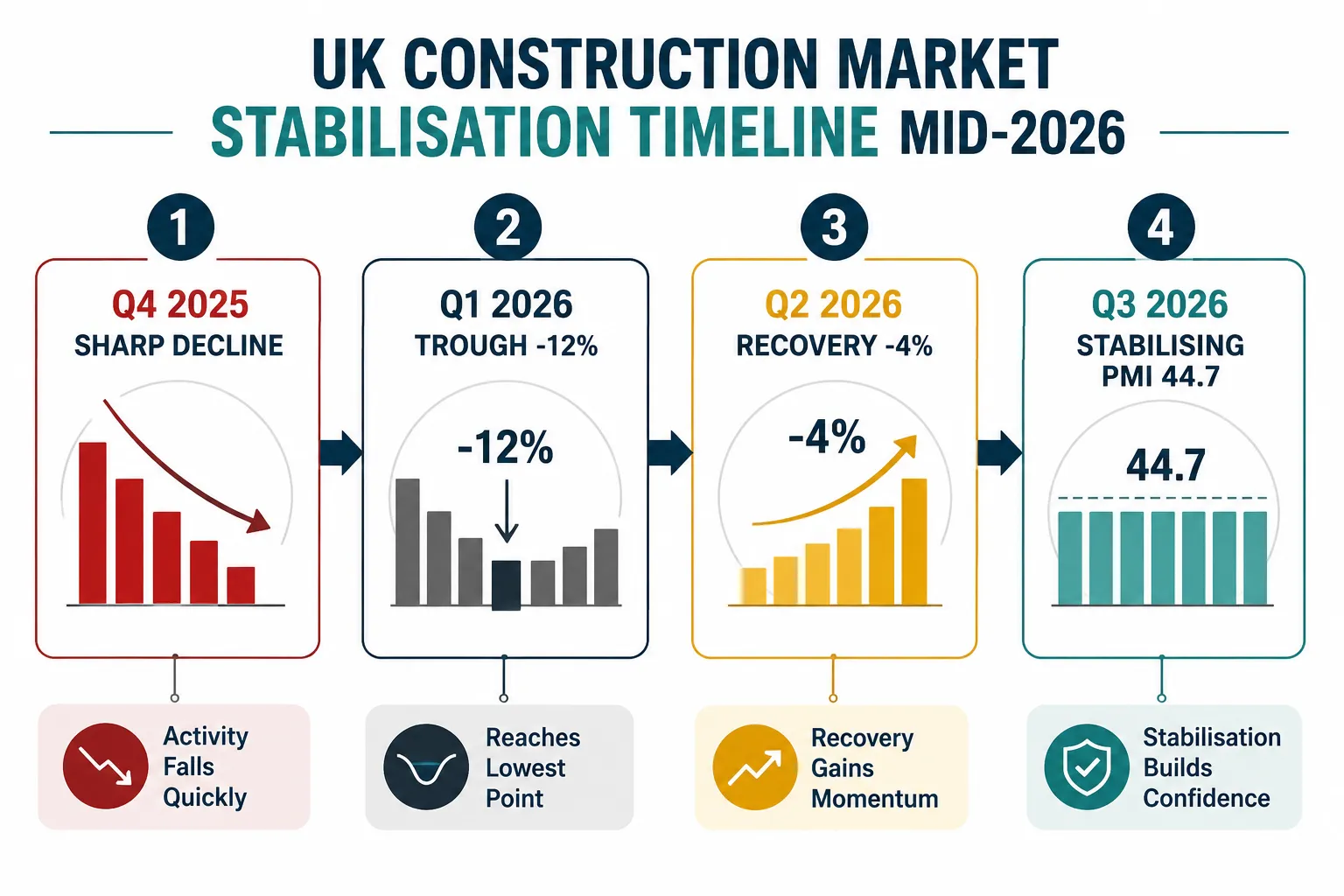
The headline numbers paint a picture of a sector that has absorbed the worst of its downturn and is beginning, cautiously, to find its footing. The RICS UK Construction Monitor for Q2 2026 recorded a net balance of workloads at −4%, a meaningful improvement on the −12% recorded in Q1, and respondents expressed "modestly positive" expectations for future workloads [1][4]. The Purchasing Managers' Index reinforces this reading: the UK construction PMI rose sharply to 44.7 in July 2026 from 38.4 in June, with market analysts noting that July data "suggest the performance of the UK construction sector has started to stabilise after a sharp downturn throughout the second quarter" [4]. The 50.0 growth threshold has not been crossed, but the direction of travel has changed.
Official output statistics from the Office for National Statistics add further texture. Total construction output grew by 0.3% in Q2 2026 versus Q1, with new work up 0.4% and repair and maintenance up 0.2% [7]. Monthly output dipped slightly in June (−0.1%), but the quarterly trend is one of stabilisation rather than continued decline [7].
The picture by segment is uneven, and that unevenness directly shapes survey risk profiles:
| Segment | Mid-2026 Direction | Key Risk Factor |
|---|---|---|
| Infrastructure | Positive growth | Programme overruns |
| Public-sector frameworks | Broadly stable | Procurement delays |
| Private housing | Weakest component | Contractor distress, BSR delays |
| Commercial | Contracting | Cost inflation, weakened demand |
| Repair and maintenance | Flat to modest growth | Defect liability exposure |
Infrastructure remains the only segment with positive growth in early 2026, while private housing is the weakest component of workloads [1][3]. Independent forecasters describe 2026 as a shallow trough before a stronger rebound: Glenigan's Summer 2026 Construction Forecast anticipates a circa 1% decline in construction activity in 2026 followed by an 11% rebound in 2027 [9]. Arcadis' Summer 2026 Market View notes relatively subdued tender price inflation due to weaker workloads, though regulatory and inflation uncertainty remain elevated [9].
Material costs add a further layer of constraint. Government building-materials statistics show deliveries of bricks down 16.3% and concrete blocks down 12.3% in June 2026 compared with June 2025, while the "All Work" materials price index rose 6.0% year-on-year [8]. Total construction output is projected to grow only around 2.4% in 2026 before accelerating to 4.3% in 2027 and 5.0% in 2028 [8].
The takeaway for survey clients: A stabilising but still-stressed market means contractors are under financial pressure, material supply chains remain disrupted, and quality control can suffer. This is precisely the environment in which an independent building survey provides its greatest value.
Why Building Surveys in a Cooling but Stabilising UK Construction Market Are More Important Than Ever
The Regulatory Landscape Has Fundamentally Changed
The Building Safety Regulator (BSR) is no longer a background compliance consideration, it is a live delivery factor for any higher-risk building. Official data on building-control approval applications for May, July 2026 show a median approval time of 22 weeks and 7,587 units approved [6]. For developers and buyers alike, that 22-week median represents a significant programme risk that a thorough pre-purchase or pre-construction survey can help to anticipate and manage.
The mid-rise and high-rise remediation pipeline remains substantial. A July 2026 government technical note estimates between 2,800 and 3,700 mid-rise (11-18m) residential buildings with or having had unsafe external wall systems requiring remediation or mitigation [6]. From April 2026, developers must report remediation progress separately for cladding and non-cladding defects. Proposals for hard statutory deadlines require remediation of higher-risk buildings over 18m by 2029 and mid-rise buildings by 2031 [6]. Any survey on an existing residential building in this height range must now explicitly assess cladding system compliance and the status of any remediation programme.
For building surveys in London and other major urban centres, where mid-rise and high-rise stock is concentrated, this regulatory context is not optional background reading, it is central to the survey brief.
Legal Exposure Has Extended Dramatically
The Building Safety Act 2022 and the Defective Premises Act 1972 together create a legal environment in which defect claims can now be pursued over much longer periods than was previously possible. The regime provides:
- A 15-year forward-looking limitation period for work completed after 28 June 2022
- A 30-year retrospective period for earlier work
- Extended scope bringing refurbishments and other work to existing dwellings within the Defective Premises Act
Developers of new homes will also be required to provide a minimum 15-year new-build warranty once the relevant measures are fully in force [6]. A First-tier Tribunal decision in July 2026 confirmed that the statutory test under the Building Safety Act is a single-stage assessment: if works give rise to a risk to the safety of people from the spread of fire or structural collapse, that is sufficient to meet the threshold [6]. This ruling pushes professionals to ensure that building surveys explicitly identify such risks and assess the adequacy of mitigation measures.
For anyone involved in a construction dispute or defect claim, the quality and completeness of a building survey report can be the difference between a successful and an unsuccessful case. Consulting a construction expert witness in London at an early stage is advisable where significant defects are identified.
New-Build Quality: The Numbers Are Still Alarming
Evidence taken by a UK parliamentary committee in mid-2026 reports that 93.7% of new-build home purchasers reported defects or snags to their developer after moving in, with over 26% reporting more than 15 problems [6]. Recurring issues include:
- Structural defects
- Faulty fire-safety equipment
- Damp and mould linked to poor material storage and inadequate ventilation design
Industry analysis of NHBC data up to December 2025 notes that the average number of reportable items per home at legal completion has fallen by 34% compared with a 2021 baseline [6]. That improvement is real, but it still leaves a large proportion of new homes with multiple defects at handover. Independent snagging surveys remain a significant tool for managing residual quality and warranty risk.
Reviewing the 10 most common property defects found in building surveys provides a useful baseline for understanding what to look for before committing to a purchase.
Risk-Checking New Builds and Refurbishments in Mid-2026: A Practical Framework
Choosing the Right Survey Level
The RICS survey framework offers three levels of inspection, and selecting the right one for the current market conditions is essential:
Level 1 (Condition Report): Suitable only for straightforward, modern properties in good condition. Given the current prevalence of defects in new builds, this level is rarely appropriate for new-build purchases.
Level 2 (Homebuyer Survey): A mid-range inspection that identifies significant defects and maintenance issues. Understanding how much a Level 2 survey costs is a useful starting point for budget planning, but in a market where contractor quality is under pressure, the limitations of this level should be understood.
Level 3 (Building Survey / Full Structural Survey): The most comprehensive option, covering construction, condition, defects, and maintenance requirements in detail. For any property with complexity, whether a new-build with potential snagging issues or a refurbishment with structural alterations, a Level 3 survey is the appropriate choice. Understanding structural survey costs in 2026 helps set realistic expectations before instructing a surveyor.
Specific Risk Areas for New Builds in Mid-2026
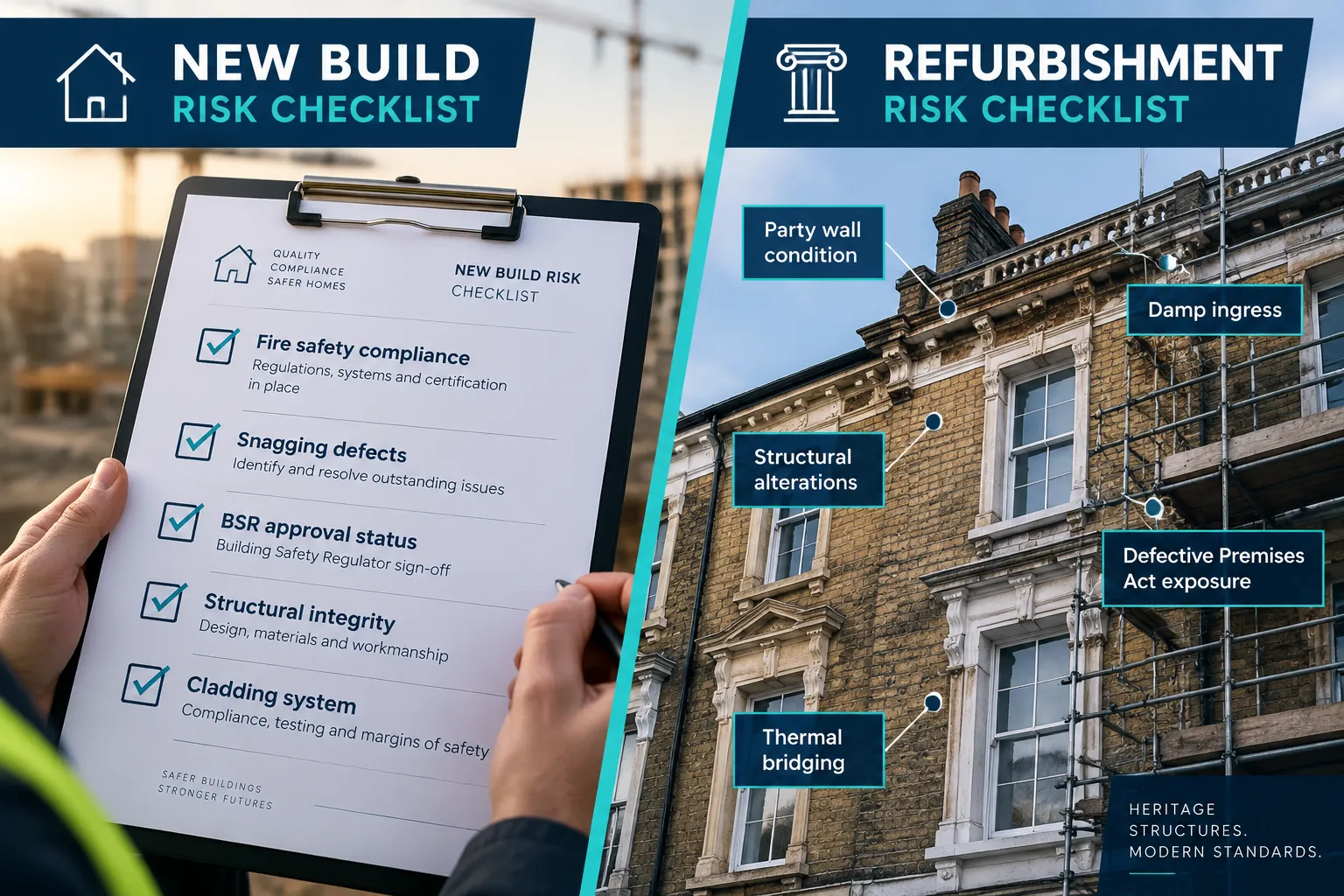
The combination of material cost pressures, skills shortages, and contractor financial distress creates specific defect risks in new-build properties completed in 2025-2026:
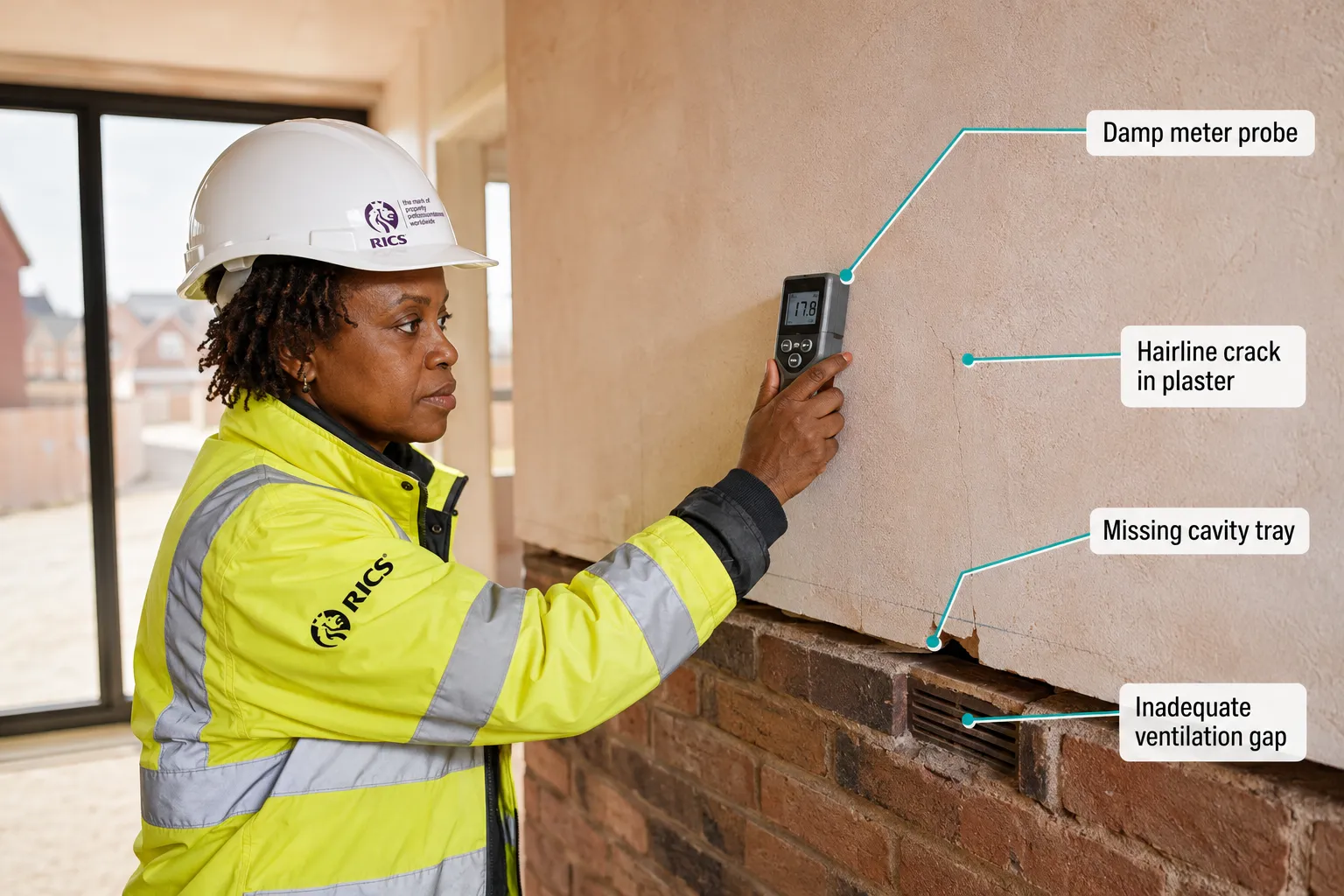
- Damp and moisture ingress from materials stored inadequately on site during prolonged construction programmes
- Inadequate ventilation design leading to condensation and mould growth
- Fire compartmentation failures where cost-cutting has affected passive fire protection installation
- Structural deficiencies at junctions and interfaces between different trade packages
- BSR compliance gaps on higher-risk buildings where approval processes have been rushed
A damp survey in London should be considered as a specialist follow-up where a Level 3 survey identifies moisture-related concerns.
Specific Risk Areas for Refurbishments in Mid-2026
Refurbishment projects carry a distinct set of risks in the current market, shaped by both the physical complexity of working within existing structures and the expanded legal framework:
- Party wall issues arising from adjacent works or alterations to shared structures, understanding what happens when a neighbour builds without a party wall agreement is essential for anyone commissioning or affected by refurbishment works
- Structural alterations carried out without proper design or building control sign-off
- Cladding and external wall systems on mid-rise buildings requiring assessment against current fire safety standards
- Defective Premises Act exposure for work completed before the current owner's tenure
- Subsidence and ground movement in properties where adjacent construction has disturbed foundations, a subsidence checklist from a surveyor's perspective provides a useful pre-survey reference
What a Comprehensive Survey Report Should Cover in 2026
Given the regulatory and legal context described above, a building survey commissioned in mid-2026 should explicitly address:
- Structural integrity, including foundations, roof structure, and any evidence of movement
- Fire safety compliance, particularly for buildings within BSR scope, including cladding system identification and compartmentation
- Damp, drainage and ventilation, covering both existing defects and design risks
- Building Safety Act and Defective Premises Act exposure, flagging any features that could give rise to claims under the extended limitation periods
- Remediation status, for any mid-rise or high-rise building, confirming whether it is on a remediation scheme and the current programme status
- Material and workmanship quality, particularly for new builds, assessing whether construction standards meet the specification
A property survey checklist for London provides a practical tool for preparing for a survey instruction and ensuring nothing critical is omitted from the brief.
Instructing a Surveyor: Practical Steps for Mid-2026
The process of commissioning a building survey should be approached methodically. Understanding who organises the survey when buying a house is a common point of confusion, particularly for first-time buyers. In all cases, the buyer, not the seller or mortgage lender, should instruct an independent RICS-accredited surveyor.
Key steps when instructing a surveyor in mid-2026:
- Confirm the surveyor holds current RICS accreditation and carries professional indemnity insurance
- Specify the survey level required and provide any known information about the property's construction type, age, and any recent alterations
- For new builds, request that the surveyor addresses BSR compliance status and fire safety documentation explicitly
- For refurbishments, request assessment of any structural alterations and their building control history
- Ask for the report to address the Building Safety Act and Defective Premises Act context where relevant
- Obtain a clear fee quote, property survey services vary in scope and cost, and the brief should be agreed in writing before the inspection
Where a survey identifies significant defects, a schedule of condition report may be required to establish a baseline before works commence or to protect a party's position in a potential dispute.
Conclusion
The mid-2026 UK construction market is neither in freefall nor in full recovery. The RICS net balance improving from −12% to −4%, the PMI rising to 44.7, and quarterly output growing by 0.3% all point to a sector that has found a tentative floor [1][4][7]. But material cost inflation running at 6.0% year-on-year, brick deliveries down 16.3%, and contractor financial stress mean that the conditions for defects, both in new builds and refurbishments, remain elevated [8].
Against this backdrop, building surveys in a cooling but stabilising UK construction market: risk-checking new builds and refurbishments in mid-2026 represent the most reliable mechanism available for protecting buyers, investors and developers from costly surprises. The extended limitation periods under the Building Safety Act 2022, the BSR's 22-week median approval times, the 93.7% new-build defect rate, and the 2,800-3,700 mid-rise buildings requiring remediation all point in the same direction: independent, comprehensive survey due diligence is not a luxury in this market, it is a necessity.
Actionable next steps:
- Instruct a RICS-accredited surveyor for any new-build purchase, specifying a Level 3 survey and requesting explicit coverage of fire safety compliance and BSR status.
- For refurbishment projects, commission a pre-works survey to establish condition and identify structural, damp and fire-safety risks before works begin.
- Review the Building Safety Act and Defective Premises Act implications with a specialist where surveys identify potential inherent defects.
- Use a property survey checklist to prepare a thorough brief before instructing a surveyor.
- Where defects are identified post-completion, seek specialist advice from a construction expert witness to assess legal options under the extended limitation periods.
References
[1] Global Construction Monitor – rics.org
[2] Rics Uk Construction Monitor Q1 2026 – rics.org
[3] Construction Journal – ww3.rics.org
[4] Rics Uk Construction Monitor Q2 2026 – rics.org
[5] Rics Uk Construction Monitor Q1 2026 – rics.org
[6] Survey Reveals Modest Recovery In Second Quarter – housingview.co.uk
[7] Uk Construction Activity Tumbles Iran War Pushes Up Costs Rics Survey Shows 2026 05 06 – reuters.com
[8] Building Construction Insights – insitemagazine.co.uk
[9] Budget Preview – ww3.rics.org
[10] Economic And Construction Update – thefis.org