
Nearly 40% of party wall disputes in London blocks of flats in 2026 involve structural alterations that were started without a valid Party Wall Award in place — and the consequences range from injunctions to voided building insurance. For any leaseholder planning a steel beam installation, a new doorway, or a structural wall removal, understanding Party Wall Surveying for Structural Openings in Flats: Managing Freeholders, Leaseholders, and Building Management Constraints is not optional — it is the difference between a smooth project and a costly legal standoff. [1][2]
This guide cuts through the complexity of multi-ownership buildings, explains exactly who needs to be notified, and maps out the practical steps that experienced surveyors follow in 2026.
Key Takeaways 📋
- Structural openings in flats almost always trigger the Party Wall etc. Act 1996, requiring formal notices and often a Party Wall Award — even if the work feels entirely internal.
- Both freeholders and neighbouring leaseholders are typically "adjoining owners" under the Act and must be served notice separately.
- A freeholder's license to alter is legally distinct from a Party Wall Award — you need both, and neither substitutes for the other.
- Building management companies now impose additional conditions (time windows, deposits, insurance minimums) that can be mirrored inside the Party Wall Award itself.
- Allow at least 2–3 months from first notice service to Award in multi-flat situations, given current surveyor demand in 2026.
Why Structural Openings in Flats Are a Party Wall Minefield
Most flat owners assume that because a wall sits entirely within their demised space, it belongs to them alone. In leasehold blocks, that assumption is almost always wrong.
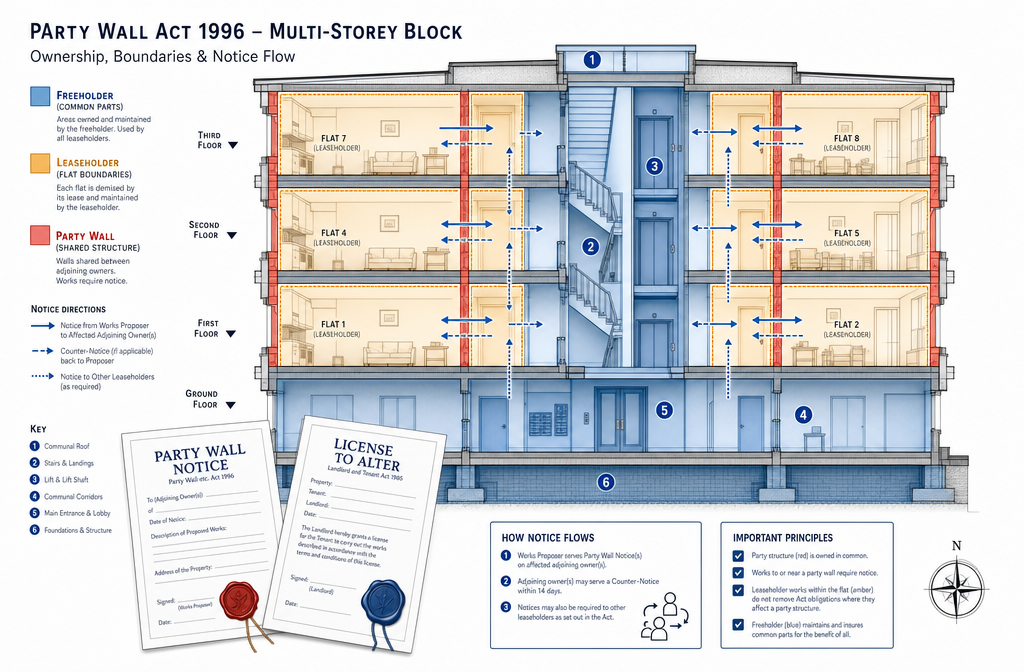
Under the Party Wall etc. Act 1996, a "party structure" includes any wall, floor, or ceiling that divides two separately owned or occupied spaces. In a typical block of flats, this means:
- The wall between your living room and your neighbour's bedroom is a party wall.
- The floor slab beneath your feet is a party structure shared with the flat below.
- Even an internal wall that bears load onto a shared beam or floor slab can engage the Act.
When a leaseholder forms a structural opening — whether for an RSJ steel beam, a wide doorway, or a kitchen-diner knock-through — the work almost certainly involves cutting into, loading, or weakening a party structure. That triggers the Act's notification requirements. [2][4]
The Leasehold Layer Makes It More Complex
In a freehold house, the party wall process involves two neighbours. In a leasehold flat, the picture is more complicated:
| Party | Role Under the Act | Why They Matter |
|---|---|---|
| Neighbouring leaseholder(s) | Adjoining Owner | Share the party wall or structure |
| Freeholder | Adjoining Owner (reversionary interest) | Owns the structure; retains structural liability |
| Building management company | Not a statutory party, but contractually powerful | Enforces lease conditions and building rules |
| Leaseholder doing the work | Building Owner | Initiates notice and bears costs |
Industry guidance consistently confirms that in leasehold blocks, notices often need to go to both the building's owners and the tenants — meaning the freeholder and the adjoining leaseholders are separate recipients. [4] Serving notice only on a neighbour and ignoring the freeholder is one of the most common — and most expensive — mistakes made in 2026.
The Notice Strategy: Who Gets Served, When, and How
Getting the notice strategy right is the foundation of party wall surveying for structural openings in flats. A misstep here can invalidate the entire process.
Step 1: Identify All Adjoining Owners
Before drafting a single notice, a surveyor must map the building. For a structural opening, the affected parties typically include:
- Leaseholders on either side of the wall being opened
- Leaseholders above and below if beams will bear into shared floor slabs or columns
- The freeholder, whose reversionary interest in the structure makes them an "owner" under the Act
A 2026 practitioner guide notes that surveyors now routinely request structural calculations and drawings showing beam bearings and load paths to determine exactly which flats are affected before notices go out. [3] This is especially important where an RSJ spans across a party wall and its bearing pad sits on a shared floor slab — the flat below may need to be notified even if the wall itself is not adjacent to their space.
Step 2: Serve the Correct Notice Type
For structural openings, the relevant notice is a Party Structure Notice under Section 2 of the Act. This must:
- Be served at least two months before work begins
- Describe the proposed works in sufficient detail (including structural drawings where available)
- Be served on each adjoining owner individually — one notice to the freeholder does not cover the leaseholders
For a deeper look at the notice requirements, the Party Wall Notice guide provides a practical breakdown of what each notice must contain.
Step 3: Await Consent or Dissent
Adjoining owners have 14 days to respond. If they consent in writing, work can proceed (though a schedule of condition is still strongly advisable). If they dissent — or simply do not reply — a dispute is deemed to have arisen, and surveyor(s) must be appointed to make a Party Wall Award. [2]
💬 Pull Quote: "Starting work after freeholder consent but before a Party Wall Award is common in 2026 — and it exposes leaseholders to injunctions from neighbours who never consented."
The Party Wall Award: What It Covers for Structural Openings
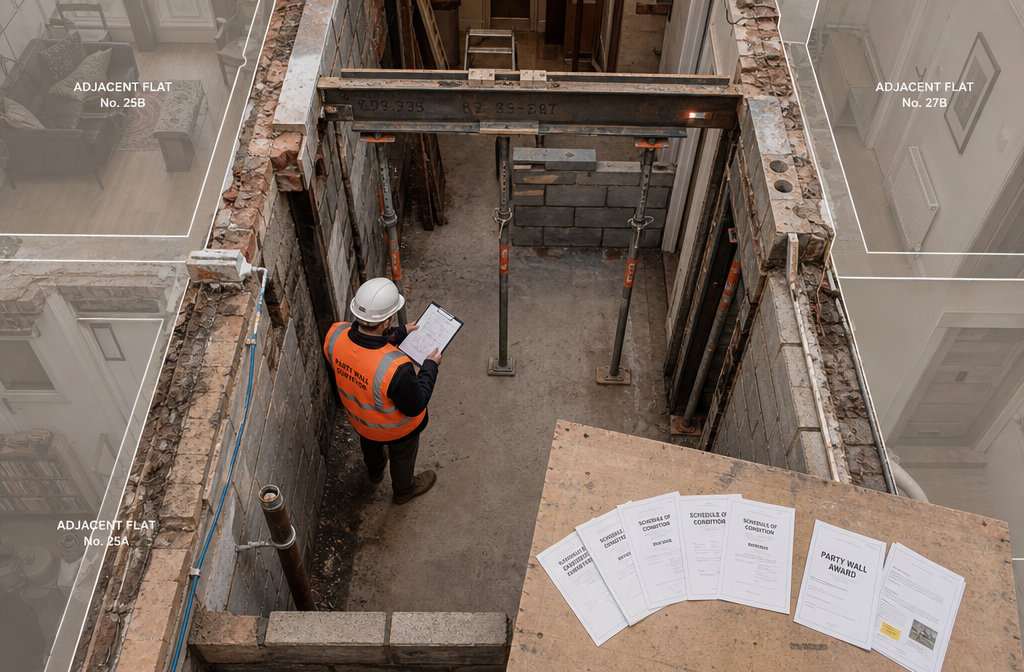
A Party Wall Award (also called a party wall agreement) is the legally binding document that governs how structural works must be carried out. For a flat structural opening, a well-drafted Award will typically address:
Structural Method and Sequence
- Temporary propping requirements — how the existing wall must be supported before cutting begins
- Steel or lintel specification — confirmation that the structural engineer's design is incorporated
- Sequence of works — often specifying that propping must be inspected before demolition starts
Protection of Adjoining Property
- Vibration and noise constraints — hammer drilling hours may be restricted to, say, 9am–5pm on weekdays only
- Protection to common parts — floor coverings, lift lobbies, and stairwells must be protected before materials are moved
- Service duct and riser protection — particularly important where openings are near electrical risers or water pipes
Pre- and Post-Works Inspection
The Award will usually require a schedule of condition report to be prepared before works begin, recording the state of adjoining flats and common parts. This protects both parties if a dispute arises about damage caused during the works.
Costs and Who Pays
Under the Act, the Building Owner (the leaseholder doing the works) bears the surveyor fees for all parties in most cases. In 2026, total Party Wall Award costs for a single structural opening in a flat typically range from £1,000 to £3,000, reflecting 30–50 surveyor hours across all parties when multiple adjoining owners are involved. [5][9]
Current London party wall surveyors are booking 4–6 weeks ahead, with hourly rates ranging from approximately £90 to £450 depending on seniority and complexity. Practitioners advise allowing at least 2–3 months from first notice service to Award for multi-flat situations. [9]
For a detailed breakdown of what you should expect to pay, see this guide to party wall surveyor costs.
Freeholders, License to Alter, and Why They Are Not the Same Thing
One of the most persistent misconceptions in 2026 is that obtaining a freeholder's license to alter removes the need for a Party Wall Award. It does not. These are two entirely separate legal processes.
What a License to Alter Does
A license to alter is a contractual permission granted by the freeholder under the terms of the lease. It typically requires:
- Structural engineer's drawings and calculations
- Confirmation of building regulations compliance
- Contractor details and insurance certificates
- A management pack fee (often £500–£1,500)
Managing agents in 2026 are tightening license to alter conditions significantly. Many now require:
- ✅ A full schedule of condition for all immediately adjoining flats
- ✅ RICS-regulated party wall surveyors and structural engineer sign-off
- ✅ Contractor public liability insurance of £5–10 million
- ✅ A security deposit of £1,000–£5,000 to cover potential damage to communal areas [8]
What a Party Wall Award Does
A Party Wall Award is a statutory instrument under the Party Wall etc. Act 1996. It protects the rights of adjoining owners — not just the freeholder — and creates a legal framework for resolving disputes. Building insurers in 2025–26 have begun requesting evidence of Party Wall Awards for structural alterations when claims arise, particularly following water ingress or structural movement. [8]
The Correct Sequence for a Flat Structural Opening
Experienced surveyors recommend the following order:
- 🔑 Obtain freeholder's in-principle consent and request a management pack
- 📐 Agree structural design with a structural engineer (steel or lintel specification)
- 📬 Serve Party Wall Notices on all adjoining leaseholders and the freeholder
- ⚖️ Appoint surveyor(s) to make an Award if dissent or no reply is received
- 🏗️ Proceed to building control approval and commence works
Skipping or reordering these steps is the primary cause of disputes and injunctions in flat structural projects. [1][2]
For guidance on what happens when disputes do arise, the party wall disputes resource covers the resolution process in detail.

Building Management Constraints: The Practical Complications in 2026
Beyond the statutory party wall process and the leasehold license to alter, building management companies impose a third layer of requirements that can significantly affect project timelines and costs.
Common Building Management Conditions in 2026
Many management companies now enforce the following through the license to alter process — and these conditions can be mirrored directly into the Party Wall Award by surveyors:
| Condition | Typical Requirement |
|---|---|
| Working hours | Structural/noisy works restricted to Mon–Fri, 8am–5pm |
| Vibration monitoring | Required for large openings or where services are nearby |
| Common parts protection | Hoarding and floor protection mandatory before works begin |
| Contractor insurance | £5–10 million public liability minimum |
| Security deposit | £1,000–£5,000 held by managing agent |
| Post-works inspection | Signed off by managing agent or their surveyor |
These constraints are not merely bureaucratic. In dense urban blocks — particularly in London — a structural opening that generates excessive vibration can crack plaster in three or four adjoining flats simultaneously. The costs of remediation, combined with surveyor fees and potential legal action, can far exceed the cost of the original works. [8]
Access Issues: A Frequently Overlooked Complication
Forming a structural opening often requires access to adjoining flats — to inspect the condition of walls, to check bearing points, or to monitor vibration during works. Under the Party Wall Act, the Building Owner does have a right of access, but this must be exercised carefully:
- 14 days' written notice must be given before accessing an adjoining owner's property
- Access must be for a legitimate party wall purpose — not general inspection
- If an adjoining leaseholder refuses access, the matter may need to be resolved through the surveyor or, in extreme cases, the courts
Where the freeholder owns common parts (corridors, risers, roof voids), their consent for access is also required — and this is often coordinated through the building management company rather than directly with the freeholder. [2]
When Multiple Adjoining Owners Disagree
In a block of flats, it is entirely possible for one adjoining leaseholder to consent while another dissents. In this scenario:
- A Party Wall Award must still be made for the dissenting owner
- The consenting owner's agreement should be recorded in writing
- If the freeholder dissents, the Award process must include them — and their surveyor's fees are also borne by the Building Owner
This is where the party wall agreed surveyor arrangement can save time and cost: if all parties agree to appoint a single "agreed surveyor," one Award covers all parties rather than requiring separate Awards for each dissenting owner.
Structural Considerations Specific to Flat Conversions
Party wall surveying for structural openings in flats differs from terraced house projects in several important ways that affect both the legal process and the physical works.
Floor Slabs as Party Structures
In vertically stacked flats, floor slabs are party structures — meaning that any beam bearing onto a shared slab engages the Act with respect to the flat below, not just the flat next door. [3] Surveyors must review structural drawings to confirm:
- Where beam bearing pads will sit
- Whether load is transferred to the slab or to independent columns
- Whether the slab has sufficient capacity for the new load
A structural survey or input from residential structural engineers is often required before notices can be properly drafted, because the scope of adjoining owners depends on the structural solution chosen.
Services and Risers
Flat party walls frequently contain electrical cables, water pipes, and gas risers serving multiple units. Cutting into a party wall for a structural opening without a proper services survey can result in:
- Severed cables affecting multiple flats
- Water damage to lower floors
- Gas supply interruption requiring emergency contractor attendance
The Party Wall Award should specifically address services protection, and the building management company will typically require evidence that a services survey has been carried out before granting the license to alter.
The Role of the Schedule of Condition
A party wall schedule of condition is a photographic and written record of the state of adjoining properties before works begin. For flat structural openings, this should cover:
- All immediately adjoining flats (above, below, and to each side)
- Common parts corridors, stairwells, and lift lobbies
- Any visible cracks, settlement, or pre-existing damage
Without this record, attributing post-works damage becomes a matter of dispute rather than evidence — and the Building Owner is typically presumed liable in the absence of proof to the contrary.
Conclusion: Actionable Next Steps for Flat Owners in 2026
Party Wall Surveying for Structural Openings in Flats: Managing Freeholders, Leaseholders, and Building Management Constraints is genuinely complex — but it is entirely manageable with the right professional team and the right sequence of actions.
Here is what to do next:
- Commission a structural engineer to produce initial drawings before approaching the freeholder — this gives the license to alter application the technical detail it needs.
- Contact the freeholder or managing agent early to understand their specific license to alter requirements and any building management conditions that will apply.
- Appoint a RICS-regulated party wall surveyor to identify all adjoining owners and draft notices — do not attempt this without professional help in a multi-flat building.
- Serve Party Wall Notices at least two months before your planned start date — and build in an additional month for Award preparation if dissent is likely.
- Do not start structural works until both the license to alter and the Party Wall Award (where required) are in place.
- Ensure a schedule of condition is prepared for all adjoining flats and common parts before any contractor touches a wall.
The cost of getting this right — typically £1,000–£3,000 in surveyor fees — is a fraction of the cost of an injunction, a damaged neighbour relationship, or a voided insurance claim. In 2026, with building insurers actively scrutinising structural alterations, the Party Wall Award is no longer just a legal formality: it is a critical piece of project protection.
For expert guidance on party wall matters and understanding what a license to alter involves, specialist surveyors can advise on the full process from initial notice strategy through to Award completion.
References
[1] Understanding The Importance Of Party Wall Surveys – https://akt-surveyors.com/understanding-the-importance-of-party-wall-surveys/
[2] Party Wall Agreement – https://hoa.org.uk/advice/guides-for-homeowners/i-am-improving/party-wall-agreement/
[3] Understanding Party Wall Award Comprehensive Guide Novellosurveyors Uuf0e – https://www.linkedin.com/pulse/understanding-party-wall-award-comprehensive-guide-novellosurveyors-uuf0e
[4] Party Wall Agreements What You Need To Know – https://www.fmb.org.uk/find-a-builder/ultimate-guides-to-home-renovation/party-wall-agreements-what-you-need-to-know.html
[5] Party Wall Surveyor Costs – https://www.designingbuildings.co.uk/wiki/Party%20Wall%20Surveyor%20Costs
[8] Party Wall Surveys And Neighbour Disputes During 2026's Construction Uptick: RICS Compliance Framework – https://nottinghillsurveyors.com/blog/party-wall-surveys-and-neighbour-disputes-during-2026s-construction-uptick-rics-compliance-framework
[9] Navigating Tariffs And Labor Shortages In Party Wall Agreements For 2026 Builds – https://partywallsurveyorlondon.uk/blogs/navigating-tariffs-and-labor-shortages-in-party-wall-agreements-for-2026-builds/