
{"cover":"Professional landscape format (1536×1024) hero image with bold text overlay 'Reinstatement Cost vs Mortgage Value' (≤42 chars) in crisp white sans-serif on a deep navy semi-transparent overlay panel, centered with 8% safe margins from every edge. Background: bright daylight editorial split composition showing a classic British terraced house on the left with a surveyor measuring its facade, and a bank/mortgage document with a property valuation stamp on the right, warm natural light, sharp editorial photography, professional navy-and-amber color palette, magazine cover aesthetic, high contrast, no price tables, no dollar amounts.","content":["Four-panel labelled comparison infographic (1536×1024) on a clean white background with teal and navy palette: Panel 1 labeled 'Reinstatement Cost' showing a brick house blueprint with callout lines pointing to 'Rebuild materials', 'Labour costs', 'Demolition & debris'; Panel 2 labeled 'Mortgage Valuation' showing a house with a sale price tag and callouts 'Market demand', 'Location premium', 'Comparable sales'; Panel 3 labeled 'Market Value' showing a street of houses with callout 'Supply & demand'; Panel 4 labeled 'Insurance Sum Insured' showing a policy document with callout 'Under-insurance risk'. Each panel has a short bold heading, thin callout lines, editorial infographic polish, no full sentences as image text, all labels 1-6 words, inside 5% safe margins.","Annotated step-by-step process flow diagram (1536×1024) on a warm cream background with charcoal and amber palette: Five numbered steps in a horizontal flow, Step 1 'Commission RCA Surveyor' with icon of a professional with clipboard; Step 2 'Site Inspection' with icon of a surveyor measuring walls; Step 3 'BCIS Index Applied' with icon of a graph showing rebuild cost inflation 2025-2026; Step 4 'Report Issued' with icon of a stamped document; Step 5 'Insurer Notified' with icon of a shield. Thin connecting arrows between steps, short 1-5 word labels per step, callout lines pointing to key details, editorial diagram quality, no pricing text, fully inside 5% safe margins.","Split-screen editorial photograph (1536×1024): left half shows a British surveyor in a hard hat inspecting visible structural cracks and damp on an older Victorian terraced property exterior in natural daylight, with a small callout label 'Defects affect rebuild cost'; right half shows a mortgage broker at a clean modern desk reviewing a property valuation report with a house floor plan visible, warm office lighting, callout label 'Lender uses market value'. High-contrast magazine composition, deep teal and warm amber color grading, sharp documentary photography style, no price tables, no checkmark grids, professional editorial quality."]
Fewer than one in three UK homeowners correctly understands the difference between what their property is worth on the open market and what it would actually cost to rebuild it from scratch, and that gap can translate into tens of thousands of pounds of under-insurance when disaster strikes [1]. Understanding Reinstatement Cost Valuation vs Mortgage Valuation: Insurance, Rebuild and Market Value Explained is not merely academic. It determines whether an insurance payout covers a full rebuild, whether a lender agrees to advance funds, and whether a surveyor's findings about defects and party wall risks feed into the right figure for the right purpose.
Key Takeaways
- Reinstatement cost and market value are fundamentally different figures that serve different purposes, confusing them is the single biggest cause of under-insurance in the UK.
- A mortgage valuation tells a lender what a property is worth to sell; a reinstatement cost assessment tells an insurer what it would cost to rebuild it.
- Rebuild costs per square metre in 2026 have risen significantly above general inflation, driven by labour shortages and material price increases.
- Structural defects, party wall issues, and unusual construction materials all affect reinstatement cost but may have little or no impact on market value.
- A professional Reinstatement Cost Assessment (RCA) carried out by a RICS-qualified surveyor remains the most reliable method for setting a buildings insurance sum insured.
What Are the Three Core Property Values and Why Do They Differ
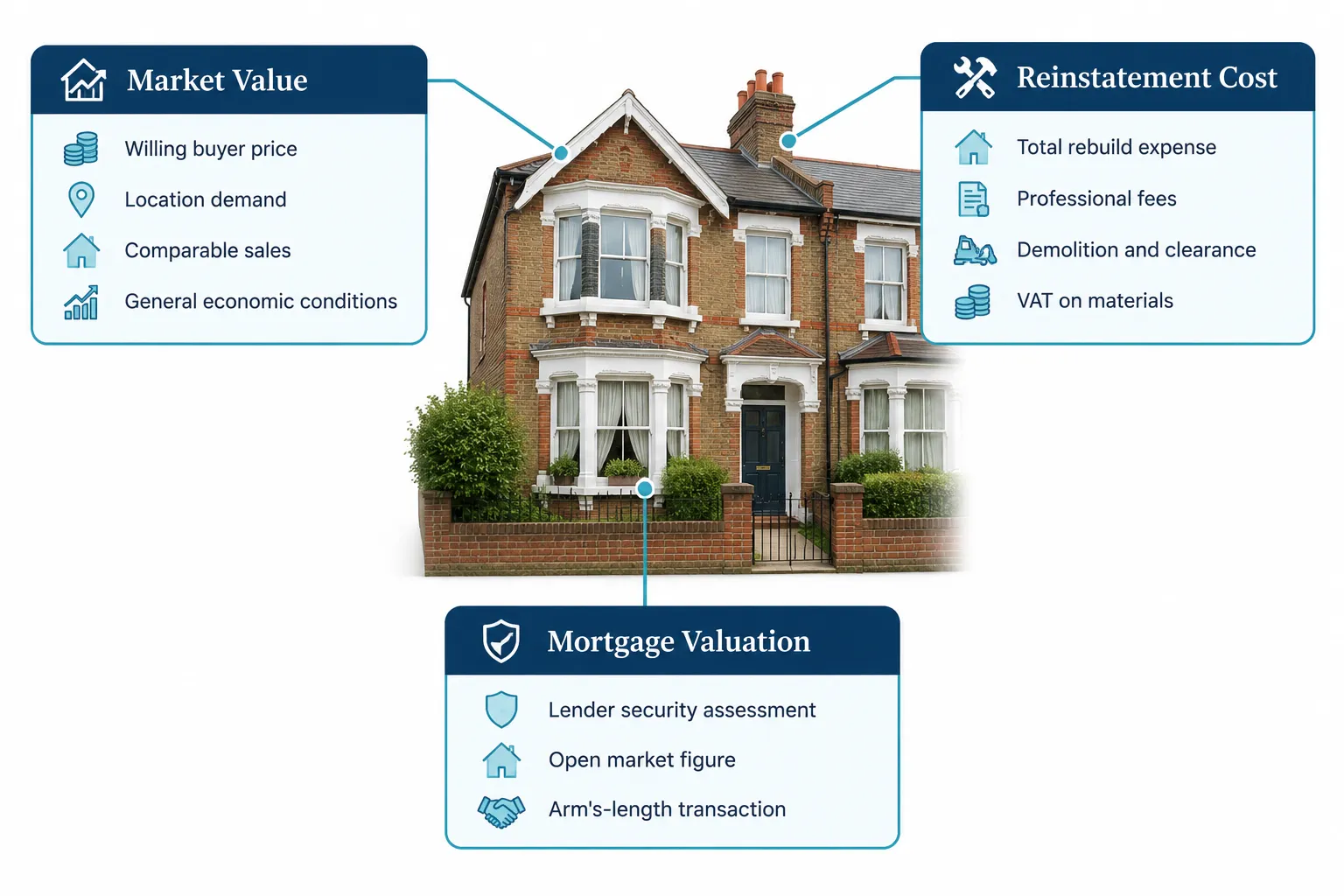
Every property effectively carries three distinct values at any given time, and each one answers a different question.
Market value is the price a willing buyer would pay a willing seller in an arm's-length transaction on the open date. It reflects location, demand, comparable sales, and the general state of the housing market. This is the figure estate agents quote and the one that appears in newspaper headlines about house price indices.
Mortgage valuation is a lender-commissioned assessment of market value carried out to protect the lender's security. It is not a structural survey, and it is not designed to benefit the buyer. Its sole purpose is to confirm that the property is worth at least the amount being borrowed. A property valuation in London for mortgage purposes will typically be brief, sometimes conducted as a desktop valuation using comparable sales data, and will not examine the cost of rebuilding the structure.
Reinstatement cost (also called rebuild cost or insurance reinstatement value) is something else entirely. It is the estimated cost of demolishing the existing structure, clearing the site, and rebuilding it to its current specification using current labour rates and material costs, including professional fees. It has no direct relationship to market value.
"A Victorian terrace in central London might have a market value of £900,000 but a reinstatement cost of only £350,000, or, in the case of a listed building with specialist materials, a reinstatement cost that exceeds its market value." [4]
This divergence is at the heart of why Reinstatement Cost Valuation vs Mortgage Valuation: Insurance, Rebuild and Market Value Explained matters so much to homeowners, lenders, and insurers alike.
Why Rebuild Cost and Market Value Move Independently
Market value is driven by supply and demand in the property market. Rebuild cost is driven by construction economics: the cost of bricks, timber, roof tiles, labour, and professional fees. In 2026, rebuild costs per square metre for a standard UK house range from approximately £1,500 to £2,200 for a basic specification, rising to £3,500 or more for high-specification or listed properties [6]. In London and the South East, regional uplifts of 15-25% are routinely applied to reflect higher labour costs [9].
Between 2025 and 2026, the BCIS House Rebuilding Cost Index, the benchmark used by most professional surveyors and insurers, recorded continued upward movement, with rebuild cost inflation running ahead of general CPI inflation for the third consecutive year [3]. This means that a reinstatement figure set three or four years ago is almost certainly out of date, leaving many homeowners materially under-insured.
How a Professional Reinstatement Cost Assessment Works in 2026
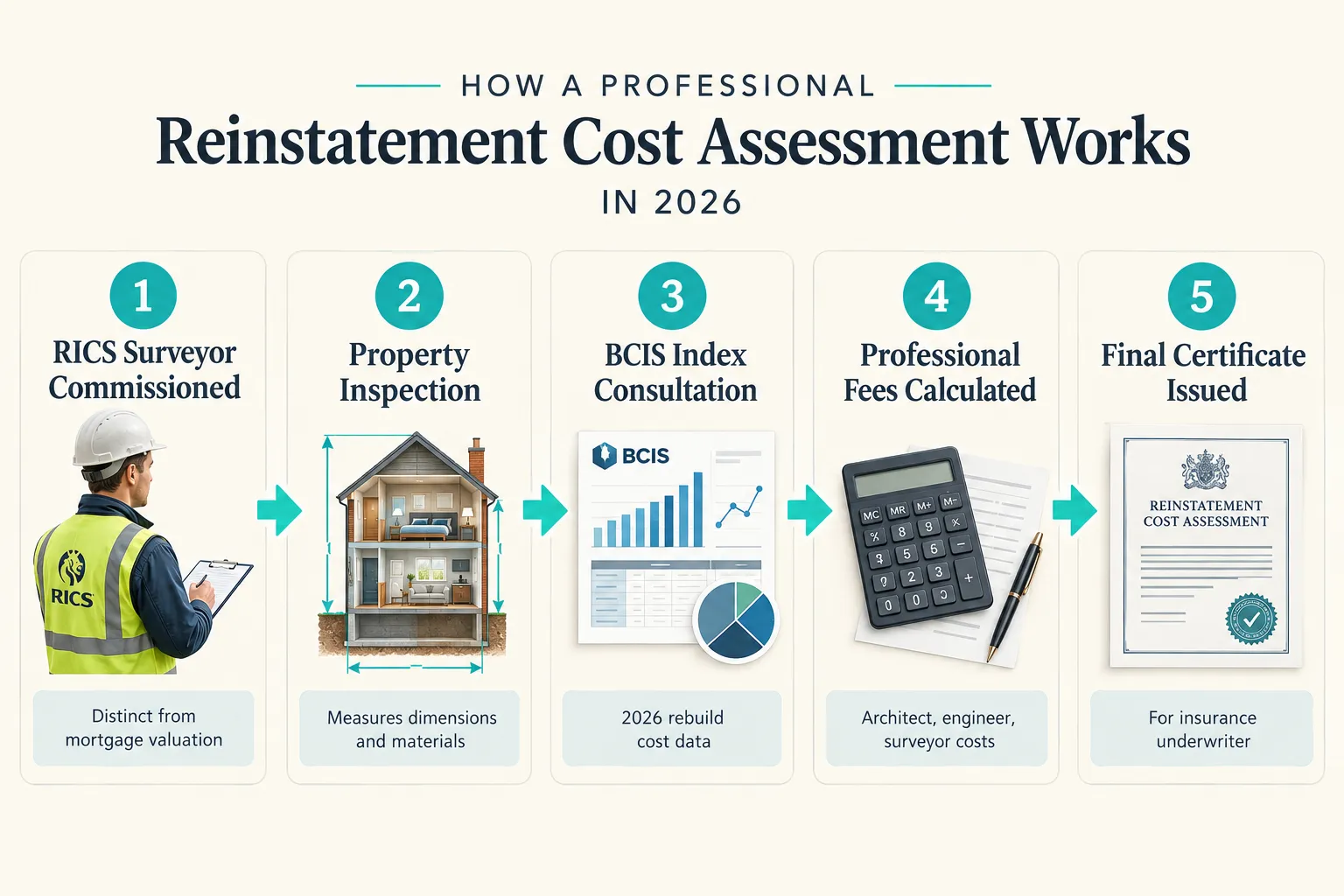
A Reinstatement Cost Valuation is a formal exercise carried out by a RICS-qualified surveyor. It is distinct from both a mortgage valuation and a building survey, though it can be commissioned alongside either. The process follows a structured methodology.
Step 1, Site inspection. The surveyor visits the property to measure floor areas, assess construction type, identify any non-standard materials (e.g. oak frames, slate roofs, ornate brickwork), and note features that would increase rebuild complexity such as basement levels, listed status, or restricted access.
Step 2, BCIS data application. The surveyor applies current BCIS elemental cost data, adjusted for location, property age, and specification. The BCIS rebuild cost calculator is widely used as a cross-check, though professional surveyors apply judgment that an online tool cannot replicate [10].
Step 3, Allowances for ancillary costs. A proper RCA includes demolition and debris removal, professional fees (architect, structural engineer, planning consultant), site clearance, and VAT where applicable. These ancillary costs alone can add 15-20% to the raw build cost [1].
Step 4, Report and certification. The surveyor issues a formal report stating the recommended sum insured. This figure is what the homeowner should declare to their buildings insurer.
Consumer Rebuild Calculators: Useful but Limited
Several online tools allow homeowners to estimate their own rebuild cost by entering property type, floor area, and postcode [2][5]. These calculators are useful for a rough sense-check but carry important limitations. They cannot account for non-standard construction, listed building obligations, restricted site access, or the specific regional labour market conditions that a surveyor assesses on the ground. For standard modern properties, they may be adequate for a preliminary figure. For older, larger, or unusual properties, a professional RCA is strongly recommended [9].
How Defects, Building Surveys, and Party Wall Risks Interact With Each Valuation Type
This is where the distinction between reinstatement cost and mortgage valuation becomes practically critical, and where many homeowners are caught out.
Structural Defects and Their Dual Impact
Consider a Victorian terraced house in South London with significant subsidence affecting the rear extension. A mortgage valuation will reflect this defect in the market value, the lender may reduce the amount it is willing to advance, or impose a retention until remediation is complete. However, the defect also has a direct bearing on the reinstatement cost: underpinning, specialist structural repair, and the possibility that a rebuild would require deeper foundations all increase the cost of reinstatement substantially.
If the homeowner has set their buildings insurance sum insured based on the mortgage valuation figure (a common but incorrect practice), they may find themselves dramatically under-insured if the property is destroyed. The insurer's liability is capped at the declared sum insured, not at the actual cost of rebuilding [7].
A damp survey or building survey that identifies penetrating damp, failed cavity wall insulation, or deteriorating roof structure will similarly affect both valuations, but in different ways and to different degrees. The mortgage valuer considers the impact on saleability; the reinstatement cost surveyor considers the cost of rebuilding correctly.
Party Wall Risks and Reinstatement Cost
Party wall matters introduce a further layer of complexity. Where a property shares a wall with a neighbour, any rebuild following a major incident must comply with the Party Wall Act 1996. This can require the appointment of party wall surveyors to agree a schedule of condition and oversee reinstatement works, adding professional fees and potential delays to the rebuild programme. A thorough RCA will include an allowance for these costs; a standard mortgage valuation will not address them at all.
Party wall disputes arising during a rebuild can significantly increase costs and timescales. Where a property is terraced or semi-detached, the majority of the UK housing stock, this risk is material and should be reflected in the reinstatement sum insured.
Listed Buildings and Conservation Areas
For listed buildings, the gap between market value and reinstatement cost can be extreme. A Grade II listed cottage may have a market value of £400,000 in a rural setting, but a reinstatement cost of £600,000 or more once the obligation to use traditional lime mortar, handmade brick, and specialist joinery is factored in [9]. Historic England requirements, planning conditions, and the scarcity of skilled craftspeople all inflate rebuild costs in ways that have no bearing on market value.
Under-Insurance: The Real-World Consequence of Getting the Numbers Wrong
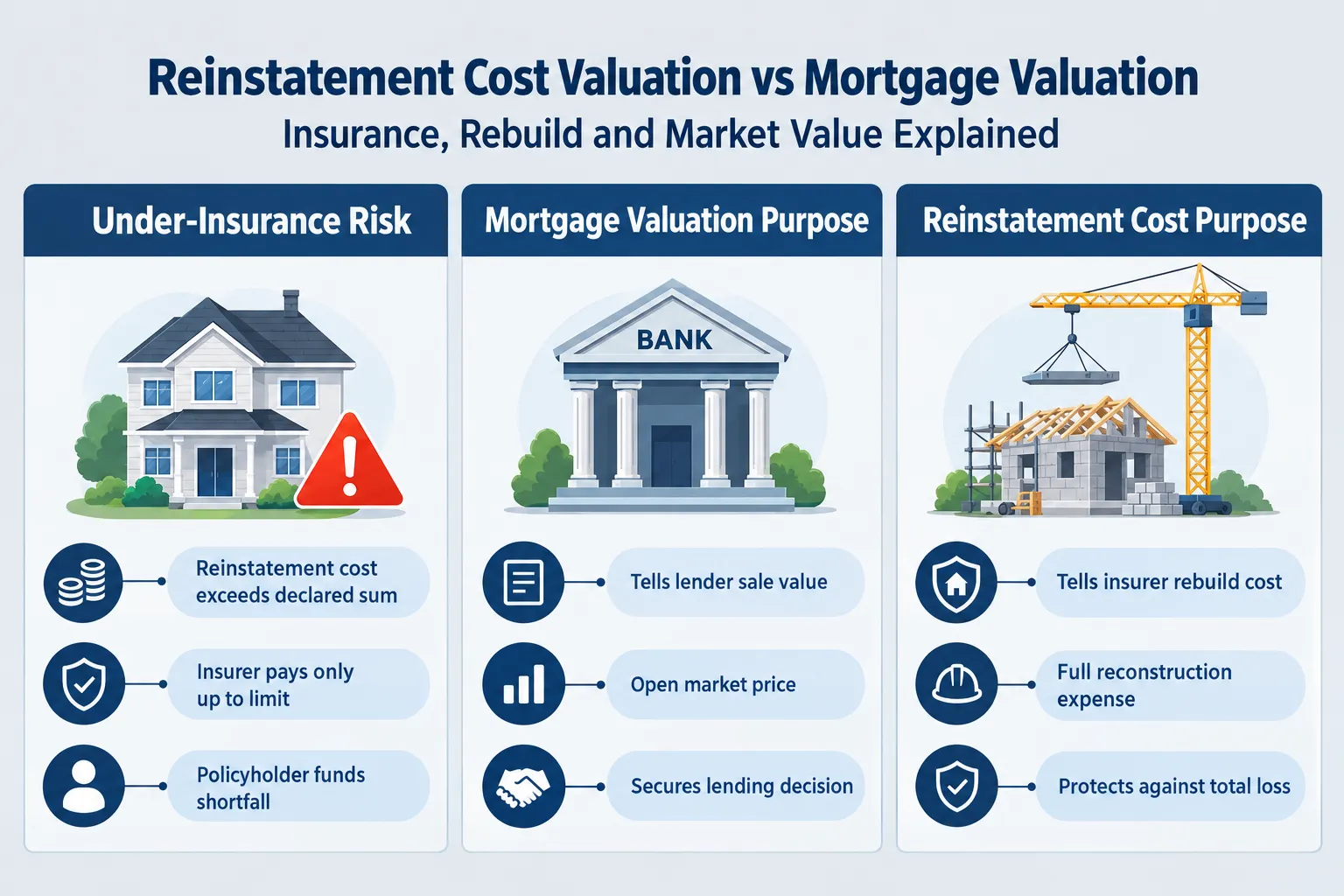
The practical stakes of confusing reinstatement cost with market value are severe. Under-insurance occurs when the declared sum insured is lower than the true reinstatement cost. In the event of a total loss, the insurer pays out only up to the declared sum, leaving the policyholder to fund the shortfall from their own resources [7].
A homeowner in a 1930s semi-detached property insures their home for £280,000, roughly the figure suggested by an online calculator used five years ago. Following a fire, the actual reinstatement cost is assessed at £420,000 once demolition, professional fees, and current 2026 material costs are included. The insurer applies the average condition (proportional reduction clause), paying out only £280,000. The homeowner faces a £140,000 shortfall.
Home insurance premiums in the UK have risen sharply in recent years, driven partly by increased claims costs as rebuild expenses have outpaced the sums insured declared by policyholders [8]. Insurers have responded by tightening average condition clauses and, in some cases, declining to renew policies where the declared sum insured is clearly inadequate relative to property size and type.
How Often Should a Reinstatement Cost Assessment Be Updated
| Property Type | Recommended Review Frequency |
|---|---|
| Standard modern house | Every 3 years minimum; after any major renovation |
| Victorian or Edwardian terraced | Every 2 years; after any structural work |
| Listed building | Every 1-2 years; after any repair or alteration |
| Commercial or mixed-use | Annually or as required by lease |
The BCIS index should be used to index-link the sum insured between formal assessments, but index-linking alone does not capture changes to the property itself [3].
Choosing the Right Valuation for the Right Purpose
Understanding Reinstatement Cost Valuation vs Mortgage Valuation: Insurance, Rebuild and Market Value Explained ultimately comes down to matching the right tool to the right need.
- Buying a property with a mortgage: The lender will commission a mortgage valuation. The buyer should additionally commission a HomeBuyer Report or full building survey to understand structural condition, the mortgage valuation does not serve this purpose.
- Setting buildings insurance: Commission a professional RCA from a RICS-qualified surveyor. Do not use the mortgage valuation figure as a proxy for the sum insured.
- Remortgaging or equity release: A new mortgage valuation will be required. This is also a sensible trigger to review the reinstatement cost assessment, particularly if construction costs have risen materially since the last RCA.
- Lease extensions or right to buy: Specialist valuations such as a lease extension valuation or a Right to Buy valuation are distinct exercises again, governed by statutory frameworks that have no direct connection to either rebuild cost or open market value in the conventional sense.
- Divorce or legal proceedings: A divorce valuation is based on market value for the purpose of asset division. It is not a substitute for an RCA.
The key principle is that each valuation type is designed for a specific purpose and audience. Substituting one for another, however convenient, introduces risk.
Conclusion
The distinction between reinstatement cost valuation and mortgage valuation is not a technicality. It is a practical matter with direct financial consequences for homeowners, lenders, and insurers. In 2026, with rebuild costs continuing to rise faster than general inflation and the BCIS index reflecting sustained upward pressure on labour and materials, the gap between what a property is worth on the market and what it would cost to rebuild has never been more significant for most UK homeowners [3][6].
Actionable next steps for homeowners and property professionals:
- Do not use a mortgage valuation figure as the basis for buildings insurance. The two figures serve different purposes and are calculated on different foundations.
- Commission a professional Reinstatement Cost Assessment from a RICS-qualified surveyor, particularly for older, larger, listed, or non-standard properties. Review it at least every three years and after any significant renovation.
- Factor in party wall obligations and structural defects when instructing a reinstatement cost surveyor, these can materially increase the true cost of rebuilding and must be reflected in the sum insured.
- Use BCIS index-linking between formal assessments to keep the sum insured broadly current, but do not rely on index-linking alone as a substitute for a fresh professional assessment.
- Seek specialist advice when the property type is unusual, listed buildings, properties in conservation areas, or those with shared walls all carry reinstatement cost risks that a standard calculator will not capture.
Getting these figures right is not complex, but it does require the right professional carrying out the right exercise for the right purpose.
References
[1] Reinstatement Cost Assessment A Professional Guide To Building Insurance Valuations 2026 – winfieldssurveyors.co.uk
[2] Rebuild Cost Calculator – ukcalculator.com
[3] Index Bcis House Rebuilding Cost Index – bcis.co.uk
[4] Rebuild Cost Vs Market Value Uk 2026 – myinsuranceexpert.co.uk
[5] Rebuild Cost Calculator – propertypassport.uk
[6] How Much Does It Cost To Rebuild A House In 2026 – nortonib.co.uk
[7] Buildings And Contents Home Insurance Uk 2026 – myinsuranceexpert.co.uk
[8] Why Are Home Insurance Premiums Going Up – nortonib.co.uk
[9] Insurance Reinstatement Valuation A 2026 Property Guide En – surveymerchant.com
[10] Bcis Rebuild Cost Calculator – build-estimate.com