Over a third of all contested property cases in England and Wales involve a dispute about value, yet the gap between what a qualified surveyor says a property is worth and what a court ultimately accepts can run into hundreds of thousands of pounds. That gap is closed, or widened, by the quality of expert witness property valuation evidence placed before the judge.
Expert Witness Property Valuation: When Courts Rely on Surveyors in UK Property Disputes sits at the intersection of professional standards, civil procedure, and high-stakes advocacy. Understanding how courts use surveyor evidence, what makes it credible, and where it can unravel is essential for property owners, legal practitioners, and surveyors alike.
Key Takeaways
- Expert witnesses owe their primary duty to the court, not to the party paying their fees, this overrides any commercial relationship with the instructing solicitor.
- RICS published a new 5th edition of its "Surveyors acting as Expert Witnesses" professional standard following a public consultation in autumn 2025, setting a globally applicable benchmark. [1]
- CPR Part 35 governs the admissibility, scope, and format of all expert evidence in civil proceedings in England and Wales, including property valuation reports.
- Courts actively gatekeep expert evidence: in Cohen & Ors v Co-operative Group Ltd [2025], a court refused to admit valuation evidence that was not sufficiently relevant to the pleaded issues. [7]
- Contingency or success-based fees are strictly prohibited for expert witnesses, and RICS has issued practice alerts warning against template-driven or AI-generated reports. [5][3]
The Role of a Surveyor as Expert Witness in UK Property Disputes
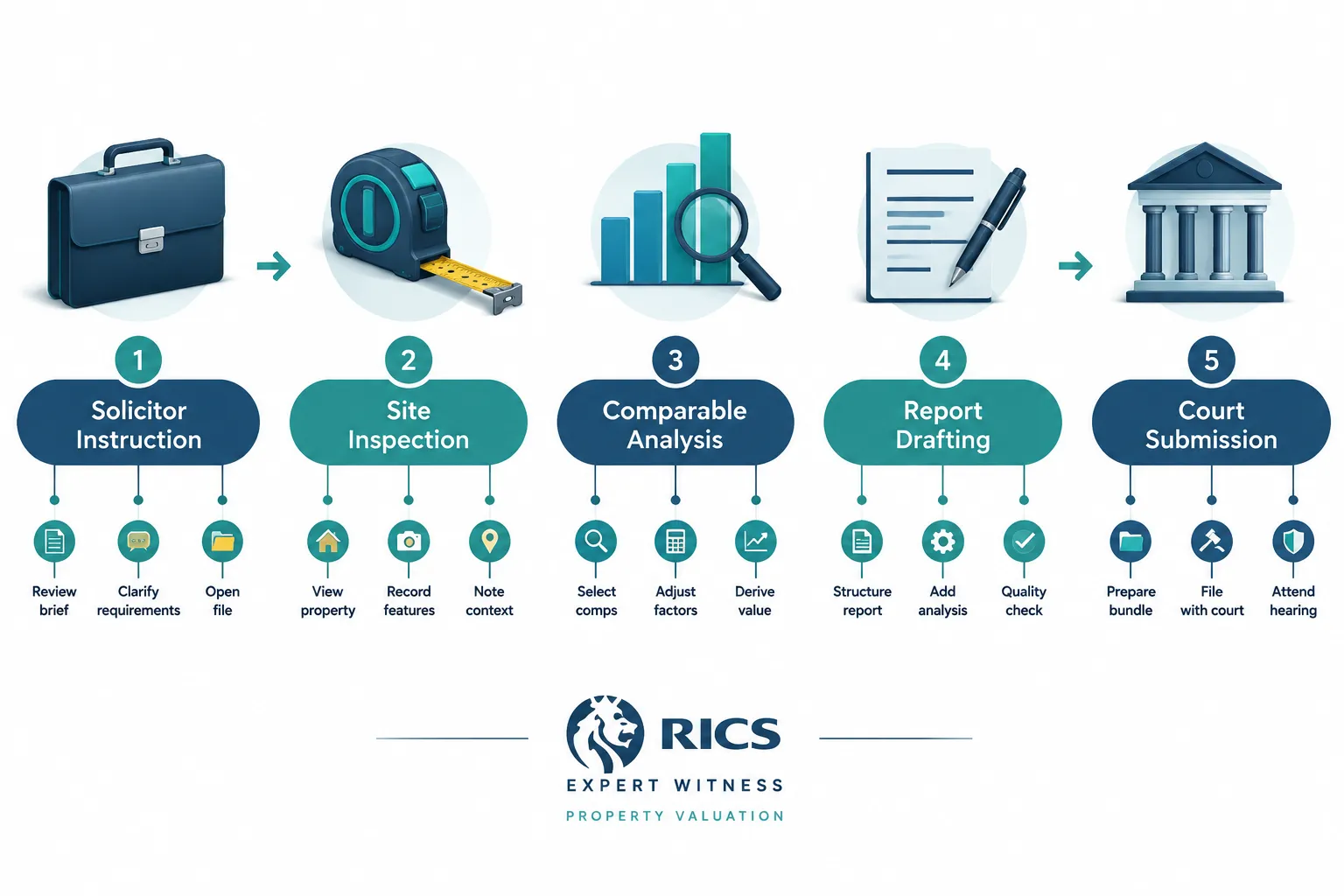
When a property dispute reaches litigation, the court needs an independent, qualified opinion on value or condition that goes beyond what either party can provide. That is where the expert witness surveyor steps in.
Surveyors typically become expert witnesses in one of four ways: instructed by solicitors in actual or anticipated litigation; asked to prepare a formal report for court use; appointed as a Single Joint Expert (SJE) agreed by both parties; or directed by the court itself to provide independent evidence. [13] Each route carries the same fundamental obligation, the expert's duty runs to the tribunal, not to the client who signs the cheque.
This distinction matters enormously in practice. A surveyor who shades an opinion to favour the instructing party risks not only losing credibility under cross-examination but also facing RICS disciplinary proceedings. The RICS client guide on surveyors acting as expert witnesses makes the point explicitly: experts must remain independent despite being paid by one side, and instructing parties must understand that the report is not a piece of advocacy. [10]
Types of Disputes Where Expert Valuation Evidence Is Needed
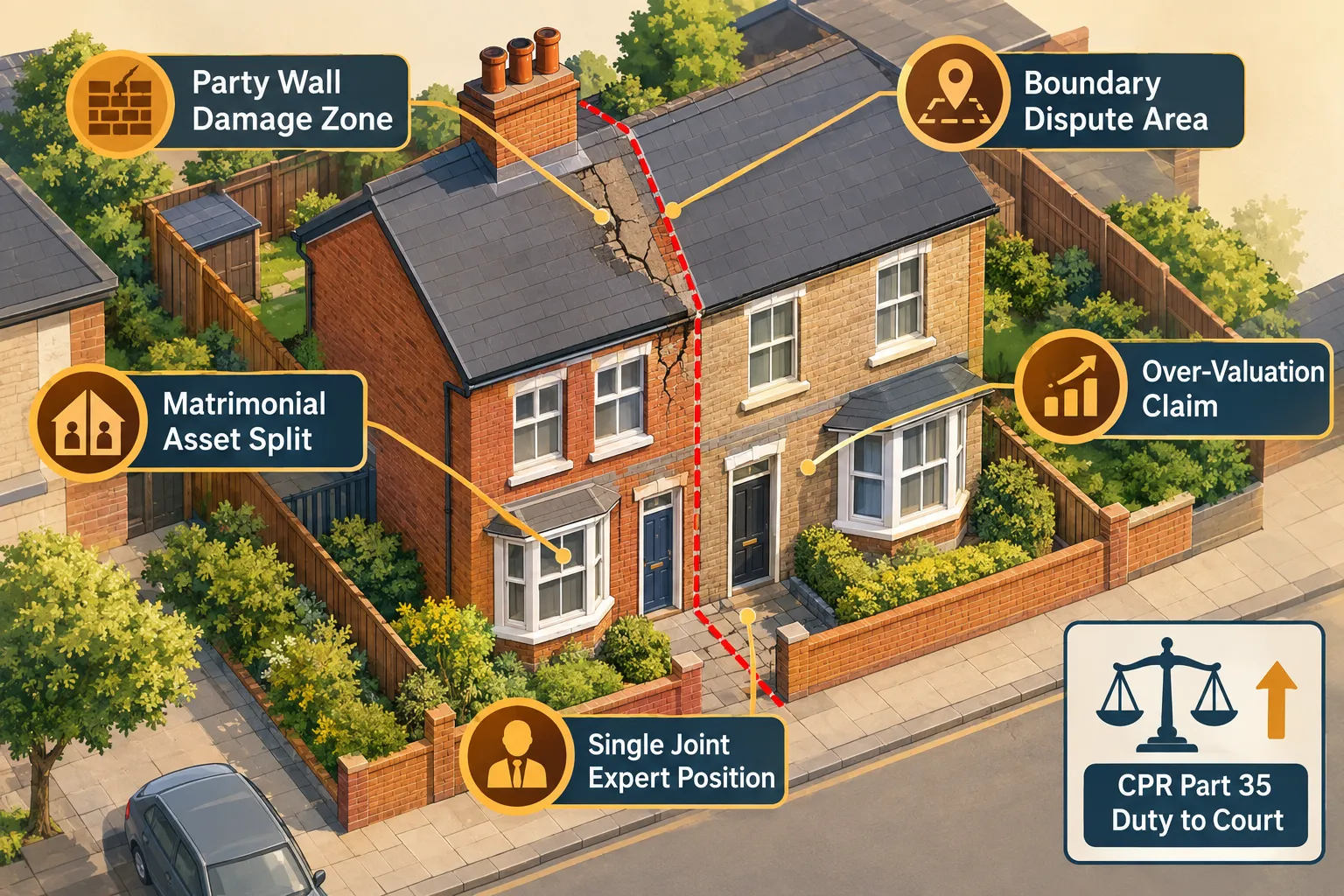
Expert witness property valuation arises across a broader range of disputes than most property owners realise:
| Dispute Type | Typical Valuation Question |
|---|---|
| Boundary and encroachment | Diminution in value caused by loss of land |
| Party wall damage | Cost of reinstatement and reduction in market value |
| Matrimonial finance | Open market value for asset division |
| Compulsory purchase | Market value and disturbance compensation |
| Alleged over- or under-valuation | Whether a previous valuation met the standard of care |
| Lease enfranchisement | Premium payable to extend or acquire a lease |
| Tax disputes | Historic value at a relevant date |
| Commercial rent review | Market rent at review date |
For disputes involving party wall damage claims, a surveyor expert may need to quantify both the physical repair cost and any residual value impact, two distinct but related opinions that must be clearly separated in the report.
Similarly, matrimonial valuation cases require a surveyor to provide an open market value that will withstand scrutiny from the other party's expert and, ultimately, from a judge who may have limited property knowledge but considerable experience in testing expert evidence.
How Courts Assess Expert Witness Property Valuation Evidence
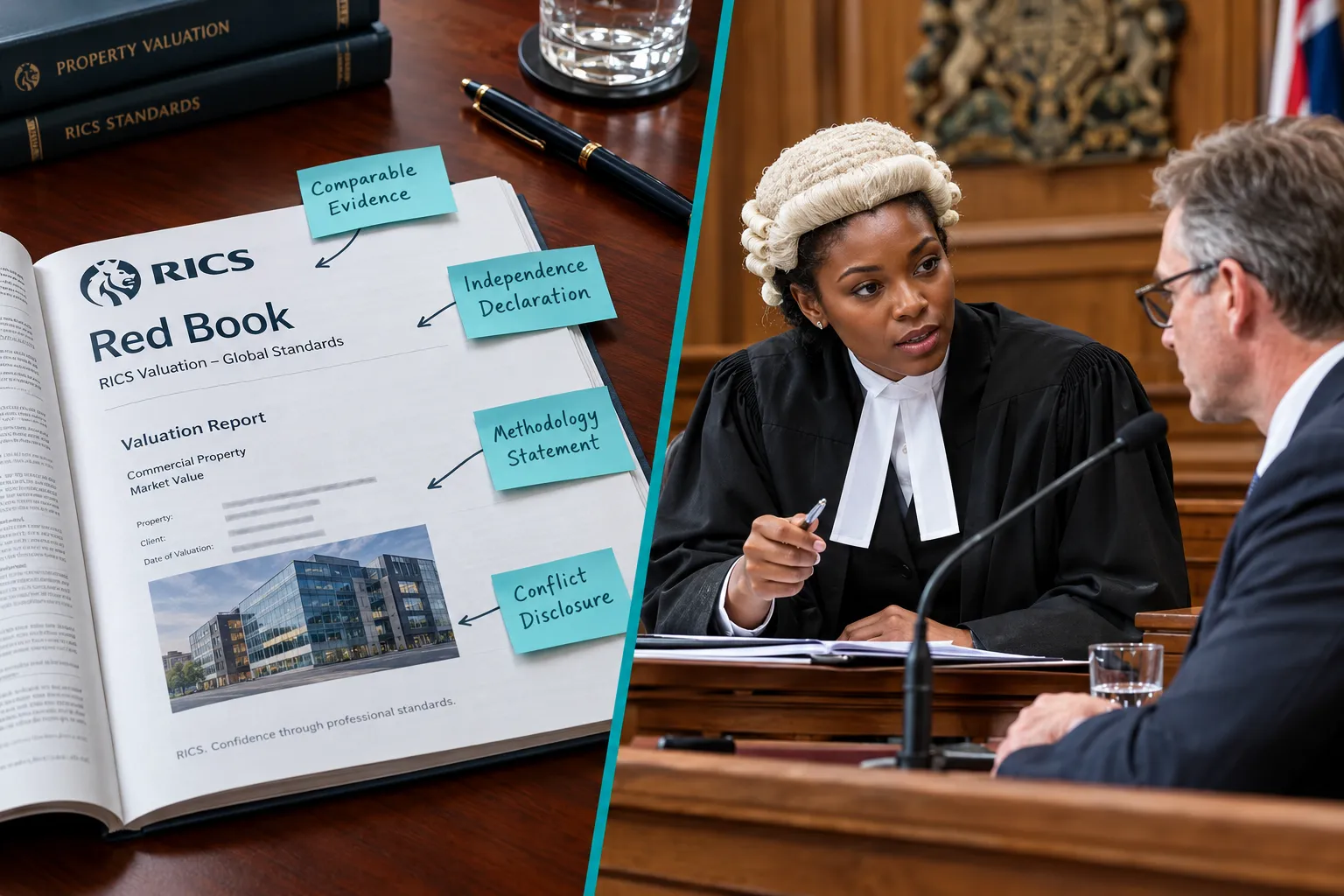
The admission and weight given to expert valuation evidence is not automatic. Courts apply a rigorous gatekeeping function under CPR Part 35, and recent case law illustrates just how seriously judges take the quality and relevance of that evidence.
The CPR Part 35 Framework
Under CPR Part 35, any expert report submitted to a court must:
- Contain a formal declaration that the expert understands their overriding duty to the court and that the report has been prepared in accordance with that duty.
- State the substance of all material instructions, whether written or oral, on which the report is based.
- Identify the methodology used to reach the valuation opinion, including comparable evidence relied upon.
- Disclose any conflicts of interest that could affect independence.
- Be the expert's own work, not a template, not a copy-paste document, and not AI-generated content presented as professional judgement.
The last point has become a live regulatory concern. RICS has explicitly warned that AI and automated tools create "unsteady foundations" for expert witnesses, reminding members that expert evidence must be grounded in professional judgement and recognised methodology rather than AI-generated content. [15]
Court Gatekeeping in Action: Cohen v Co-operative Group
In Cohen & Ors v Co-operative Group Ltd & Ors [2025] EWHC 526 (Ch), the court refused permission to adduce business valuation expert evidence on the grounds that it was not sufficiently relevant to the pleaded issues and would have added unnecessary complexity and cost. [7] The judgment is a clear reminder that courts will exclude expert valuation evidence where it does not materially assist the resolution of the dispute, even in commercially complex cases. Surveyors and their instructing solicitors must therefore ensure that the scope of the expert's instructions is tightly aligned with the actual issues before the court.
Lessons from Regal BA Limited v Jun Zhang [2026]
One of the most instructive recent cases for expert witness property valuation practitioners is Regal BA Limited v Jun Zhang [2026] EWHC 1446 (Ch). The learning points published for expert witnesses from this case are pointed: [2]
- Surveyors must avoid allowing knowledge of the contract price or actual sale price to influence their independent valuation opinion.
- Errors about comparable properties must be disclosed to the opposing expert promptly and corrected, concealing or downplaying such errors damages credibility far more than the error itself.
- Instructing parties must handle document provision carefully to avoid inadvertently undermining the independence and evidential value of the expert's report.
Pull quote: "The expert's job is not to win the case for the client. It is to give the court the most accurate, independent assessment of value that professional expertise can provide.", RICS client guide on surveyors acting as expert witnesses [10]
RICS Standards, Report Structure, and Emerging Risks in Expert Witness Work
The professional framework governing expert witness property valuation in the UK has been significantly strengthened in 2025 and 2026, with new standards, practice alerts, and training requirements all pointing in the same direction: higher accountability, less tolerance for template work, and a clearer distinction between expert evidence and advocacy.
The New 5th Edition RICS Professional Standard
Following a public consultation in autumn 2025, RICS issued the 5th edition of its "Surveyors acting as Expert Witnesses" professional standard. [1][4] Key changes include:
- Global application: the standard now applies to RICS members acting as expert witnesses in any jurisdiction, not only England and Wales. [4]
- Strengthened mandatory requirements on conflicts of interest, terms of engagement, fee structures, and report preparation. [6]
- Clearer role distinction: the standard draws a firm line between the expert witness role and advisory, advocacy, or consultancy roles, a surveyor cannot wear both hats in the same matter. [4]
For practitioners seeking a valuation dispute expert witness in London, these updated standards set the minimum benchmark against which any report will be judged.
Structuring a Court-Ready Valuation Report
A well-structured expert valuation report typically contains the following elements:
- Instructions and scope, a clear statement of who instructed the expert, on what terms, and what questions the report addresses.
- Expert's qualifications and experience, relevant RICS membership, years of experience, and specialism.
- Inspection details, date, access arrangements, and any limitations on inspection.
- Factual background, property description, tenure, planning status, and any relevant history.
- Methodology, the valuation approach adopted (comparable, income, depreciated replacement cost) and why it was chosen.
- Comparable evidence, a schedule of comparable transactions with adjustments explained and justified.
- Valuation opinion, the expert's concluded view, expressed with appropriate precision and qualified where necessary.
- CPR Part 35 declaration, the mandatory statement of the expert's duty to the court.
- Statement of truth, confirming the report is accurate to the best of the expert's knowledge and belief.
For context on how RICS Red Book valuation reports are structured in non-litigation contexts, the principles of independence, methodology transparency, and comparable evidence are consistent, litigation simply adds the procedural overlay of CPR Part 35.
The Housing Disrepair Practice Alert and Template Risk
RICS issued an April 2025 practice alert specifically targeting housing disrepair (HDR) expert witness work, but its implications extend to all expert valuation instructions. [3] The alert states unequivocally that:
- Copy-paste reporting is unacceptable. Every signed report must be the surveyor's own work, reflecting their own inspection and professional judgement.
- Pre-populated schedules and third-party boilerplate are not a substitute for independent analysis.
- Standard schedules of charges used without individual assessment are a regulatory risk.
The commercial pressures in high-volume HDR work, where surveyors may be processing dozens of instructions simultaneously, have created conditions where template shortcuts are tempting. RICS has made clear that those shortcuts are incompatible with the expert witness role. [3][8]
Fee Arrangements and Independence
One of the clearest rules in expert witness practice is also one of the most frequently misunderstood by non-lawyers: contingency fees and success-based fees are prohibited for expert witnesses. [5] A surveyor whose fee depends on the outcome of the case cannot be independent, and any report produced under such an arrangement is vulnerable to challenge and exclusion.
This prohibition applies regardless of how the fee arrangement is described. Deferred fees, outcome-related bonuses, and arrangements where the expert is paid only if the client recovers damages all fall within the prohibition.
Training and Accreditation
Recognising the growing complexity of expert witness work, RICS launched a formal Expert Witness Certificate training programme in December 2025. [12] The programme covers CPR Part 35 compliance, report-writing standards, and the practical demands of giving oral evidence in court or before tribunals. For surveyors considering expert witness instructions, this accreditation signals a level of preparation that courts and instructing solicitors are increasingly likely to expect.
Cross-Examination and How Valuation Opinions Are Tested
The most demanding test of any expert valuation report is not the drafting stage, it is the witness box. Cross-examination by an experienced barrister is designed to probe the assumptions, methodology, and independence underlying the valuation opinion. Understanding how that process works helps both surveyors and their instructing parties prepare more effectively.
Common Lines of Attack in Cross-Examination
Comparable selection is almost always challenged. An opposing advocate will ask why certain transactions were included and others excluded, whether adjustments for condition, size, or location are justified, and whether the expert has applied consistent criteria across all comparables. Surveyors who cannot explain their comparable selection in plain terms will struggle.
Methodology is the second battleground. Where a surveyor has chosen one approach over another, for example, a comparable method over an income approach in a commercial dispute, the choice must be defensible. Courts expect experts to acknowledge the limitations of their chosen method, not to present it as the only possible approach.
Independence is tested by exploring the expert's relationship with the instructing party, any previous instructions from the same solicitor or client, and whether the report reflects the expert's own views or has been shaped by the instructing party's preferred outcome.
Errors and omissions discovered during the proceedings must be addressed promptly. As the Regal BA v Jun Zhang case illustrates, the failure to disclose and correct errors about comparable properties is treated by courts as a serious credibility issue. [2]
Single Joint Experts: A Different Dynamic
Where the court appoints or the parties agree to a Single Joint Expert (SJE), the dynamic changes. The SJE is instructed by both parties and answers written questions from both sides. There is no cross-examination in the traditional adversarial sense, but the SJE's report carries considerable weight precisely because it is not associated with either party's case. For disputes involving boundary disputes resolution or party wall matters, an SJE appointment can significantly reduce costs and the risk of irreconcilable expert opinions.
When Experts Meet: The Without-Prejudice Discussion
CPR Part 35 encourages, and courts frequently direct, a without-prejudice discussion between opposing experts before trial. The purpose is to identify areas of agreement and narrow the issues in dispute. The outcome is a joint statement setting out agreed facts, agreed methodology, and the remaining points of disagreement. A well-conducted experts' meeting can resolve a significant proportion of the valuation dispute before the parties ever reach the courtroom.
Surveyors should approach these meetings as a professional dialogue, not a negotiation. Agreeing a point that is genuinely agreed is not a concession to the other side, it is a service to the court and a demonstration of the expert's independence.
Practical Guidance for Instructing Parties and Surveyors
Whether a property owner, solicitor, or surveyor is approaching expert witness property valuation for the first time or reviewing existing arrangements, the following practical points apply in 2026.
For Property Owners and Solicitors
- Instruct early. An expert who is brought in after the pleadings are settled may find their scope constrained by issues that were framed without valuation evidence in mind.
- Provide complete, unfiltered documents. As Regal BA v Jun Zhang confirmed, selective document provision can undermine the expert's independence and the value of their evidence. [2]
- Understand the duty. The expert's report is not a piece of advocacy. Instructing parties who pressure experts to reach a particular conclusion risk both the credibility of the evidence and potential wasted costs orders.
- Consider the proportionality test. Courts will refuse expert evidence that is disproportionate to the value of the dispute or insufficiently relevant to the pleaded issues, as demonstrated in Cohen v Co-operative Group. [7]
For those involved in commercial property disputes, consulting commercial property surveyors in London with specific expert witness experience is a practical starting point.
For Surveyors Accepting Expert Witness Instructions
- Check conflicts of interest before accepting. The new RICS 5th edition standard strengthens mandatory requirements on conflict disclosure. [4]
- Agree the scope in writing. Terms of engagement must be clear about the questions to be addressed, the format of the report, and the fee arrangement, which must not be contingency-based. [5]
- Do not rely on templates or AI tools. RICS has been explicit: the signed report must be the surveyor's own work. [3][15]
- Disclose errors promptly. If a comparable is found to be incorrectly described or an assumption proves wrong, correct the record immediately. [2]
- Consider the RICS Expert Witness Certificate as a formal demonstration of competence in this specialist area. [12]
For those working on party wall expert witness matters in London, the same principles apply, independence, methodology transparency, and a duty that runs to the tribunal rather than the instructing party.
Understanding what affects a property valuation, from location and condition to lease length and planning constraints, is foundational knowledge for any surveyor preparing expert evidence, since those factors will be scrutinised in cross-examination.
Conclusion
Expert Witness Property Valuation: When Courts Rely on Surveyors in UK Property Disputes is not a niche specialism reserved for large commercial cases. It is a regular feature of boundary disputes, party wall damage claims, matrimonial finance proceedings, tax disputes, and commercial rent reviews across England and Wales. The quality of surveyor expert evidence can determine the outcome of those disputes, and the standards governing that evidence have never been more demanding.
The RICS 5th edition professional standard, the April 2025 practice alerts, the prohibition on contingency fees, and the explicit warnings about AI-generated content all point in the same direction: courts expect expert valuation evidence to be independent, methodologically rigorous, and genuinely the surveyor's own professional judgement.
Actionable next steps for 2026:
- Surveyors considering expert witness instructions should review the new RICS 5th edition standard and consider enrolling in the RICS Expert Witness Certificate programme.
- Solicitors and property owners approaching a valuation dispute should instruct a RICS-registered valuer with demonstrable expert witness experience and ensure document provision is complete and unfiltered.
- In any dispute where value is contested, seek a Red Book valuation from RICS registered valuers in London as an early step, a well-evidenced valuation opinion can resolve disputes before they reach litigation.
- Where a party wall or boundary dispute is escalating, engaging a specialist party wall expert witness in London early can prevent the dispute from becoming more expensive and adversarial than necessary.
The court does not need a surveyor who will fight for the client's position. It needs a surveyor who will tell it the truth about value, clearly and independently. That is the standard, and in 2026, it is being enforced more rigorously than ever.
References
[1] Surveyors Acting As Expert Witnesses – rics.org
[2] Regal Ba Limited V Jun Zhang 2026 Ewhc 1446 Ch – ewi.org.uk
[3] Hdr Expert Witness Practice Alert – rics.org
[4] New Expert Witness Guidance For Rics Members – nmrk.com
[5] Expert Witness Duties Responsibilities – ww3.rics.org
[6] Rics Consultation On Professional Standard For Surveyors Acting As Expert Witnesses 5th Edition 2025 – ewi.org.uk
[7] Cohen & Ors v Co-operative Group Ltd & Ors [2025] EWHC 526 (Ch) – casemine.com
[8] Regulation Practice Alerts – rics.org
[9] Rics Launches Global Consultation On Updated Expert Witness Standard – rics.org
[10] Surveyors Acting As Expert Witnesses Client Guide – rics.org