
Commercial tenants in England and Wales collectively face hundreds of millions of pounds in dilapidations claims every year, yet a significant proportion of those claims are inflated, disputed, or entirely avoidable with the right preparation. A dilapidations survey for commercial tenants: how to limit end-of-lease costs and disputes is not simply a box-ticking exercise. Handled correctly, it is one of the most powerful financial tools a tenant can deploy to protect their business at the end of a lease.
This guide explains what a dilapidations survey involves, when to commission one, and how to use expert surveying, schedules of condition, and legal protections to reduce your liability, without waiting until a landlord's schedule lands on your desk.
Key Takeaways
- Commission a Schedule of Condition at the start of every commercial lease to cap your repair obligations from day one.
- Instruct a specialist surveyor 6 to 12 months before lease expiry, not after the landlord serves a terminal schedule of dilapidations.
- Section 18(1) of the Landlord and Tenant Act 1927 places a legal cap on dilapidations claims; a diminution valuation can significantly reduce what you owe.
- Dilapidations provisions must now appear on balance sheets under IFRS and UK GAAP, making early financial planning essential.
- Negotiation, not litigation, resolves most dilapidations disputes, but you need documented evidence to negotiate effectively.
What Is a Dilapidations Survey and Why Does It Matter for Commercial Tenants
A dilapidations survey is a formal inspection of a commercial property carried out to identify breaches of the tenant's repairing, decorating, and reinstatement obligations under the lease. The survey produces a written report, often called a schedule of dilapidations, that lists each alleged breach alongside an estimated cost of remedy [3].
Dilapidations disputes arise because most commercial leases impose significant obligations on tenants: to keep the premises in good repair, to redecorate at specified intervals, and to remove alterations and reinstate the property to its original condition at lease end. When a tenant vacates, the landlord's surveyor typically prepares a terminal schedule of dilapidations setting out every alleged breach and the cost to remedy it. These schedules can run to tens or even hundreds of thousands of pounds, and they frequently include items that are exaggerated, legally uncapped, or simply incorrect [1].
The RICS 7th edition guidance on dilapidations in England and Wales remains the governing professional standard for surveyors preparing and responding to these schedules [1]. Understanding how that standard works, and how to use it in your favour, is the foundation of effective dilapidations management.
For tenants in Scotland, the legal framework is materially different. RICS publishes separate guidance for Scotland that reflects the distinct obligations and remedies available under Scots law [6]. Tenants with Scottish premises should always instruct a surveyor familiar with that jurisdiction.
To understand what a specialist survey involves and how dilapidation surveys in London are structured, it is worth reviewing the scope of work before instructing a surveyor.
The Schedule of Condition: Your Most Important Lease-Start Protection
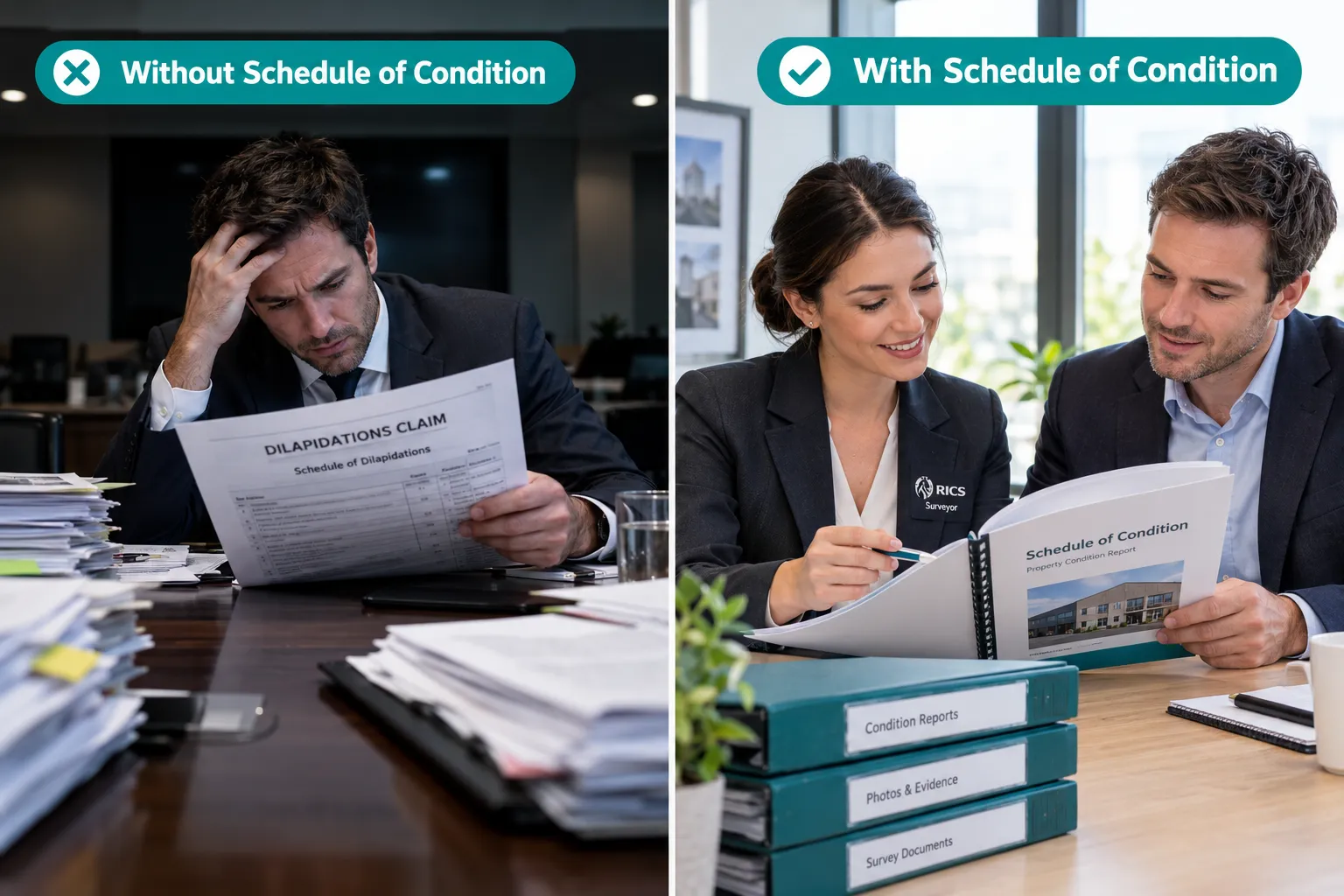
The single most effective step a commercial tenant can take to limit end-of-lease costs is to negotiate and attach a Schedule of Condition to the lease before or at the point of signing. This document records the exact physical state of the property at the commencement of the tenancy, supported by photographs and written descriptions [2].
Without a Schedule of Condition, a tenant may be required to return the property in a better condition than it was when they took it on, a position that is both commercially unfair and legally challengeable, but expensive to dispute retrospectively.
What a Schedule of Condition should include:
- Photographs of all internal and external elements, dated and referenced
- Written descriptions of existing defects, wear, and decorative condition
- Notes on any pre-existing alterations or non-standard installations
- Confirmation that both parties have agreed and signed the document
A Schedule of Condition limits the tenant's repairing covenant to the condition evidenced at lease start. This means the landlord cannot demand that the tenant remedy defects that existed before the lease began [2].
For a detailed explanation of what this type of report covers, see what is a Schedule of Condition report.
When to Commission a Dilapidations Survey for Commercial Tenants: How to Limit End-of-Lease Costs and Disputes
Timing is critical. Many tenants make the mistake of waiting until they receive the landlord's terminal schedule before engaging a surveyor. By that point, the landlord has already set the agenda, the costs are framed in their favour, and the tenant is in a reactive position.
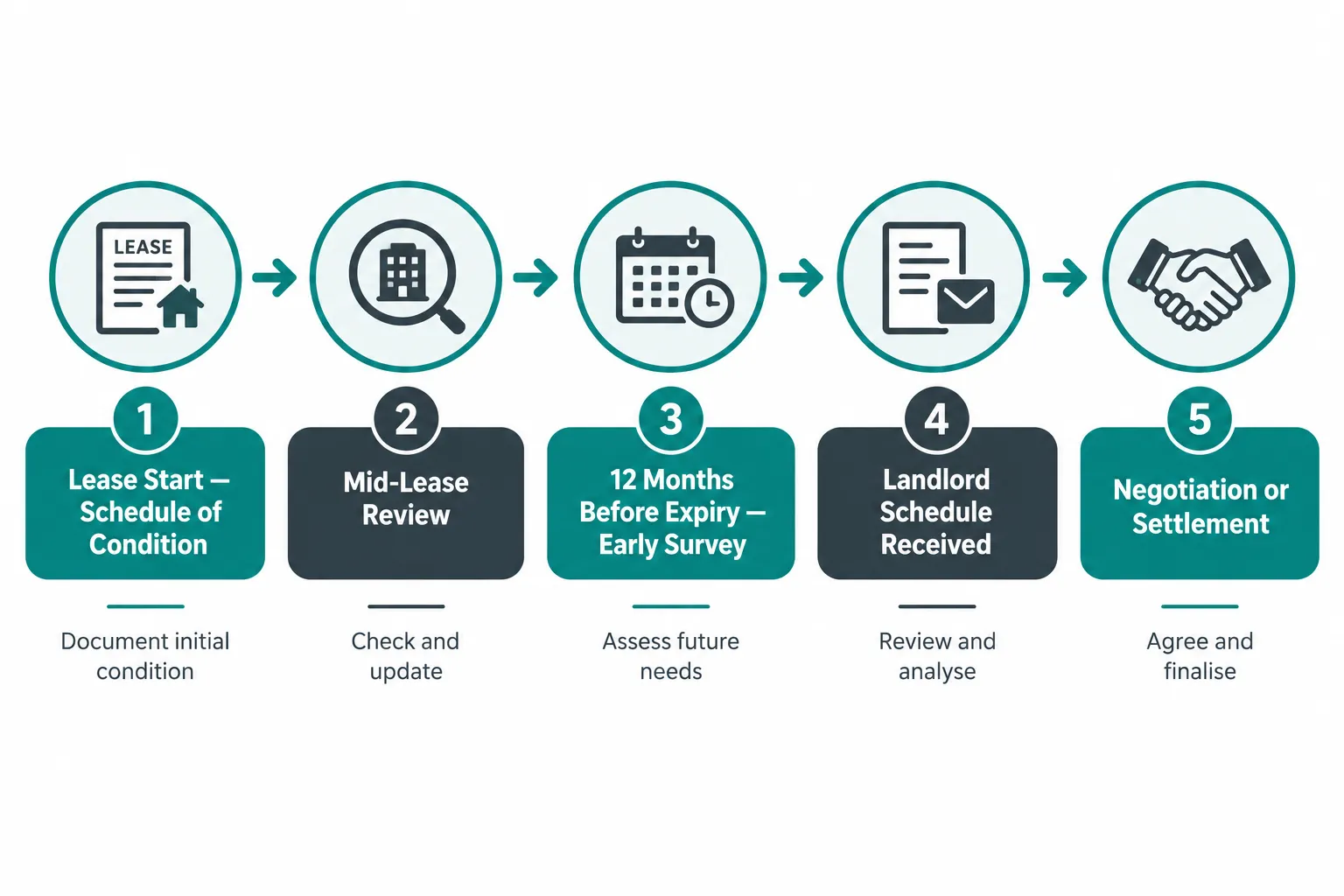
The recommended approach is proactive and staged:
| Stage | Timing | Action |
|---|---|---|
| Lease commencement | Day one | Agree and attach Schedule of Condition |
| Mid-lease review | Every 3-5 years | Internal review of repair obligations and alterations |
| Early dilapidations survey | 12 months before expiry | Commission independent tenant's survey |
| Response to landlord schedule | Within 56 days (RICS protocol) | Serve a counter-schedule via your surveyor |
| Negotiation and settlement | Before or after lease end | Agree a financial settlement or remedial works |
Industry guidance now strongly recommends commissioning a tenant's dilapidations survey 6 to 12 months before lease expiry [3]. This gives the tenant time to:
- Understand their actual obligations before the landlord quantifies them
- Carry out cost-effective remedial works rather than paying a landlord's premium rates
- Identify items where no liability exists and build a documented defence
- Prepare financial provisions accurately for accounting purposes
Early engagement also creates negotiating leverage. A tenant who arrives at the end of the lease with a well-documented counter-position is in a far stronger position than one who simply accepts the landlord's figures.
Understanding Your Legal Protections: Section 18(1) and Diminution Valuations
One of the most important, and most underused, protections available to commercial tenants is Section 18(1) of the Landlord and Tenant Act 1927. This provision places a statutory cap on dilapidations claims in two ways:
-
The first limb: The landlord's claim cannot exceed the diminution in the value of the landlord's reversion caused by the breach. In plain terms, the landlord cannot recover more than the reduction in the property's market value attributable to the disrepair.
-
The second limb: No damages are recoverable at all if the landlord intends to demolish, structurally alter, or redevelop the property in a way that would render the repairs valueless.
A diminution valuation is a specialist RICS valuation that quantifies the actual reduction in the property's value caused by the alleged disrepair. In many cases, particularly where a landlord plans to refurbish or redevelop, this valuation demonstrates that the property's value has not been reduced by the full cost of the claimed repairs, and the tenant's liability is correspondingly lower [9].
"A diminution valuation is not a technicality, it is a fundamental legal cap that every commercial tenant facing a large dilapidations claim should consider."
Specialist valuers and expert witnesses play a key role here. For tenants facing disputed claims, valuation dispute expert witness services in London provide the independent professional evidence needed to challenge inflated schedules effectively.
The RICS protocol for dilapidations (set out in the 7th edition guidance) also requires both parties' surveyors to follow a structured process of negotiation before litigation, which keeps most disputes out of court [1].
How Dilapidations Affect Your Balance Sheet: Accounting and Financial Planning
Since the adoption of IFRS 16 and the related requirements under UK GAAP, commercial tenants are required to recognise a dilapidations provision on their balance sheet throughout the lease term [8]. This provision represents the estimated future cost of restoring the property to the condition required by the lease.
Failure to maintain an accurate provision creates two problems:
- Financial reporting risk: Understated provisions can misrepresent a company's liabilities to shareholders, lenders, and auditors.
- Cash flow risk: A large, unplanned dilapidations settlement at lease end can create significant liquidity pressure, particularly for smaller businesses.
Regular dilapidations surveys, not just at lease end, but at intervals during the lease, allow tenants to maintain accurate provisions, update their financial forecasts, and avoid last-minute surprises [8].
This is particularly relevant for multi-site occupiers managing a portfolio of commercial leases. A structured, data-driven approach to dilapidations management across a portfolio can produce substantial savings and reduce the risk of disputes at multiple sites simultaneously.
For businesses occupying commercial premises in London, working with commercial property surveyors in London who understand both the surveying and valuation dimensions of dilapidations is essential for accurate provisioning.
Responding to a Landlord's Schedule of Dilapidations
When a landlord serves a terminal schedule of dilapidations, the tenant has a defined window, typically 56 days under the RICS dilapidations protocol, to respond [1]. The response should be prepared by a specialist building surveyor acting on the tenant's behalf and should address each item in the landlord's schedule systematically.
A robust tenant's response will typically:
- Challenge items where no lease obligation exists
- Dispute the scope or specification of claimed remedial works
- Apply betterment arguments where landlord repairs would improve the property beyond its pre-lease condition
- Reference the Schedule of Condition to exclude pre-existing defects
- Commission a diminution valuation where the Section 18(1) cap is likely to reduce the claim
- Identify items where the landlord's costing is excessive or based on inappropriate specifications
The goal is not necessarily to avoid all liability, most tenants do have genuine obligations, but to ensure the claim is fair, accurate, and legally capped. In practice, the majority of dilapidations disputes are resolved through negotiation between the parties' surveyors, with a financial settlement agreed in lieu of works [7].
Where disputes cannot be resolved, options include mediation, independent expert determination, or litigation. However, these routes are costly and time-consuming, and the RICS protocol is specifically designed to encourage settlement before they become necessary [7].
Practical Strategies for Tenants: Managing Alterations and Reinstatement
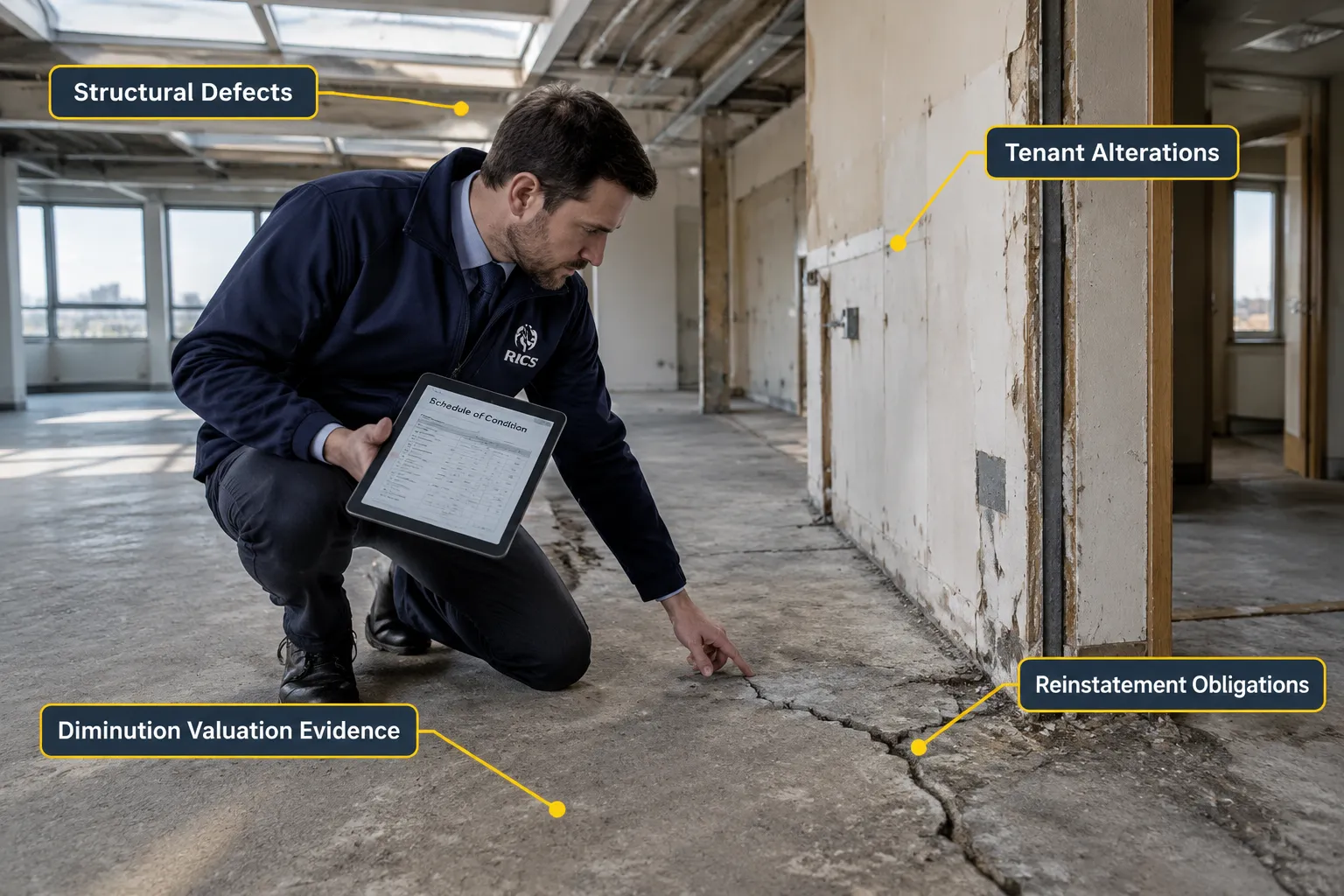
Many of the most contentious dilapidations items relate to tenant alterations, fit-outs, partitions, raised floors, suspended ceilings, and mechanical and electrical installations. Most commercial leases require tenants to reinstate the property to its original condition at lease end unless the landlord has agreed in writing to waive reinstatement.
Key actions to manage alteration risk:
- Always obtain a formal licence to alter before carrying out any works, and ensure it specifies whether reinstatement is required
- Keep records of all alterations, including specifications, drawings, and contractor invoices
- Review reinstatement obligations well before lease expiry, reinstatement works are almost always cheaper when planned in advance
- Consider negotiating a waiver of reinstatement with the landlord, particularly if the alterations add value to the property
- Document the condition of the property after reinstatement works are complete
Sustainability is becoming an increasingly important factor in dilapidations negotiations. In 2026, landlords and tenants are paying greater attention to circular fit-out principles, the idea that fit-out components should be designed for reuse or recycling rather than demolition. Tenants who can demonstrate that their fit-out has residual value may be better placed to negotiate a waiver of full reinstatement.
Dilapidations Survey for Commercial Tenants: How to Limit End-of-Lease Costs and Disputes, Choosing the Right Surveyor
Not all surveyors have the specialist knowledge required to handle commercial dilapidations effectively. Tenants should look for a RICS-qualified building surveyor with specific experience in commercial dilapidations, including:
- Preparation and negotiation of schedules of dilapidations
- Diminution valuations and Section 18(1) analysis
- Expert witness experience for disputed claims
- Knowledge of the RICS 7th edition guidance and dilapidations protocol [4]
The cost of a commercial dilapidations survey in 2026 typically ranges from approximately £500 for a small unit to £5,000 or more for a large or complex property [10]. This investment is almost always justified: a well-prepared tenant's survey can reduce a landlord's claim by a multiple of the survey fee, particularly on larger premises.
For tenants with premises across London and the South East, commercial property surveyors in London with dilapidations expertise provide both the surveying and valuation services needed to manage end-of-lease risk comprehensively.
Where a claim is disputed and expert witness evidence is required, an expert witness report from a London surveyor provides the independent professional opinion that courts and mediators require.
Conclusion: Actionable Next Steps for Commercial Tenants
A dilapidations survey for commercial tenants, approached early, managed strategically, and supported by the right professional expertise, transforms what is often a reactive crisis into a controlled, manageable process.
Take these steps now:
- If you are entering a new lease: Negotiate a Schedule of Condition before signing and attach it formally to the lease documents.
- If you are mid-lease: Review your repairing obligations, document all alterations, and ensure your balance sheet provision is accurate and up to date.
- If your lease expires within 12 months: Commission an independent tenant's dilapidations survey immediately, do not wait for the landlord's schedule.
- If you have received a landlord's schedule: Instruct a specialist surveyor to prepare a counter-schedule and consider a diminution valuation to apply the Section 18(1) cap.
- If a dispute has escalated: Seek expert witness support and explore mediation before committing to litigation.
The legal framework, including the RICS 7th edition guidance, the dilapidations protocol, and Section 18(1) of the Landlord and Tenant Act 1927, provides tenants with real and substantial protections [1][9]. The key is to use those protections proactively, with the support of a qualified specialist, rather than discovering them only after an inflated claim has arrived.
References
[1] Dilapidations In England And Wales – rics.org
[2] Rics Dilapidations Consumer Guide 1 – chpk.co.uk
[3] What Is A Dilapidation Survey – jarvale.co.uk
[4] Building Surveying Standards – aemdev.rics.org
[6] Dilapidations In Scotland – rics.org
[7] Options Commercial Property Dispute – pearcelegal.co.uk
[8] How Can Dilapidations Assessments Affect Your Balance Sheet – linkedin.com
[9] Diminution Valuations In Dilapidation Claims – higgsllp.co.uk
[10] Dilapidations Survey What It Is When Needed – earlkendrick.com