Roughly 4.98 million leasehold dwellings exist in England alone, yet many owners remain genuinely uncertain about what drives the premium they must pay, and why the figure for buying the freehold almost always differs from the cost of simply extending the lease. Understanding Lease Extension Valuation vs Buying the Freehold: How Surveyors Calculate Different Premiums is not merely an academic exercise; it directly determines how much money leaves a leaseholder's pocket at the negotiating table.
Key Takeaways
- Lease extension and freehold purchase premiums are both calculated under the same statutory framework, but freehold purchase typically costs more because it transfers the entire reversionary interest and all ground-rent income.
- Marriage value, the uplift in combined property value created by the transaction, is still payable in full on any lease with fewer than 80 years remaining, despite being abolished in statute by the Leasehold and Freehold Reform Act 2024 (LFRA), because the relevant provisions have not yet been commenced as of 2026.
- The shorter the unexpired lease term, the higher the premium; crossing below 80 years triggers marriage value and can dramatically increase costs.
- The LFRA 2024 will eventually abolish marriage value, cap ground rent at 0.1% of freehold vacant possession value in calculations, and introduce prescribed rates, but no commencement date has been set for these valuation provisions as of August 2026.
- Professional surveyor fees for a lease extension valuation typically run between £600 and £1,500, a predictable cost that should be budgeted alongside the statutory premium itself.
The Statutory Framework Both Valuations Share
Before examining the differences, it helps to understand what lease extension and freehold purchase valuations have in common. Both are governed, for now, by the Leasehold Reform, Housing and Urban Development Act 1993 (the "1993 Act"). Both require a qualified surveyor to model the financial interests being transferred from freeholder to leaseholder, and both use the same core building blocks.
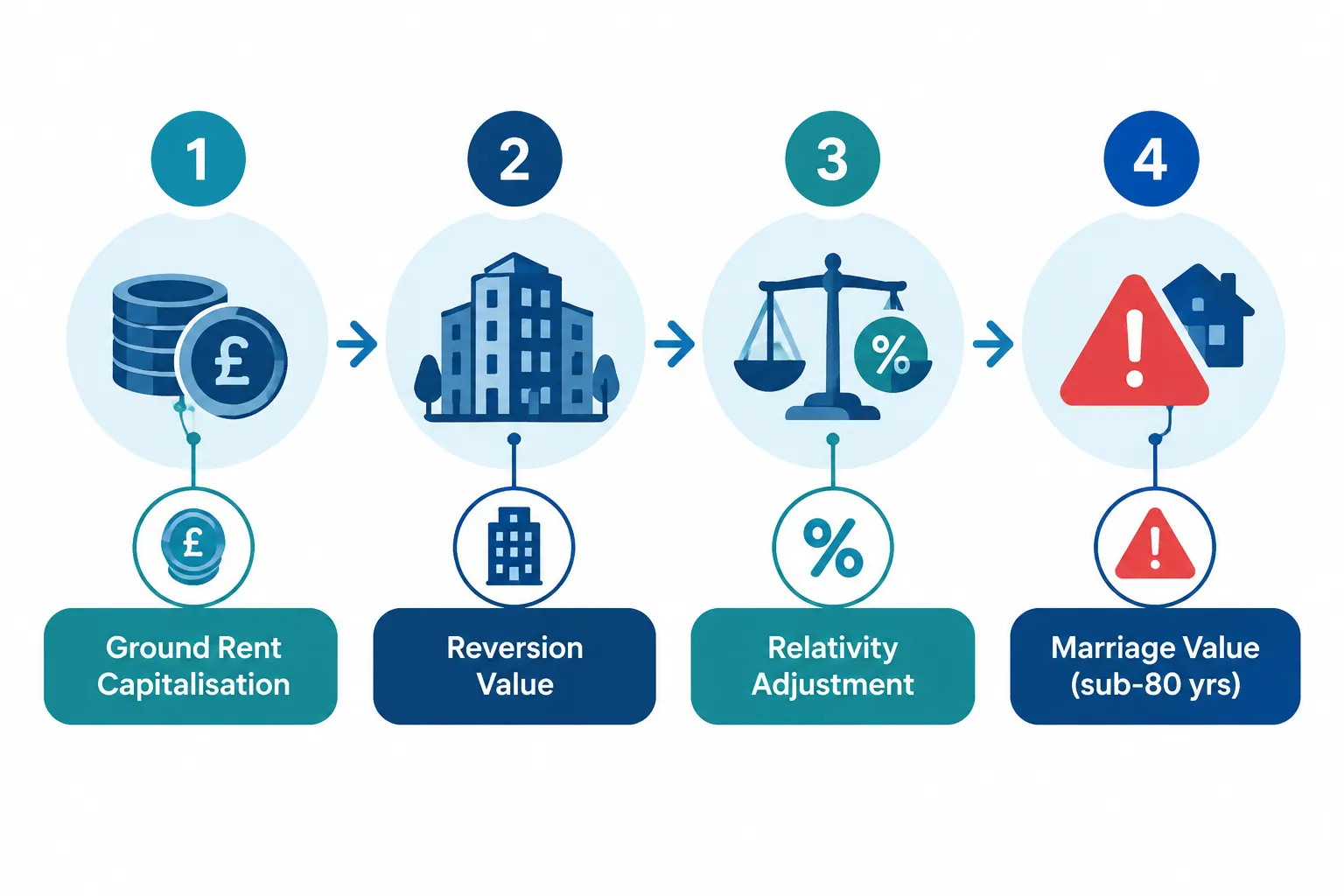
Those building blocks are:
- Ground rent capitalisation: The present value of the income stream the freeholder will lose when ground rent falls to a peppercorn.
- Reversion value: The present value of the freeholder's right to regain possession of the property at the end of the current lease term.
- Relativity: An adjustment that reflects how much less a leasehold interest with a short unexpired term is worth compared with the freehold, expressed as a percentage.
- Marriage value: An additional sum payable only when the unexpired lease term has fallen below 80 years, representing half the uplift in combined property value created by the transaction.
Surveyors apply these components using capitalisation and deferment rates, typically around 5-6% for deferment in most London markets, to discount future income and reversionary interests back to today's values. For a detailed explanation of how these rates interact in a London context, the Lease Extension Valuation London guide from Kingston Surveyors provides a practical overview.
Why Ground Rent Matters More Than Most Owners Realise
Ground rent is often dismissed as a minor annual charge, but in a valuation it represents a capitalised income stream. A ground rent of £250 per year on a lease with 85 years remaining, capitalised at 6%, produces a present value figure that adds meaningfully to the premium. When that same ground rent escalates, doubling every 25 years, for example, the capitalised value rises sharply, sometimes adding thousands of pounds to the statutory premium.
Under the LFRA 2024, once the relevant provisions are commenced, ground rent will be capped at 0.1% of the freehold vacant possession value for calculation purposes [5]. A parliamentary written answer confirmed that this cap, alongside the abolition of marriage value and the introduction of prescribed rates, forms the core of the new valuation model [5]. However, as of August 2026, these provisions remain uncommenced, and surveyors must still capitalise the actual contractual ground rent [1][12].
How Surveyors Calculate a Lease Extension Premium
A statutory lease extension under the 1993 Act adds 90 years to the unexpired term and reduces ground rent to a peppercorn. The surveyor's task is to calculate the premium that fairly compensates the freeholder for giving up those two things.
The formula, in simplified terms, is:
Premium = Ground Rent Capitalisation + Reversion Value + (50% of Marriage Value if applicable)
Worked Example: Lease Extension at 95 Years Remaining
Consider a flat in London with a market value of £300,000, a ground rent of £200 per year, and 95 years remaining on the lease.
| Component | Calculation basis | Approximate value |
|---|---|---|
| Ground rent capitalisation | £200/yr capitalised at 6% | ~£1,800 |
| Reversion value | £300,000 deferred 95 yrs at 5% | ~£2,100 |
| Marriage value | Not applicable (above 80 yrs) | £0 |
| Total premium | ~£3,900 |
This aligns with online calculator estimates suggesting premiums of roughly £3,000,£5,000 for a flat worth approximately £300,000 with a lease above 90 years [8][4].
Worked Example: Lease Extension at 75 Years Remaining
Now reduce the unexpired term to 75 years. Marriage value now applies because the lease has fallen below 80 years.
| Component | Approximate value |
|---|---|
| Ground rent capitalisation | ~£2,100 |
| Reversion value | ~£5,500 |
| Marriage value (50% share) | ~£8,000,£14,000 |
| Total premium | ~£15,600,£21,600 |
Calculator estimates for a similar property at around 70-75 years unexpired suggest premiums in the range of £14,000,£22,000 [8][11]. The jump is stark. Marriage value alone can represent the largest single component of the premium once the lease dips below 80 years [7].
Key point: Every year a leaseholder delays acting on a lease below 80 years, the marriage value component grows, sometimes by thousands of pounds annually. This is why surveyors consistently advise acting before the lease crosses that threshold [1][9].
For answers to common questions about timescales, eligibility, and costs, the Lease Extension Estimate and FAQs page covers the most frequent leaseholder queries.
Lease Extension Valuation vs Buying the Freehold: How Surveyors Calculate Different Premiums
The core distinction between a lease extension premium and a freehold purchase premium lies in what is actually being transferred.
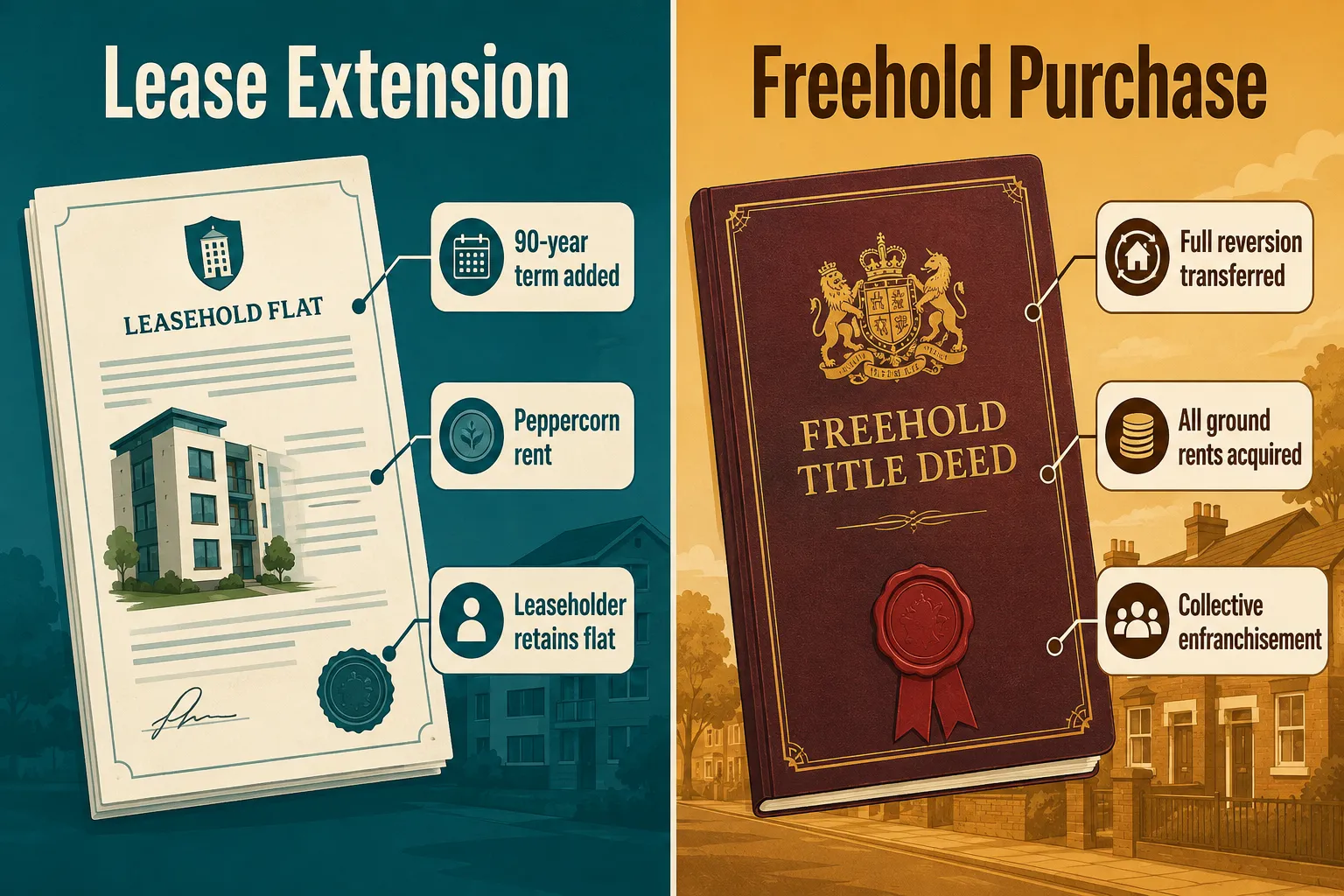
When a leaseholder extends their lease, the freeholder gives up:
- The right to receive ground rent for the new extended term
- The right to regain possession at the end of the existing term
When leaseholders collectively buy the freehold (collective enfranchisement), the freeholder gives up everything: the entire reversionary interest, all future ground rents from all flats, and the right to manage the building. This is a fundamentally larger transfer of value, which is why freehold purchase premiums are almost always higher than individual lease extension premiums on the same property [4][11].
The Additional Components in Freehold Purchase
In a collective enfranchisement valuation, surveyors must additionally account for:
- Ground rents from all participating flats, not just one
- The freehold reversion on all flats, including any that are not participating
- Development value or hope value, if the freeholder can demonstrate a reasonable prospect of development
- Relativity adjustments across multiple leases with potentially different unexpired terms
This means that even before marriage value is considered, a freehold purchase valuation is structurally more complex and the headline premium is higher. For a building of six flats, each paying £250 per year ground rent, the capitalised ground rent component alone is six times larger than in a single lease extension.
Marriage Value in Collective Enfranchisement
Marriage value applies in collective enfranchisement on the same sub-80-year trigger as in individual lease extensions. However, because the calculation aggregates multiple flats, the marriage value component can be substantial, particularly in older buildings where several leases may have drifted below 80 years simultaneously.
The LFRA 2024 abolishes marriage value for both lease extensions and freehold purchases once commenced [7][6]. An impact assessment addendum published by the government estimated that the reforms could reduce aggregate premiums by tens of millions of pounds across the appraisal period [2]. However, practitioners and commentators stress that these savings remain theoretical: no commencement date has been set for the valuation provisions, and realistic estimates now point to 2027-2028 at the earliest [9][12].
For those considering the collective route, the Buying the Freehold London page sets out the process, eligibility requirements, and strategic considerations specific to London properties.
The Impact of the Leasehold and Freehold Reform Act 2024 on Valuations
The LFRA 2024 represents the most significant overhaul of leasehold valuation law in a generation. Its stated aims include making the process cheaper, simpler, and fairer for leaseholders. The key valuation changes in the Act are:
- Abolition of marriage value for all lease extensions and freehold purchases, regardless of lease length [7][6]
- Ground rent capped at 0.1% of freehold vacant possession value for calculation purposes, regardless of the actual contractual ground rent [5]
- Prescribed rates for deferment and capitalisation, to be set by ministers, removing the current uncertainty and dispute over which rates to apply [5]
- Standard 990-year extension terms replacing the current 90-year extension [9]
- A unified valuation method applicable to both lease extensions and freehold purchases, designed to narrow the gap between the two premiums [13][14]
What Is Actually in Force in 2026
Despite the headlines, a technical review of commencement orders confirms that the valuation provisions of the LFRA 2024, including the abolition of marriage value and the new prescribed rates, have not been commenced as of August 2026 [1][12]. They are annotated as "yet to be applied." Surveyors completing transactions in 2026 must still use the existing 1993 Act framework in full [1][9].
A High Court challenge (ARC Time Freehold Income Authorised Fund v Secretary of State) confirmed that the LFRA's valuation changes are compatible with human rights law under Article 1 of Protocol 1 ECHR [6][14]. This ruling clears a significant legal obstacle to implementation but does not itself bring the provisions into force [6].
The government has indicated that a consultation on prescribed valuation rates was scheduled for summer 2025 [5]. More recent commentary warns that anyone quoting precise implementation dates is "guessing," and that 2027-2028 is a more realistic horizon [9][12].
Practical implication for 2026: Do not base a decision on when to extend or enfranchise on anticipated reforms. Act on the law currently in force. If the lease is approaching 80 years, the cost of waiting, in marriage value terms, almost certainly outweighs any potential saving from future reform [1][9].
Surveyor Fees and the Full Cost Picture
Understanding the premium is only part of the financial picture. Professional fees are a significant and predictable element of both lease extension and freehold purchase transactions.

Typical surveyor valuation fees for a lease extension in 2026 fall in the range of £600,£900 for a specialist valuation report, with some firms quoting £800,£1,500 for the valuation plus negotiation support [3][10]. A full end-to-end service including negotiation and correspondence can cost around £2,475 plus VAT [10]. A typical transaction budget might look like this:
| Professional cost | Typical range |
|---|---|
| Surveyor valuation fee | £600,£1,500 |
| Leaseholder's solicitor | £1,200,£2,500 |
| Freeholder's surveyor (leaseholder pays) | £400,£800 |
| Freeholder's legal fees (leaseholder pays) | £400,£800 |
| Land Registry fee | £20,£500 |
Note that leaseholders are generally required to pay the freeholder's reasonable surveyor and legal costs as part of the statutory process, a factor that adds to the total outlay beyond the premium itself [3].
For context on what RICS-standard valuations involve and how fees are structured, the RICS Valuation Cost guide provides a useful reference. Where a freeholder cannot be traced, specialist advice is available through an Absentee Freeholder Valuation service, which handles the additional procedural steps required in those circumstances.
Strategic Considerations: Extension or Freehold?
Choosing between extending a lease and buying the freehold is not purely a valuation question, it is also a strategic and practical one.
Factors favouring a lease extension:
- Simpler process requiring only one leaseholder to act
- Lower upfront premium (especially above 80 years remaining)
- Suitable when collective enfranchisement is not viable (e.g., fewer than the required proportion of qualifying tenants)
- Faster to complete
Factors favouring buying the freehold:
- Full control over the building, service charges, and management
- Eliminates ground rent permanently for all participating leaseholders
- Can be more cost-effective per flat when ground rents are high or multiple leases are short
- Removes ongoing freeholder relationship and associated disputes
The forthcoming prescribed-rate regime and abolition of marriage value are expected to compress the gap between extension and freehold premiums, particularly in blocks with multiple short leases [2][13]. Once commenced, this may shift the strategic calculus, but for now, surveyors advise clients based on the current law.
For broader context on leasehold property in London, the Leasehold in London overview from Kingston Surveyors covers the full range of options and obligations facing leaseholders in 2026.
Conclusion
The differences in how surveyors calculate Lease Extension Valuation vs Buying the Freehold: How Surveyors Calculate Different Premiums come down to the scope of what is being transferred, the number of interests involved, and, critically, whether the unexpired lease term has crossed the 80-year marriage value threshold.
Actionable next steps for leaseholders in 2026:
- Check your unexpired lease term immediately. If it is approaching 80 years, commission a surveyor's valuation now rather than waiting for LFRA reforms that have no confirmed commencement date [1][9].
- Obtain a formal valuation before serving notice. A RICS-qualified surveyor will calculate the premium using the current statutory framework, giving you a defensible opening position.
- Budget for the full cost picture, including the freeholder's reasonable professional fees, not just the premium itself [3].
- Assess collective enfranchisement viability if you live in a block, buying the freehold collectively can deliver long-term savings despite the higher initial premium.
- Monitor LFRA commencement. When the valuation provisions are eventually brought into force, the abolition of marriage value will materially reduce premiums on sub-80-year leases. Stay informed, but do not gamble on timing.
Working with a qualified, experienced surveyor is the single most important step. An accurate valuation protects against overpaying and provides the foundation for effective negotiation, whether the goal is a 90-year extension or full freehold ownership.
References
[1] Leasehold And Freehold Reform Act 2024 – connaughtlaw.com
[2] 250404 Lfra Ia Addendum Final Version – assets.publishing.service.gov.uk
[3] Lease Extension Costs – hoa.org.uk
[4] How Much Does Lease Extension Cost 2026 – propertypassport.uk
[5] questions-statements.parliament.uk – questions-statements.parliament.uk
[6] Marriage Value Abolished High Court Upholds Leasehold Reform Act – clapham-collinge.co.uk
[7] What Is Marriage Value Leasehold – propertypassport.uk
[8] Lease Extension Calculator – housecheckup.co.uk
[9] Leasehold Reform Act 2024 Explained – homethink.co.uk
[10] Surveyor For Lease Extension – surveymerchant.com