Nearly one in three UK property transactions collapses after an offer is accepted, and hidden structural defects are among the most cited reasons. Yet thousands of buyers every year spend money on a mortgage valuation, assume they are protected, and discover too late that the report they paid for was never written for them in the first place. Understanding the real difference between building survey cost vs valuation fee is not a minor administrative detail, it is one of the most financially consequential decisions a buyer will make in 2026.
This article provides a clear, side-by-side breakdown of what each service includes, what it costs, and what it actually delivers in terms of defect coverage, negotiation leverage, and long-term risk reduction.
Key Takeaways
- A mortgage valuation is produced for the lender, not the buyer, and rarely identifies structural defects in detail.
- A building survey is the buyer's own independent report, covering condition, defects, and maintenance risks.
- In 2026, a mortgage valuation typically costs between £150 and £1,500 depending on property value and lender; a Level 3 building survey ranges from £600 to £1,500 or more.
- Buyers who commission a building survey gain documented evidence to renegotiate the purchase price or withdraw safely.
- RICS standards govern both types of report, but the scope, depth, and legal ownership of each differ fundamentally.
What a Mortgage Valuation Actually Covers
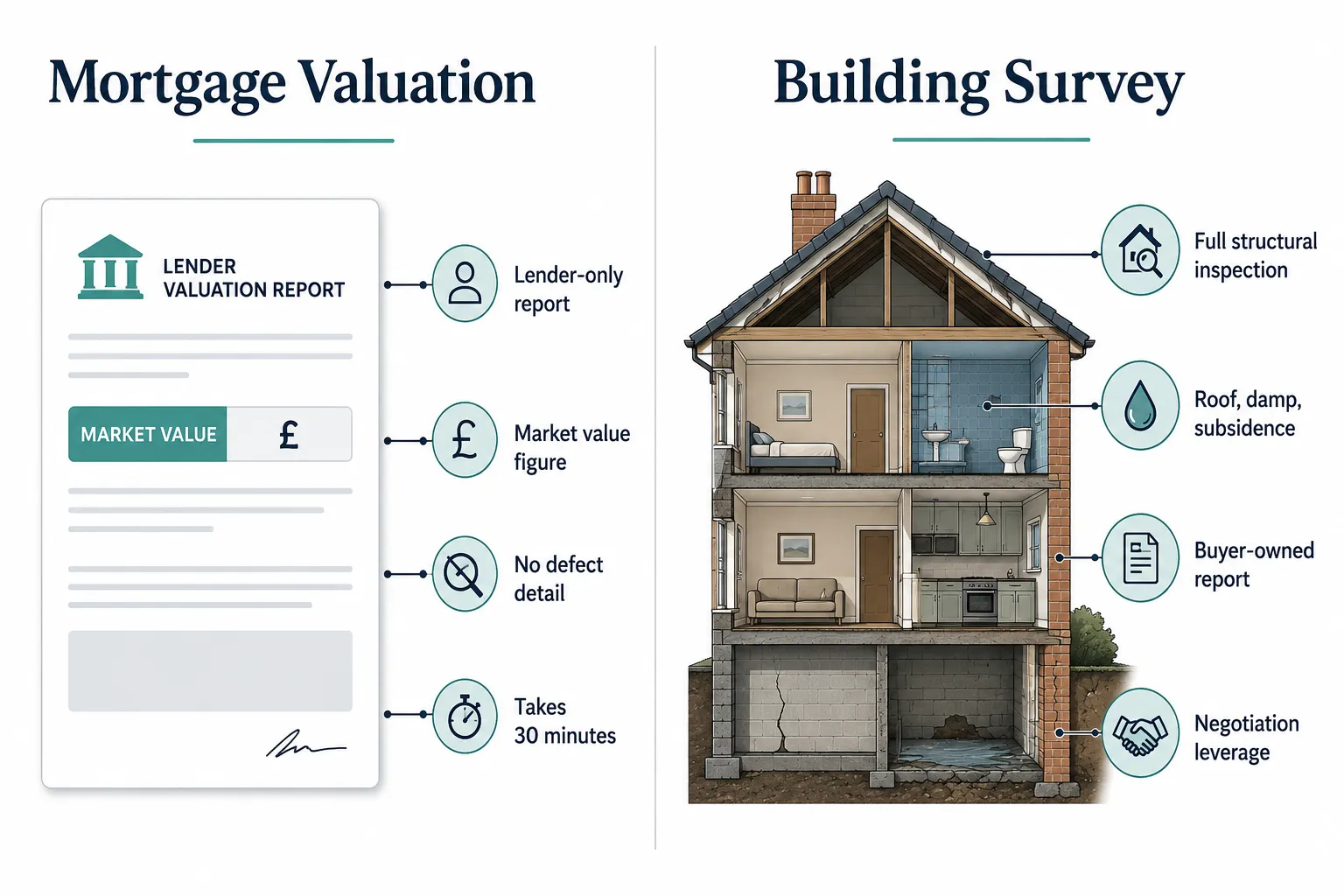
When a buyer applies for a mortgage, the lender instructs a valuation to confirm the property is worth the amount being lent. This is a lender-protection exercise, not a buyer-protection exercise. The resulting document belongs to the lender and is produced primarily to satisfy underwriting requirements [1].
A mortgage valuation typically involves a brief visit, sometimes as short as 20 to 30 minutes, during which a RICS-registered valuer assesses the property's market value against comparable sales. The report is rarely shared in full with the buyer, and even when a summary is provided, it contains little or no detail about the building's structural condition.
Halifax, for example, offers a standard valuation for mortgage purposes that confirms market value but explicitly states it is not a survey and does not provide advice on the condition of the property [5]. Kensington Mortgages similarly charges a valuation fee as part of its mortgage product costs, with the figure varying by loan size and property value, but the output remains a lender-facing document.
What a mortgage valuation does NOT cover:
- Roof structure, coverings, or chimney stacks
- Damp, rot, or timber decay
- Subsidence or structural movement
- Drainage, electrics, or heating systems
- Outbuildings, extensions, or boundary issues
For buyers who want to understand what factors affect a property valuation, it is worth noting that a valuation focuses on market comparables and location rather than on the physical condition of the building.
How Much Does a Mortgage Valuation Cost in 2026?
Valuation fees are typically calculated as a percentage of the property's value or set on a sliding scale. Based on current market data, buyers can expect the following approximate ranges [4]:
| Property Value | Approximate Valuation Fee |
|---|---|
| Up to £100,000 | £150, £250 |
| £100,001, £250,000 | £250, £400 |
| £250,001, £500,000 | £400, £600 |
| £500,001, £1,000,000 | £600, £900 |
| Over £1,000,000 | £900, £1,500+ |
Some lenders offer free valuations as part of a mortgage deal, particularly on standard residential purchases. However, "free" in this context means the lender absorbs the cost, the buyer still receives no independent protection [8].
What a Building Survey Delivers: Scope, Standards, and Value
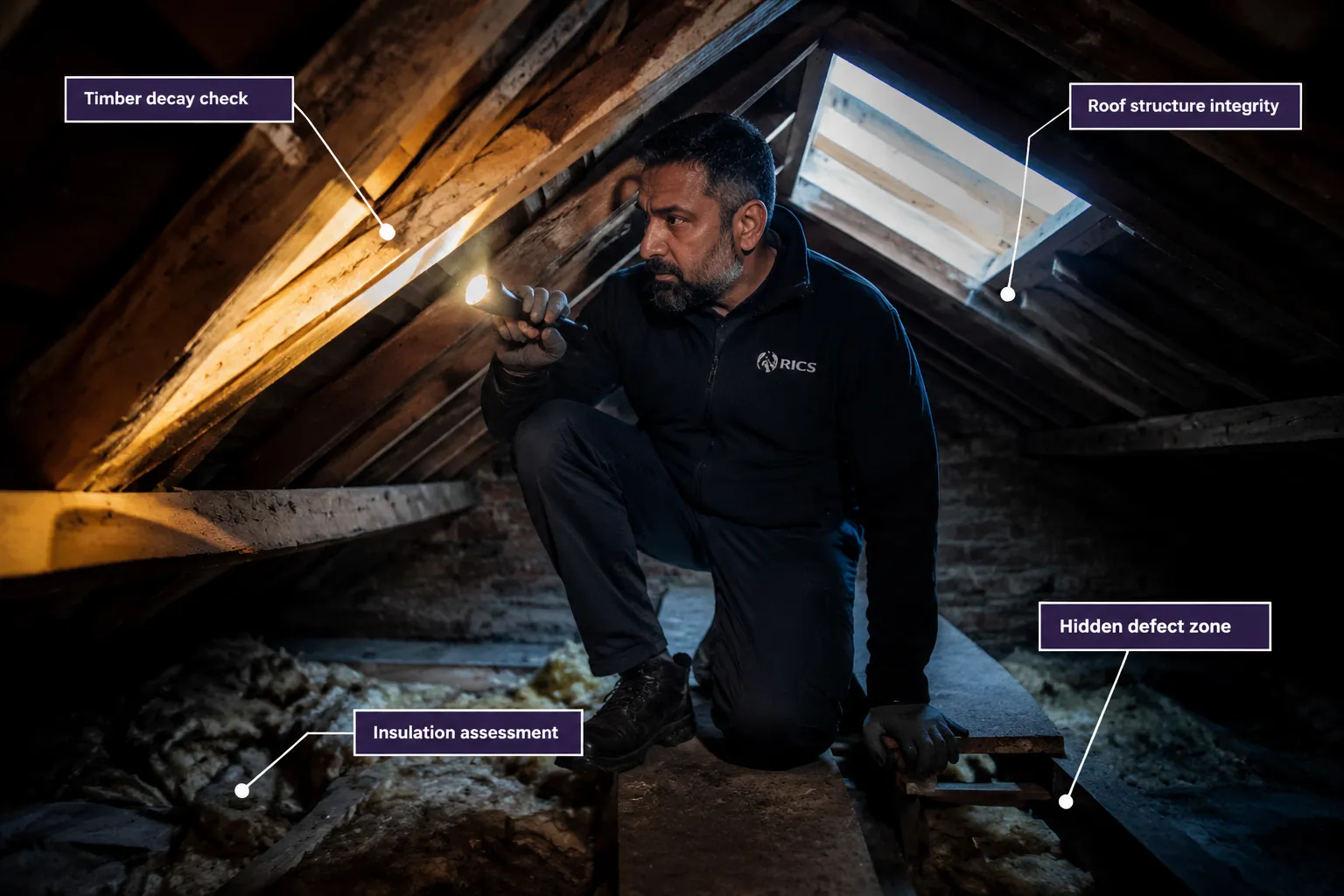
A building survey, formally categorised under RICS Home Survey Standards as a Level 3 survey, is the most comprehensive inspection available to residential buyers. Unlike a mortgage valuation, this report is commissioned by and belongs to the buyer. Its purpose is to identify defects, assess their severity, and provide guidance on remediation [3].
RICS has been developing updated Home Survey Standards to ensure that all Level 1, 2, and 3 surveys meet consistent quality benchmarks. The draft standard published in 2025 reinforces requirements around inspector competence, reporting clarity, and the use of condition ratings [6][9]. This matters because it means buyers commissioning a survey in 2026 can expect a more standardised, accountable output than in previous years.
A Level 3 building survey typically includes:
- Full structural inspection of walls, floors, roof, and foundations
- Damp and timber assessment, including identification of rot, woodworm, and rising damp
- Drainage and services overview (visual inspection)
- Identification of subsidence, settlement, or heave
- Condition ratings (1 = no action, 2 = monitor, 3 = urgent attention)
- Estimated repair costs or guidance on obtaining specialist quotes
- Legal and planning observations, such as evidence of unpermitted works
For buyers purchasing older or non-standard properties, a building survey in London or elsewhere in the UK provides the depth of analysis that a mortgage valuation simply cannot replicate. Similarly, buyers in the South East may benefit from a building survey in Kent carried out by a locally experienced RICS surveyor who understands regional construction types.
RICS Levels Explained
| Survey Level | Formal Name | Typical Use Case |
|---|---|---|
| Level 1 | RICS Home Survey, Level 1 | New builds, modern properties in good condition |
| Level 2 | RICS Home Survey, Level 2 | Standard properties in reasonable condition |
| Level 3 | RICS Home Survey, Level 3 | Older, larger, or non-standard properties |
For buyers uncertain whether a Level 2 or Level 3 report is appropriate, the guide on HomeBuyers Report vs Building Survey provides a clear framework for choosing the right level of inspection.
How Much Does a Building Survey Cost in 2026?
Building survey fees vary by property size, age, location, and surveyor. Typical 2026 ranges are [7][10]:
| Survey Level | Approximate Cost Range |
|---|---|
| Level 1 | £300, £600 |
| Level 2 (HomeBuyer Report) | £400, £900 |
| Level 3 (Full Building Survey) | £600, £1,500+ |
London and the South East command higher fees due to property values and surveyor availability. Buyers wanting to understand how much a Level 2 survey costs can find detailed breakdowns by region and property type.
A building survey costing £800 on a £400,000 property represents 0.2% of the purchase price, yet it can uncover defects worth tens of thousands of pounds in remediation costs.
Building Survey Cost vs Valuation Fee: A Direct Comparison
The core distinction in the building survey cost vs valuation fee debate is not simply price, it is purpose, ownership, and outcome. The table below summarises the key differences:
| Feature | Mortgage Valuation | Level 3 Building Survey |
|---|---|---|
| Who commissions it? | Lender | Buyer |
| Who owns the report? | Lender | Buyer |
| Structural defect coverage | Minimal or none | Comprehensive |
| Damp and timber assessment | Not included | Included |
| Negotiation leverage | None | Significant |
| Typical 2026 cost | £150, £1,500 | £600, £1,500+ |
| RICS regulated | Yes | Yes |
The Negotiation Leverage Argument
One of the most underappreciated benefits of commissioning a building survey is the negotiation power it provides. When a Level 3 survey identifies, for example, significant roof covering deterioration, failed cavity wall ties, or evidence of subsidence, the buyer has documented, professional evidence to:
- Request a reduction in the agreed purchase price
- Ask the seller to carry out remedial works before exchange
- Withdraw from the transaction without financial penalty
A mortgage valuation provides none of this. Because it does not assess condition in detail, it cannot be used as leverage in price negotiations. Buyers who rely solely on a valuation are, in effect, proceeding blind on the physical condition of what may be the largest purchase of their lives.
It is also worth noting that the 10 most common property defects found in building surveys, including damp penetration, roof failures, and structural cracking, are precisely the issues that a valuation will not flag.
Fee Inflation, Market Pressures, and What Buyers Should Watch in 2026
The UK property survey market is experiencing notable fee pressures in 2026. Buy-to-let mortgage fees have risen sharply, with some lenders increasing arrangement and valuation charges by 10 to 15% compared with 2024 levels [2]. This has a knock-on effect on the overall cost of purchasing, particularly for investors and portfolio landlords who may be tempted to cut costs by skipping an independent survey.
At the same time, RICS has been working to raise the baseline quality of home surveys through its updated Home Survey Standard, which sets clearer expectations around inspector competence and reporting [9]. The practical implication for buyers is positive: a survey commissioned from a RICS-regulated firm in 2026 should meet a higher and more consistent standard than in previous years.
However, the market also contains a segment of very low-cost survey offerings. Surveyors operating under significant fee pressure may be unable to dedicate the time required to conduct a thorough inspection. A Level 3 survey on a Victorian terrace requires several hours on site plus report-writing time. Fees significantly below the market range may indicate a compressed inspection that misses critical defects [1].
Practical guidance for buyers evaluating survey costs:
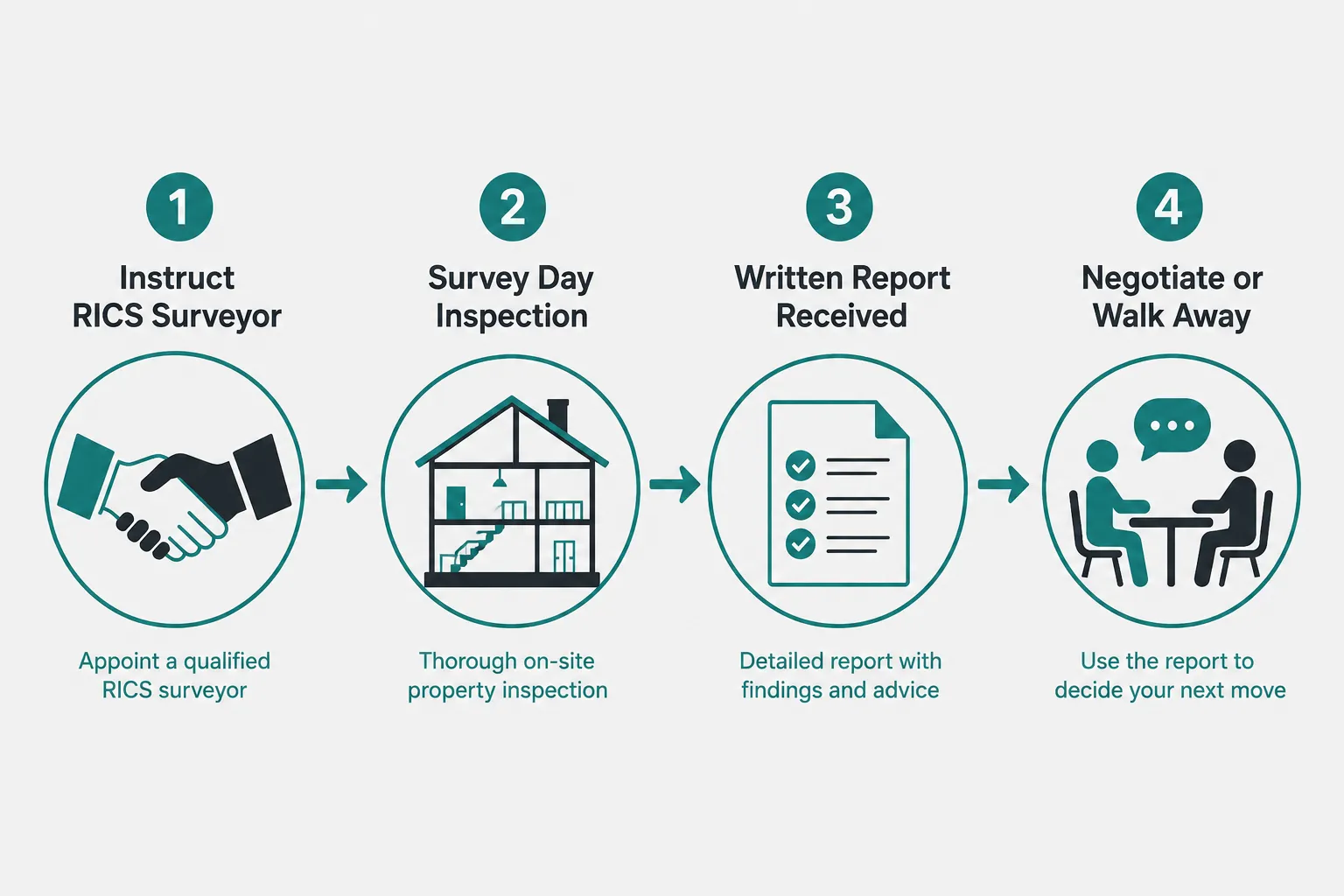
- Obtain at least two or three quotes from RICS-regulated firms
- Ask each surveyor how long they will spend on site
- Confirm whether the report includes condition ratings and estimated repair costs
- Check whether damp and timber is assessed visually or with specialist equipment
- Verify the surveyor has experience with the property type and age
For buyers in specific regions, local RICS-regulated surveyors will have knowledge of construction methods, materials, and common defects particular to that area. Finding building surveyors near you through a verified directory ensures both regulatory compliance and local expertise.
When a Valuation Alone May Be Sufficient
There are limited circumstances where a mortgage valuation, supplemented by no additional survey, may be a reasonable decision:
- A newly built property covered by an NHBC Buildmark or similar structural warranty
- A property the buyer has owned before and knows intimately
- A modern flat in a managed block where a recent building survey was conducted for the freeholder
In all other cases, and particularly for any property built before 1980, any property showing visible signs of repair or alteration, or any property with a complex structure, commissioning an independent Level 2 or Level 3 survey is strongly advisable. For buyers who want to understand the cost of a RICS-regulated valuation separately from a survey, the RICS valuation cost guide provides a clear breakdown of what independent valuations involve and when they are needed.
Conclusion
The building survey cost vs valuation fee question ultimately comes down to what buyers are actually purchasing with their money. A mortgage valuation buys lender confidence. A building survey buys buyer knowledge, and in a property market where structural defects can cost tens of thousands of pounds to remediate, that knowledge is not a luxury.
Actionable next steps for UK buyers in 2026:
- Do not assume the lender's valuation protects you. Read any valuation summary carefully and note what it does not cover.
- Commission a Level 2 or Level 3 survey on any property that is not a new build. The cost is a fraction of the potential remediation bill for undiscovered defects.
- Use the survey report as a negotiation tool. Any condition-rated defect at Level 3 is a legitimate basis for renegotiating the purchase price.
- Choose a RICS-regulated surveyor with experience in the property type and region. Ask about time on site and report format before instructing.
- Budget for both costs. A valuation fee is often unavoidable as a lender requirement; a building survey is an additional and separate investment in your own protection.
Buyers who treat these two services as interchangeable are taking a risk that the numbers rarely justify. The fee gap between a valuation and a full building survey is typically a few hundred pounds. The gap between knowing and not knowing the condition of a property can be far greater.
References
[1] House Surveys UK: The Costs, Types and Benefits of an RICS Home Survey – rics.org
[2] BTL Mortgage Fees Rise 2026 – realyield.co.uk
[3] Home Survey Standards – rics.org
[4] How Much Does a House Survey Cost – hoa.org.uk
[5] Valuation Schemes – halifax.co.uk
[6] RICS Draft Home Survey Standard 2025: Implications for Surveyors – linkedin.com
[7] Surveying a House – myjobquote.co.uk
[8] Estimate Your Overall Buying and Moving Costs – moneyhelper.org.uk
[9] Understanding the RICS Home Survey Standard Proposal – rics.org
[10] House Survey Costs – checkatrade.com