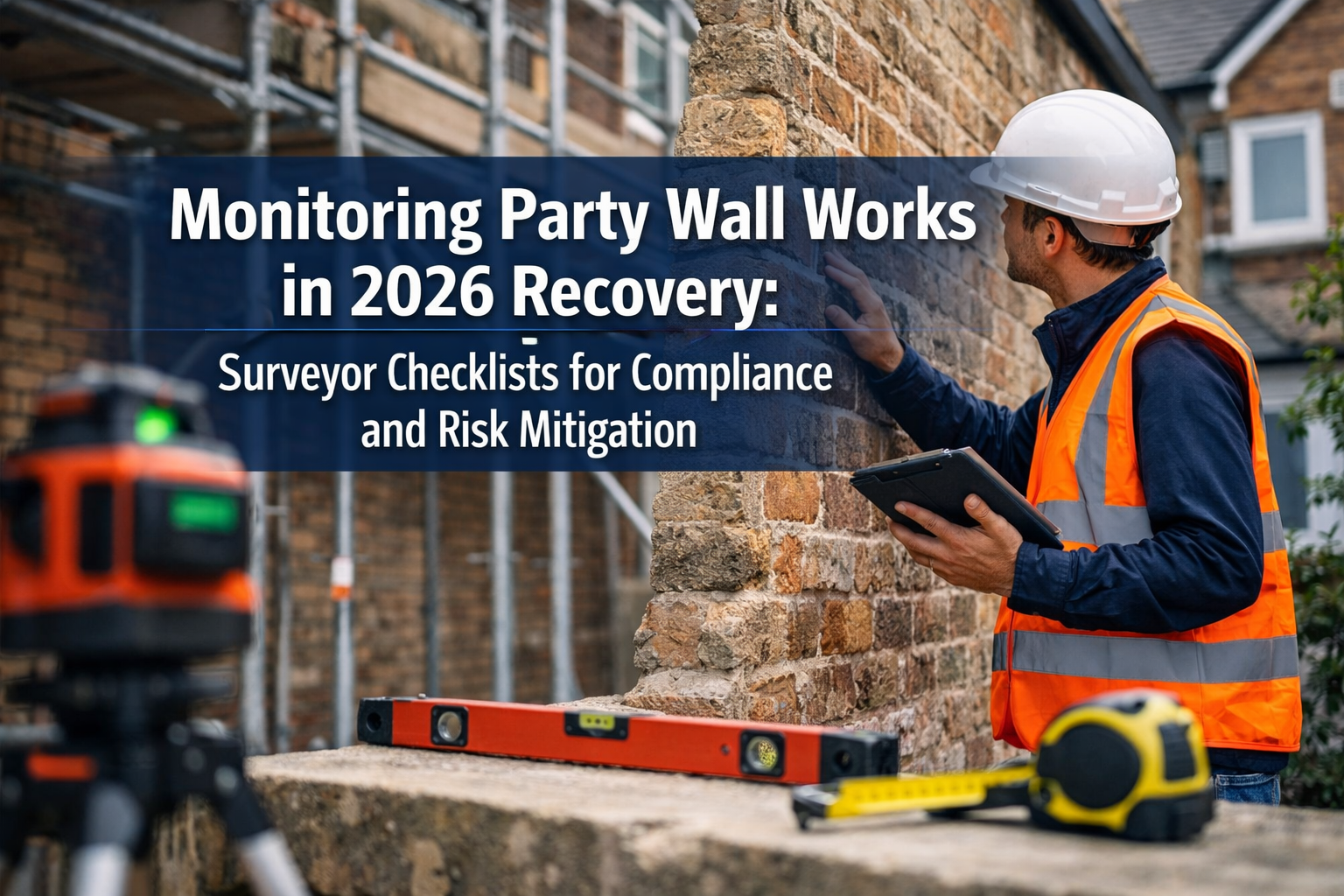
The UK property market's January 2026 surge has triggered a 34% increase in party wall notifications compared to the same period last year. As transaction volumes climb following RICS optimism forecasts, surveyors face mounting pressure to maintain rigorous monitoring protocols while processing unprecedented caseloads. Monitoring Party Wall Works in 2026 Recovery: Surveyor Checklists for Compliance and Risk Mitigation has become essential as rushed construction schedules and cost-cutting pressures threaten compliance standards.
This comprehensive guide provides surveyors with practical checklists and on-site protocols to verify adherence to party wall awards, spot defects early, and maintain accurate schedules of condition during this critical recovery period. With agreed surveyor fees ranging from £700-£1,500 for straightforward works[1], maintaining professional standards while managing increased workloads requires systematic approaches to risk mitigation.
Key Takeaways
- Structured monitoring protocols reduce compliance failures by up to 60% during high-volume construction periods
- Early defect identification through systematic site visits prevents costly disputes and protects all parties' interests
- Updated schedules of condition provide essential evidence for resolving damage claims and maintaining professional standards
- Digital documentation tools streamline compliance verification and create defensible audit trails
- Risk-based inspection frequency balances thoroughness with practical resource constraints during recovery periods
Essential Pre-Commencement Verification Protocols for Monitoring Party Wall Works in 2026 Recovery
Before any construction begins, surveyors must establish robust baseline documentation and verification systems. The rush to capitalize on market recovery should never compromise foundational compliance checks.
Pre-Work Documentation Requirements
Complete schedule of condition preparation forms the cornerstone of effective monitoring. This detailed photographic and written record of all affected properties must be comprehensive enough to withstand scrutiny months or years later when damage to property claims arise.
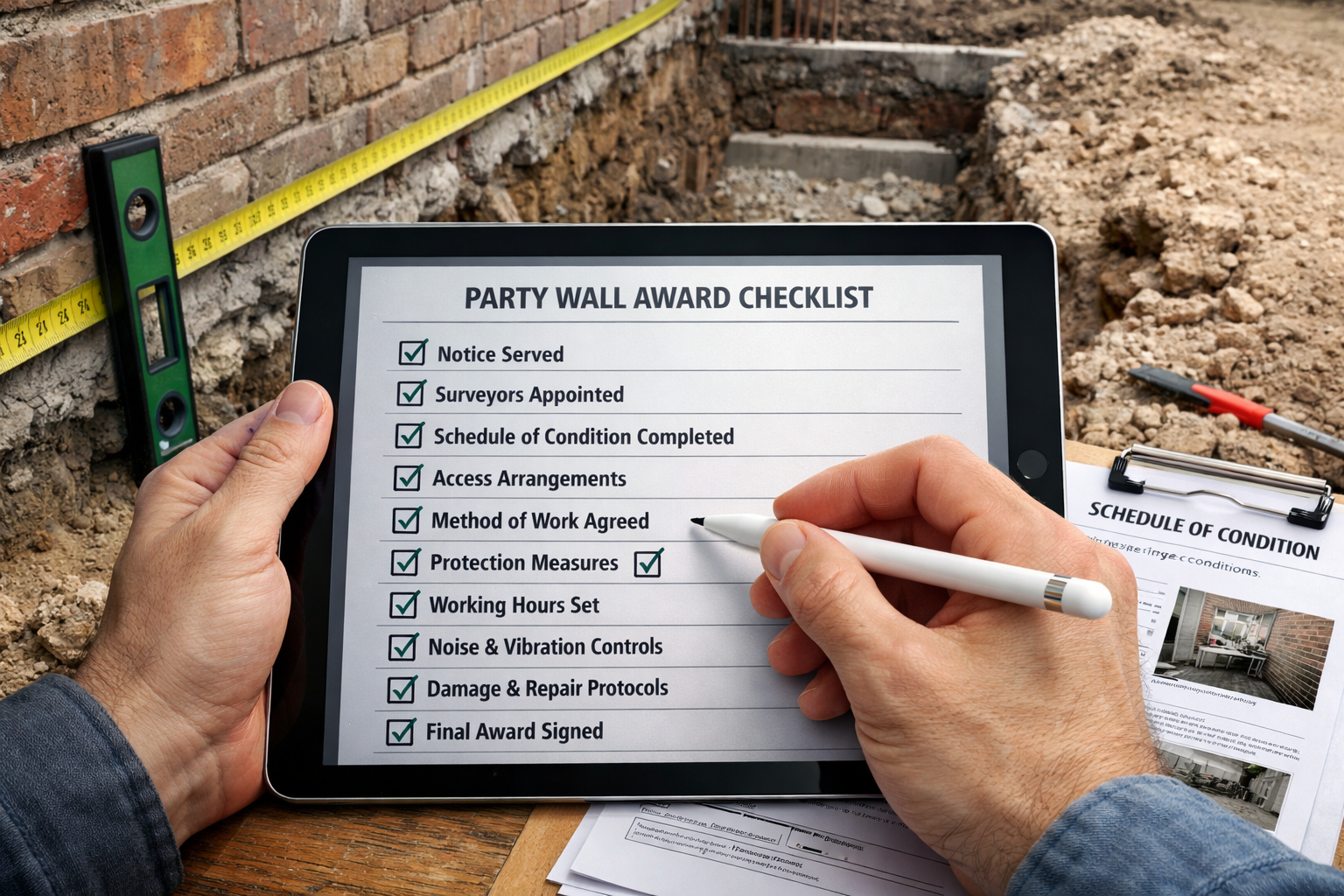
Essential pre-commencement checklist items include:
✅ Award Verification
- Confirm all parties have received and acknowledged the party wall award
- Verify notice periods have been properly observed
- Check that work descriptions match actual planned construction
- Ensure special conditions are clearly documented and understood
✅ Access Arrangements
- Document agreed access points and times in writing
- Photograph access routes to establish baseline condition
- Confirm insurance certificates are current and adequate
- Establish emergency contact protocols for all parties
✅ Baseline Condition Assessment
- Photograph every room in adjoining properties from multiple angles
- Document existing cracks with width measurements and reference points
- Record structural elements including walls, ceilings, floors, and external features
- Note pre-existing defects to avoid future attribution disputes
✅ Method Statement Review
- Verify construction methods align with award specifications
- Assess adequacy of proposed protective measures
- Confirm temporary works designs meet structural requirements
- Review sequencing to identify high-risk phases requiring enhanced monitoring
Contractor Competency Verification
The building owner's contractor selection directly impacts risk levels. Surveyors should verify:
- Professional qualifications and relevant experience with similar party wall works
- Insurance coverage including public liability and professional indemnity at adequate levels
- Health and safety protocols appropriate for the work scope
- Previous party wall compliance record through references or industry checks
When carrying out party wall work, contractor quality often determines whether monitoring remains straightforward or becomes intensive damage control.
Digital Documentation Systems
Modern monitoring requires efficient digital systems:
| Tool Type | Application | Benefit |
|---|---|---|
| Cloud storage | Centralized photo/document repository | Real-time access for all parties |
| Timestamped photos | Condition evidence with metadata | Defensible chronological records |
| Digital checklists | Standardized inspection protocols | Consistent quality assurance |
| Measurement apps | Crack monitoring and dimensional verification | Objective quantitative data |
| Communication logs | Email and call tracking | Complete audit trail |
These systems prove invaluable when party wall disputes escalate and detailed evidence becomes essential.
On-Site Inspection Protocols and Defect Identification During Active Construction
Active construction phases demand vigilant monitoring to catch problems before they escalate into major disputes or structural concerns. Monitoring Party Wall Works in 2026 Recovery: Surveyor Checklists for Compliance and Risk Mitigation requires risk-proportionate inspection frequencies.
Risk-Based Inspection Scheduling
Not all works require identical monitoring intensity. Surveyors should calibrate inspection frequency based on:
High-Risk Works (Weekly or more frequent inspections):
- Foundation underpinning or excavation works within 3 metres of adjoining structures
- Structural alterations removing load-bearing elements
- Demolition works affecting party walls
- Works in properties with pre-existing structural concerns
Medium-Risk Works (Bi-weekly inspections):
- Loft conversions affecting party walls
- Damp-proof course installation
- Chimney breast removal from shared chimneys
- Standard basement conversions with proper shoring
Lower-Risk Works (Monthly or milestone-based inspections):
- Minor repairs to party walls
- Installation of damp-proof membranes
- Cutting into party walls for beam insertions with proper support
- Cosmetic works with minimal structural impact
Systematic Site Inspection Checklist
Each site visit should follow a structured protocol:
🔍 Structural Integrity Checks
- Visual inspection of party wall for new cracks, movement, or distortion
- Verification of temporary support adequacy and condition
- Assessment of excavation stability and shoring systems
- Monitoring of settlement indicators in adjoining properties
🔍 Compliance Verification
- Confirmation work matches award specifications
- Review of construction methods against approved approach
- Verification of working hours adherence
- Assessment of noise, dust, and vibration control measures
🔍 Protective Measures Assessment
- Inspection of protective hoarding and barriers
- Verification of party wall protection during works
- Assessment of weather protection for exposed structures
- Review of fire safety provisions for temporary conditions
🔍 Adjoining Owner Property Monitoring
- Internal inspection for new cracks or damage
- Assessment of doors and windows for operation issues
- Review of services (plumbing, electrical) for disruption
- Documentation of any complaints or concerns raised
Early Defect Identification Techniques
Catching problems early prevents minor issues from becoming major disputes:
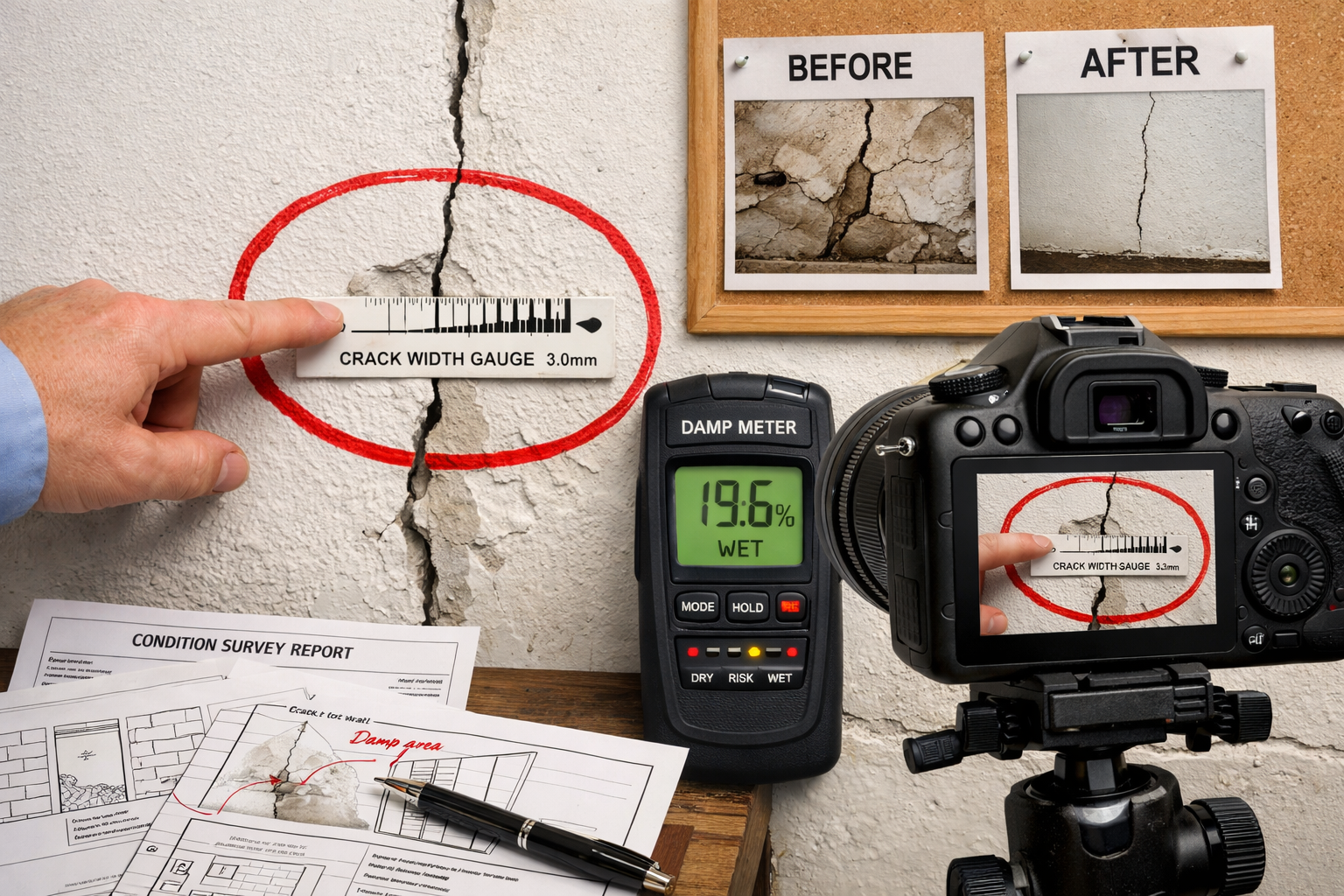
Crack Monitoring Protocol:
- Establish reference points for all existing cracks during baseline survey
- Use tell-tales or crack width gauges for quantitative monitoring
- Photograph cracks with scale references and consistent lighting
- Document progression rates to distinguish active from dormant movement
Settlement Indicators:
- Monitor door and window alignment and operation
- Check for gaps appearing between skirting boards and floors
- Assess external brickwork for step cracking patterns
- Review internal finishes for new distortion or separation
Moisture and Damp Issues:
- Inspect for new water ingress during and after works
- Monitor exposed party walls for weather damage
- Check basement waterproofing effectiveness
- Assess impact on existing damp-proof courses
When working with an agreed surveyor, consistent documentation of these observations protects both parties' interests and facilitates fair dispute resolution.
Documentation Standards During Construction
Every site visit must produce defensible records:
- Written inspection report with date, time, attendees, and findings
- Comprehensive photographs with clear labeling and context
- Measurement records for any defects or deviations
- Contractor communications documenting instructions or concerns
- Adjoining owner feedback capturing their observations and concerns
This documentation becomes crucial evidence if disputes arise or if expert witness testimony becomes necessary.
Post-Completion Verification and Schedule of Condition Updates for Compliance Assurance
The final phase of Monitoring Party Wall Works in 2026 Recovery: Surveyor Checklists for Compliance and Risk Mitigation requires thorough verification that works comply with awards and that any damage has been properly addressed.

Final Inspection Comprehensive Checklist
Post-completion verification should be as thorough as the initial baseline assessment:
✅ Structural Completion Verification
- Confirm all works described in the award have been completed
- Verify structural integrity of party wall and adjoining structures
- Assess quality of workmanship against professional standards
- Confirm removal of all temporary works and supports
✅ Damage Assessment and Remediation
- Compare current condition against baseline schedule of condition
- Identify all damage attributable to the works
- Verify completion of agreed remedial works
- Assess quality of repairs to ensure like-for-like restoration
✅ Building Control and Compliance
- Confirm Building Control sign-off where applicable
- Verify compliance with all award special conditions
- Review contractor's completion documentation
- Ensure all required certificates are provided
✅ Adjoining Owner Satisfaction
- Conduct joint inspection with adjoining owner
- Address any outstanding concerns or observations
- Document agreement on condition or identify remaining disputes
- Obtain sign-off where appropriate
Schedule of Condition Update Protocol
The updated schedule of condition serves as the definitive record of post-work property condition:
Photographic Documentation:
- Replicate all baseline photographs from identical positions
- Use consistent lighting and camera settings for comparison
- Capture close-ups of any damage or repairs
- Include date stamps and reference markers
Written Condition Report:
- Room-by-room comparison against baseline documentation
- Detailed description of any changes or damage
- Assessment of repair quality and completeness
- Professional opinion on causation for any disputed damage
Comparative Analysis:
- Side-by-side presentation of before and after images
- Quantitative measurements of any changes
- Clear attribution of damage to party wall works or other causes
- Recommendations for any outstanding remedial works
Dispute Resolution and Outstanding Issues
Not all projects conclude with complete agreement. Surveyors must manage remaining disputes professionally:
Minor Disagreements:
- Document specific points of contention clearly
- Provide professional opinions with supporting evidence
- Facilitate negotiation between parties
- Recommend proportionate remedial solutions
Significant Disputes:
- Prepare comprehensive evidence packages
- Consider third-party expert opinions where appropriate
- Explore mediation before formal dispute resolution
- Maintain professional neutrality and evidence-based positions
Understanding common party wall questions helps surveyors anticipate and address concerns before they escalate.
Sign-Off and Record Retention
Proper closure protects all parties:
- Formal completion documentation signed by relevant parties
- Final account settlement with clear breakdown of costs
- Archive retention of all documentation for minimum 6 years (12 years recommended)
- Lessons learned documentation for process improvement
Professional chartered surveyors maintain comprehensive archives that protect against future claims and demonstrate professional standards.
Risk Mitigation Strategies for High-Volume Monitoring Periods
The 2026 recovery presents unique challenges as surveyors balance quality with increased caseloads. Effective risk mitigation requires systematic approaches:
Triage and Prioritization Systems
Case Classification Framework:
🔴 High Priority – Immediate attention required:
- Complex structural works affecting multiple properties
- Projects with pre-existing disputes or difficult relationships
- Works involving vulnerable structures or occupants
- High-value properties where damage costs would be significant
🟡 Medium Priority – Standard monitoring protocols:
- Routine loft conversions and extensions
- Experienced contractors with good track records
- Cooperative parties with clear communication
- Properties in good baseline condition
🟢 Lower Priority – Reduced monitoring frequency:
- Minor works with minimal structural impact
- Highly experienced specialist contractors
- Excellent party relationships with written agreements
- Recent properties with no structural concerns
Quality Assurance Systems
Maintaining standards during busy periods requires systematic approaches:
- Standardized templates for all documentation types
- Peer review processes for complex cases or disputes
- Regular training updates on emerging issues and techniques
- Technology leverage to improve efficiency without compromising quality
- Clear delegation protocols for junior surveyors under supervision
Professional Indemnity Considerations
Higher volumes increase exposure. Surveyors should:
- Review insurance coverage adequacy for increased caseload
- Document decision-making rationale comprehensively
- Decline instructions beyond capacity or competence
- Maintain clear scope of appointment documentation
- Follow RICS guidance on professional standards consistently
Communication Excellence
Clear communication prevents many disputes:
Regular Updates:
- Weekly progress reports during active construction
- Prompt notification of any concerns or defects
- Clear explanation of technical issues in accessible language
- Proactive management of expectations
Stakeholder Management:
- Building owner education on obligations and responsibilities
- Adjoining owner reassurance and concern addressing
- Contractor coordination and instruction clarity
- Clear boundaries on surveyor role and limitations
Technology Integration for Efficient Monitoring
Modern tools enhance monitoring effectiveness:
Digital Inspection Tools
- Tablet-based checklists with offline capability
- Cloud-synchronized photo storage with automatic backup
- Crack monitoring apps with measurement overlays
- 3D scanning technology for complex structural assessment
- Drone photography for roof and elevation documentation
Project Management Platforms
Centralized systems improve coordination:
- Real-time access for all authorized parties
- Automated reminder systems for scheduled inspections
- Document version control and audit trails
- Secure communication channels
- Integrated reporting and invoicing
Data Analytics
Pattern recognition improves risk assessment:
- Historical defect analysis by work type
- Contractor performance tracking
- Seasonal risk factor identification
- Cost prediction modeling
- Resource allocation optimization
Conclusion
Monitoring Party Wall Works in 2026 Recovery: Surveyor Checklists for Compliance and Risk Mitigation demands systematic approaches, professional diligence, and appropriate technology integration. As the property market recovery accelerates, surveyors face the dual challenge of managing increased volumes while maintaining the rigorous standards that protect all parties' interests.
The comprehensive checklists and protocols outlined in this guide provide a framework for consistent, defensible monitoring that catches problems early, maintains compliance with party wall awards, and creates the documentation necessary for fair dispute resolution when issues arise.
Actionable Next Steps
- Implement standardized checklists for pre-commencement, active monitoring, and completion phases
- Establish risk-based inspection scheduling appropriate to work complexity and risk factors
- Invest in digital documentation systems that improve efficiency without compromising quality
- Review professional indemnity coverage to ensure adequacy for increased caseload exposure
- Develop triage protocols that prioritize resources toward highest-risk projects
- Maintain comprehensive archives of all documentation for future reference and protection
Professional surveyors who systematically apply these protocols will successfully navigate the 2026 recovery period while maintaining the high standards that protect property owners, preserve professional reputations, and prevent costly disputes. The investment in thorough monitoring pays dividends through reduced claims, satisfied clients, and defensible professional practices.
For surveyors managing party wall matters across London and the Southeast, understanding party wall notice requirements and maintaining rigorous monitoring protocols ensures compliance and protects all parties throughout the construction process.
References
[1] Party Wall Notice Requirements For Prs Database Compliance Works Surveyor Tactics Post Renters Rights Act Registration In 2026 – https://nottinghillsurveyors.com/blog/party-wall-notice-requirements-for-prs-database-compliance-works-surveyor-tactics-post-renters-rights-act-registration-in-2026