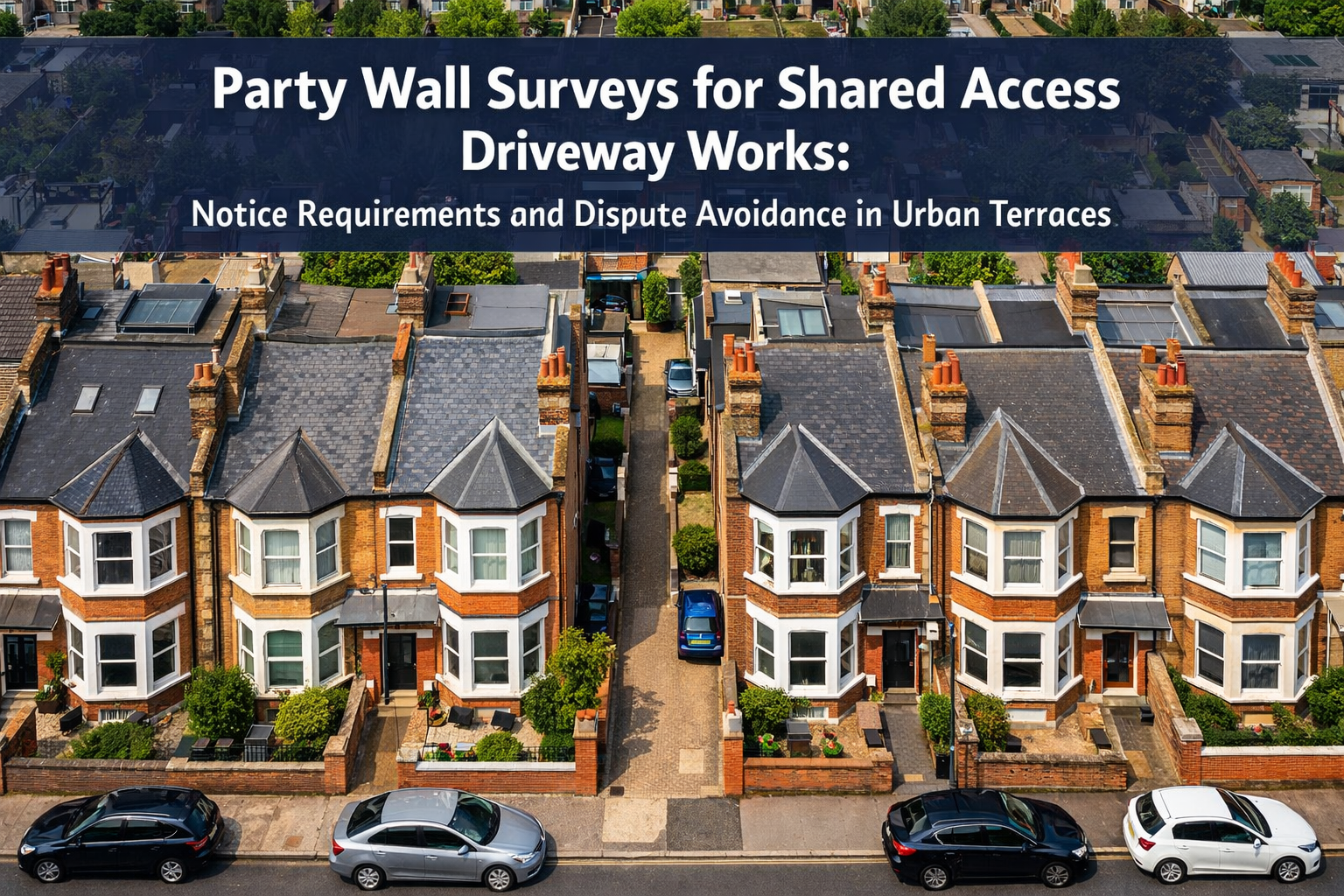

More than 60% of party wall disputes in urban terraced properties stem from misunderstandings about shared driveway modifications—yet most could be prevented with proper notice procedures and documentation. In 2026, as property values continue to rise in densely populated areas, understanding the legal framework governing shared access works has never been more critical for homeowners planning improvements.
When terraced properties share driveways or access routes, even minor modifications can trigger mandatory party wall procedures under the Party Wall etc. Act 1996. Party Wall Surveys for Shared Access Driveway Works: Notice Requirements and Dispute Avoidance in Urban Terraces represents a specialized area where property law, neighbor relations, and practical construction considerations intersect. This comprehensive guide explains exactly when notices are required, how to serve them correctly, and which preventative measures protect both parties from costly legal disputes.
Key Takeaways
- Formal written notice is mandatory even when neighbors verbally agree to driveway works—informal approval provides no legal protection [2]
- Notice periods vary by work type: one month for excavation or new boundary walls, two months for works affecting existing party structures [1]
- Schedules of Condition are essential documentation that record property state before work begins, serving as crucial evidence if damage disputes arise [1]
- Non-response triggers automatic dissent: neighbors who don't respond within 14 days are legally deemed to have dissented, requiring surveyor appointment [2]
- Failure to serve proper notice can result in injunctions that halt work entirely until correct procedures are followed [1]
Understanding Party Wall Requirements for Shared Access Driveway Works 🏘️
What Qualifies as Notifiable Driveway Work
Shared access driveways in urban terraces frequently involve structures and boundaries covered by the Party Wall etc. Act 1996. Understanding which modifications trigger formal notice requirements prevents inadvertent violations that can lead to party wall disputes.
Work types requiring party wall notices include:
- Boundary wall construction or modification along the driveway edge where properties meet
- Excavation work within 3 meters of a neighboring structure if going deeper than its foundations
- Excavation within 6 meters if the work extends below a 45-degree plane from the neighbor's foundation base [4]
- Raising, underpinning, or altering existing boundary walls that separate driveway access
- Installing new drainage or utilities that affect shared boundary structures
Garden boundary walls specifically fall under party wall agreement requirements, a fact many homeowners overlook when planning driveway improvements [4]. Even decorative walls or low barriers separating driveway sections may require formal procedures if they sit on or straddle the boundary line.
The Critical Distinction: Party Structures vs. Boundary Works
The Act distinguishes between works to existing party structures (requiring two months' notice) and new construction at the boundary line (requiring one month's notice) [1]. For shared driveways, this distinction matters significantly:
| Work Type | Notice Period | Common Examples |
|---|---|---|
| New wall at boundary | 1 month | Installing new boundary fence posts, building retaining wall on boundary line |
| Work to existing party wall | 2 months | Raising height of shared boundary wall, inserting damp-proof course |
| Excavation near boundary | 1 month | Digging foundations for driveway extension, installing underground drainage |
| Access to neighboring land | 14 days | Scaffolding placement, temporary access for construction equipment [3] |
Understanding these thresholds prevents the common mistake of using insufficient notice periods, which can invalidate the entire procedure and expose homeowners to legal challenges.
Notice Requirements for Party Wall Surveys in Shared Access Scenarios 📋
Mandatory Written Notice: Why Verbal Agreements Fail
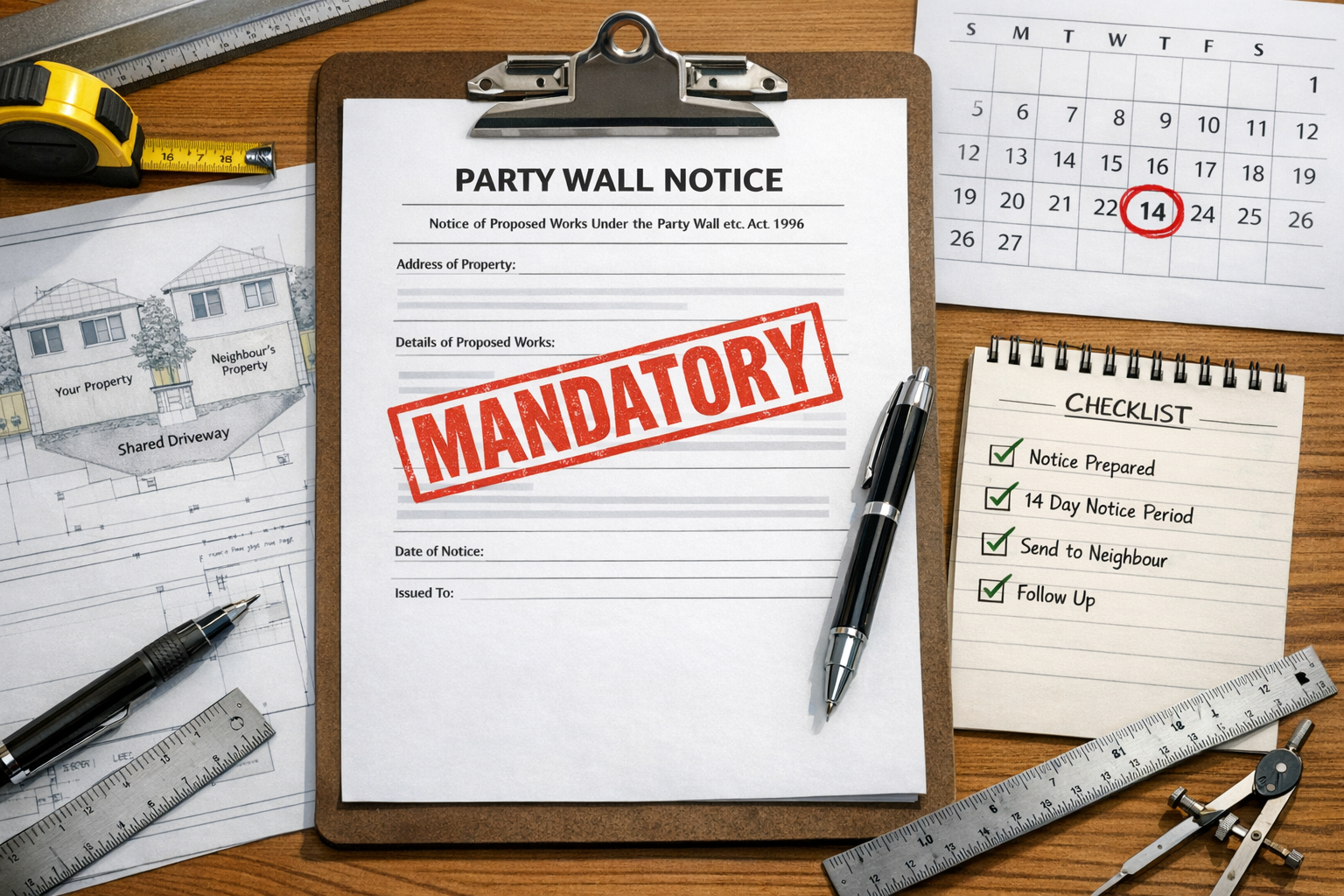
A widespread misconception undermines countless party wall procedures: the belief that neighbor consent eliminates the need for formal notice. This is categorically false. Even when neighbors enthusiastically support planned driveway works, written Party Wall Notice must be formally served before work begins [2].
Verbal agreements or informal emails provide zero legal protection under the Act. Neighbors retain the right to change their position, and without proper documentation, homeowners face potential injunctions that halt work mid-project. The formal notice serves multiple essential functions:
✅ Establishes legal timeline for neighbor response and surveyor appointment
✅ Documents work scope in detail, preventing scope creep disputes
✅ Triggers protection mechanisms including schedules of condition
✅ Creates enforceable framework for access, working hours, and damage remediation
Serving Notice: The 14-Day Response Window
Once a party wall notice is properly served, neighbors have exactly 14 days to respond in writing [2]. This response period is strictly calculated and non-negotiable. Three outcomes are possible:
1. Written Consent – Neighbor agrees in writing to the proposed works, allowing the project to proceed without surveyors (though a schedule of condition remains advisable)
2. Written Dissent – Neighbor formally objects, triggering the surveyor appointment process
3. No Response – Perhaps the most misunderstood scenario: silence equals dissent [2]
The third outcome catches many homeowners off-guard. When neighbors fail to respond within 14 days, the Act deems them to have dissented automatically. The building owner must then send a further notice requiring surveyor appointment within 10 days. If the neighbor still doesn't respond, the building owner must appoint a surveyor on the neighbor's behalf [2].
This cascade of procedures underscores why early notice service is critical—the statutory timelines can extend project start dates significantly if neighbors don't engage promptly.
Section 8 Access Notices for Driveway Construction
Separate from party wall notices, Section 8 of the Act governs access to neighboring land for construction purposes. When driveway works require temporary access to adjacent property—for scaffolding, equipment placement, or construction materials—contractors must provide 14 days' written notice [3].
Section 8 access notices must specify:
- Exact dates and duration of required access
- Specific areas of neighboring property needed
- Protective measures to prevent damage
- Acceptable working hours (typically standard business hours)
- Compensation arrangements if applicable
Emergency situations provide the only exception to the 14-day requirement. Access must occur during usual working hours unless otherwise agreed, and the building owner remains liable for any damage caused during access [3].
For urban terraces with limited space between properties, Section 8 access becomes particularly important. Many driveway projects physically cannot proceed without temporary use of neighboring land, making this notice requirement as critical as the primary party wall notice.
Schedules of Condition and Joint Inspections: Your Dispute Prevention Shield 🛡️
The Essential Schedule of Condition
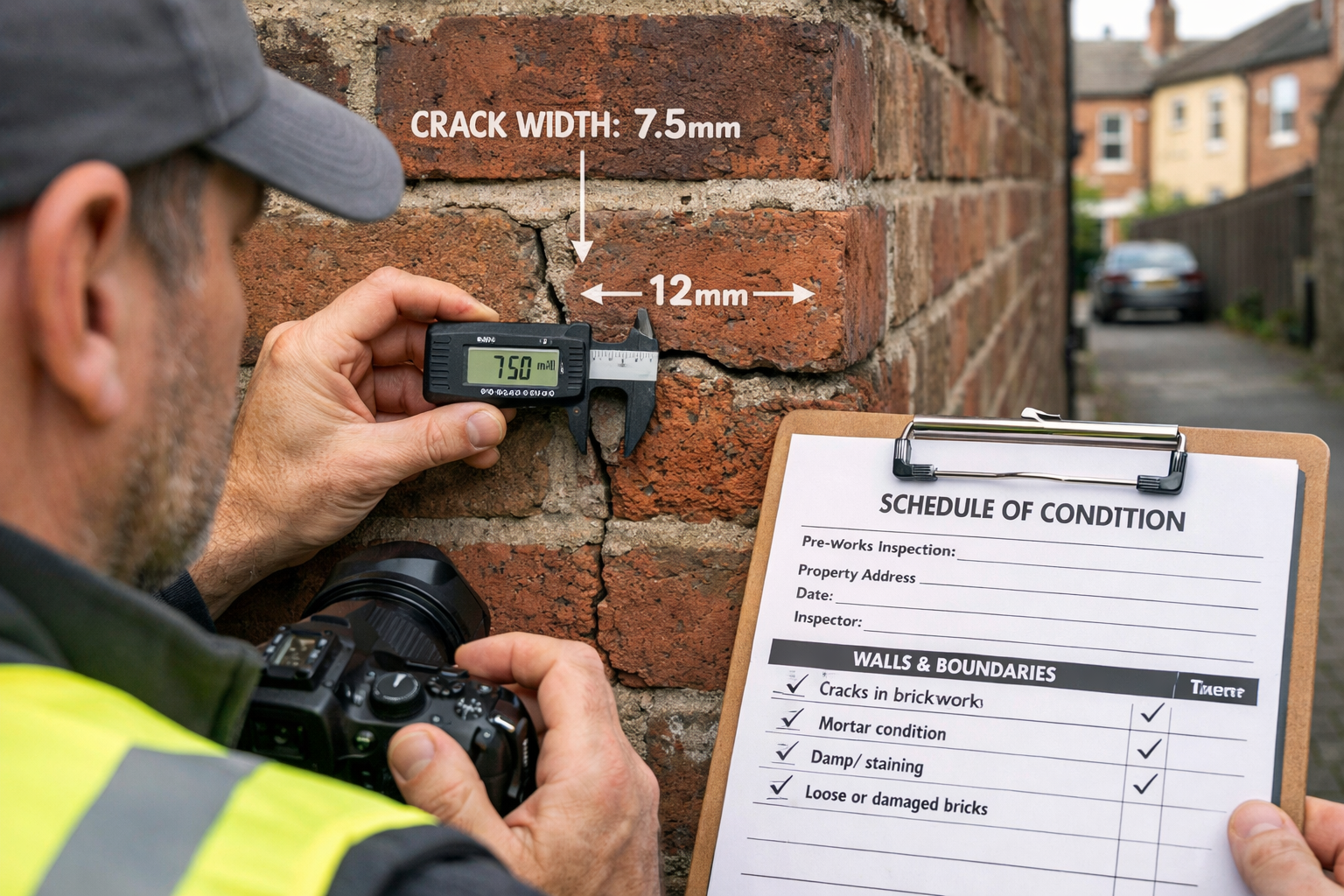
Among all dispute prevention tools available under the Party Wall Act, the schedule of condition stands as the most powerful protective measure for both building owners and adjoining owners. This detailed photographic and written record documents the exact condition of neighboring properties before any work commences [1].
A comprehensive schedule of condition includes:
📸 Detailed photographs of all walls, structures, and finishes adjacent to planned works
📝 Written descriptions of existing defects, cracks, settlement, or deterioration
📐 Measurements of existing cracks or structural issues with precise dimensions
🗓️ Date-stamped documentation establishing baseline conditions
🔍 Video walkthroughs for complex properties or extensive adjacent areas
This evidence becomes invaluable when disputes arise about whether construction work caused specific damage. Without a schedule of condition, determining causation becomes nearly impossible—existing cracks become conflated with new damage, and memories fade about pre-existing conditions.
The schedule protects building owners from false damage claims while simultaneously protecting neighbors by creating accountability for genuine construction-related damage. Both parties benefit from this objective record.
Who Conducts the Inspection?
When neighbors consent to works without appointing surveyors, building owners should still commission an independent surveyor to prepare a schedule of condition. The modest cost (typically £300-£800 depending on property size) provides insurance against future disputes worth thousands in legal fees.
When the party wall surveyor process is triggered through dissent, the appointed surveyor(s) will prepare the schedule as part of the party wall agreement or award. This becomes a mandatory component of the formal documentation.
Joint Inspections: Building Trust Through Transparency
Beyond the technical schedule of condition, joint inspections involving both property owners, contractors, and surveyors serve a crucial relationship-building function. These collaborative walkthroughs:
- Allow neighbors to ask questions directly about planned works
- Demonstrate the building owner's commitment to transparency
- Identify potential concerns before they escalate into formal disputes
- Create shared understanding of existing conditions
- Establish working relationship between all parties
For shared driveway projects in urban terraces where neighbors live in close proximity, this human element of dispute prevention often proves as important as the legal documentation. When neighbors feel informed and respected, they're far less likely to pursue adversarial approaches to minor issues that inevitably arise during construction.
Specific Scenarios: When Party Wall Surveys Apply to Driveway Modifications
Resurfacing and Drainage Installation
Simple driveway resurfacing—replacing tarmac or paving without excavation—typically falls outside party wall requirements. However, the moment work involves:
- Excavation for new drainage systems running along or near the boundary
- Lowering the driveway level which affects adjacent foundations
- Installing new soakaways or drainage within 3-6 meters of neighboring structures
The Act's provisions engage, and formal notices become mandatory. The excavation depth and proximity to neighboring foundations determine whether work falls under the 3-meter or 6-meter rules [4].
Boundary Wall Modifications for Vehicle Access
Widening driveway access often requires modifying or removing sections of boundary walls. Any work that involves:
- Removing sections of party walls or boundary walls
- Creating new openings in existing boundary structures
- Raising or lowering boundary wall heights
- Installing new gates or pillars on the boundary line
These modifications trigger two-month notice requirements for existing structures or one-month notices for new construction at the boundary [1]. Even when the wall sits entirely on one property, if it serves a boundary function between shared driveway areas, party wall procedures apply.
Underpinning and Foundation Work
Urban terraced properties frequently experience settlement or subsidence requiring foundation repairs. When underpinning work occurs near shared driveways, particularly where properties share access routes, the Act's excavation provisions apply strictly.
Work within 3 meters of a neighbor's structure that goes deeper than their foundations requires one month's notice [4]. The 6-meter rule extends this requirement for deeper excavations. Given that many urban terraces were built with shallow foundations, even modest excavation depths can trigger these thresholds.
Avoiding Common Pitfalls That Trigger Disputes ⚠️
The Retrospective Work Trap
Perhaps the most serious mistake homeowners make is proceeding with notifiable work without serving proper notice, then attempting to regularize the situation afterward. The Party Wall Act does not permit retrospective notices or awards [2].
Once work is completed without proper procedure, the Act offers no remedy. Disputes must be resolved through:
- Direct negotiation between neighbors
- Mediation services
- Civil court proceedings if agreement cannot be reached
Court proceedings prove far more expensive and time-consuming than proper party wall procedures. Worse, judges view failure to follow statutory procedures unfavorably, potentially awarding higher damages or costs against building owners who ignored their legal obligations.
The "Small Work" Misconception
Many homeowners assume minor modifications don't warrant formal procedures. This dangerous assumption leads to disputes when:
- "Small" excavation work triggers the 3-meter rule
- "Minor" boundary wall repairs actually constitute notifiable alterations
- "Quick" drainage installation affects neighboring foundations
The Act contains no materiality threshold—work either falls within its scope or doesn't, regardless of scale. When in doubt, consult with professionals familiar with legal requirements for party walls rather than making assumptions based on project size.
Ignoring Tenant Rights in Rental Properties
Recent legislative developments in 2026 have strengthened tenant rights in party wall procedures, particularly for institutional buy-to-let properties [5]. When planning driveway works affecting rental properties:
- Tenants may have notification rights separate from landlord consent
- Landlord-initiated works face additional procedural requirements
- Section 8 access to rental properties requires consideration of tenant occupancy
Building owners must verify whether neighboring properties are owner-occupied or tenanted, as this affects notice service and access arrangements. Serving notice only on landlords when tenants occupy the property can invalidate the procedure.
The Surveyor Appointment Process: Agreed vs. Individual Surveyors
When Dissent Triggers Surveyor Involvement
Once a neighbor dissents (or is deemed to have dissented through non-response), the Act requires surveyor appointment to produce a binding party wall award. Two approaches exist:
Agreed Surveyor Approach:
Both parties jointly appoint a single surveyor who acts impartially for both sides. This typically proves more cost-effective, with fees split between parties. The agreed surveyor must maintain strict impartiality and cannot favor either party.
Individual Surveyors Approach:
Each party appoints their own surveyor, who then work together to produce the award. This provides each party with dedicated representation but increases costs. The two surveyors must agree on all award terms or appoint a third surveyor to resolve disagreements.
What the Party Wall Award Must Include
The formal party wall award serves as a binding agreement covering all aspects of the proposed work. For shared driveway projects, awards typically specify:
✓ Detailed work description including drawings and specifications
✓ Schedule of condition documenting pre-work property state
✓ Access arrangements including dates, times, and areas
✓ Working hours and noise restrictions
✓ Protective measures to prevent damage
✓ Insurance requirements and liability provisions
✓ Dispute resolution procedures for issues arising during work
The award becomes legally binding on both parties and their successors in title. Future property owners inherit the rights and obligations established in the award, making it a document of lasting significance.
Cost Allocation for Surveyor Fees
Under the Act, the building owner (the party initiating works) typically bears all surveyor costs, including fees for both the agreed surveyor or both individual surveyors [1]. This cost allocation applies even when neighbors object unreasonably to straightforward works.
Surveyor fees for shared driveway projects typically range from £800-£2,500 depending on complexity, though costs can escalate for contentious disputes requiring extensive negotiation or third surveyor appointment. Building owners should budget for these costs alongside construction expenses.
Practical Steps for Smooth Party Wall Procedures 📝
Pre-Work Planning Timeline
Successful party wall procedures require advance planning well before construction start dates. A realistic timeline for shared driveway works includes:
8-12 weeks before desired start date:
- Finalize construction plans and specifications
- Identify all potentially affected neighbors
- Engage party wall surveyor for preliminary advice
- Prepare detailed notice documents
6-8 weeks before start:
- Serve formal party wall notices
- Serve Section 8 access notices if required
- Begin neighbor communication about project scope
4-6 weeks before start:
- Receive neighbor responses or process deemed dissent
- Appoint surveyors if required
- Commence schedule of condition inspections
2-4 weeks before start:
- Finalize party wall award or agreement
- Confirm access arrangements and working hours
- Conduct final joint inspection if appropriate
1 week before start:
- Notify neighbors of confirmed start date
- Ensure contractors understand award requirements
- Verify insurance coverage is in place
This timeline assumes straightforward procedures with cooperative neighbors. Complex projects or contentious disputes may require additional time, particularly if third surveyor appointment becomes necessary.
Documentation Best Practices
Meticulous record-keeping prevents disputes and provides evidence if disagreements arise:
📄 Maintain copies of all notices with proof of service (recorded delivery receipts, hand-delivery acknowledgments)
📄 Photograph all correspondence including emails and text messages about the works
📄 Keep detailed project diary noting dates, activities, and any neighbor interactions
📄 Preserve all surveyor communications including draft and final awards
📄 Store schedule of condition securely with backup copies
Digital documentation with cloud backup ensures nothing is lost if disputes arise months or years after work completion.
Communication Strategies That Prevent Escalation
Beyond legal requirements, proactive communication dramatically reduces dispute risk:
🗣️ Early informal discussion before serving formal notices helps gauge neighbor concerns
🗣️ Clear project explanation including benefits and potential temporary inconveniences
🗣️ Regular updates during construction about progress and any changes
🗣️ Immediate notification of any incidents or damage with prompt remediation offers
🗣️ Post-completion follow-up to ensure neighbor satisfaction and address lingering concerns
When neighbors understand what to expect and feel their concerns are heard, they're far more likely to approach issues collaboratively rather than adversarially. The modest time investment in good communication yields substantial returns in dispute avoidance.
What Happens When Disputes Arise Despite Precautions
The Appeal Process for Party Wall Awards
Party wall awards are not final—either party can appeal within 14 days of receiving the award [1]. Appeals go to the County Court, where a judge reviews whether surveyors followed proper procedures and made reasonable determinations.
Grounds for successful appeals typically involve:
- Procedural irregularities in surveyor appointment or award preparation
- Surveyors exceeding their authority under the Act
- Awards containing unreasonable or unenforceable provisions
- Failure to properly consider relevant factors
Appeals based merely on disagreement with surveyor judgment rarely succeed—courts defer to surveyor expertise on technical matters. The appeal process adds significant time and cost to projects, making thorough initial procedures even more valuable.
Injunctions and Work Stoppages
When building owners proceed without proper notice or violate award terms, neighbors can seek injunctions compelling work stoppage [1]. Courts readily grant injunctions for clear party wall violations, as the Act establishes unambiguous statutory duties.
Injunctions prove extremely disruptive and expensive:
- Construction must halt immediately, leaving projects incomplete
- Contractors may charge additional mobilization fees to restart
- Materials exposed to weather may deteriorate
- Mortgage lenders may withhold funds for incomplete projects
- Legal costs for both parties escalate rapidly
The threat of injunction provides powerful incentive for compliance with notice requirements and award terms. No building owner should risk this outcome by cutting procedural corners.
Damage Claims and Compensation
Despite careful precautions, construction work sometimes causes genuine damage to neighboring properties. The party wall award typically establishes procedures for damage claims:
Immediate damage notification to building owner and surveyors
Surveyor inspection to assess damage and causation
Repair scope agreement between surveyors
Remediation work by building owner or compensation payment
The schedule of condition becomes crucial evidence distinguishing pre-existing conditions from construction-related damage. Without this baseline documentation, damage disputes become expensive battles of competing expert opinions.
Building owners remain strictly liable for damage caused by their works, regardless of contractor negligence. Adequate insurance coverage is essential, and awards typically require proof of insurance before work commences.
2026 Regulatory Context and Emerging Trends
Legislative Updates Affecting Shared Access Properties
The party wall framework continues evolving to address modern property arrangements. In 2026, several developments affect shared driveway scenarios:
Enhanced tenant notification requirements for rental properties undergoing party wall works [5]
Stricter enforcement of notice requirements by local authorities
Digital service options for party wall notices (though paper remains standard)
Greater scrutiny of agreed surveyor impartiality in dispute situations
Property owners planning works should verify current requirements with qualified surveyors, as regulatory interpretation continues developing through case law and professional guidance updates.
Technology in Party Wall Surveys
Modern surveying technology enhances schedule of condition accuracy and dispute resolution:
- 3D laser scanning creates precise digital models of existing conditions
- Drone photography documents roof and upper-story conditions safely
- Digital crack monitoring tracks movement during construction with millimeter precision
- Cloud-based documentation ensures all parties access current project information
- Video conferencing enables remote joint inspections when scheduling challenges arise
These technologies supplement rather than replace traditional surveying methods, providing additional evidence layers that strengthen dispute prevention.
Conclusion: Protecting Your Investment Through Proper Procedures
Party Wall Surveys for Shared Access Driveway Works: Notice Requirements and Dispute Avoidance in Urban Terraces represents a specialized but essential area of property law that directly affects thousands of homeowners annually. The key lessons are clear:
🔑 Never rely on informal agreements—written notices are mandatory regardless of neighbor relations
🔑 Plan timeline carefully—statutory notice periods are non-negotiable and can extend project starts
🔑 Invest in schedules of condition—this modest expense prevents costly damage disputes
🔑 Engage qualified surveyors early—professional guidance prevents expensive procedural mistakes
🔑 Communicate proactively—good neighbor relations complement legal compliance
The party wall framework exists to balance property owner rights with neighbor protections. When followed properly, it provides clear procedures that allow beneficial improvements while preventing disputes. When ignored, it exposes building owners to injunctions, damage claims, and legal costs far exceeding the expense of proper compliance.
Your Next Steps
If you're planning shared driveway works in an urban terrace property:
- Consult a qualified party wall surveyor at least 8-12 weeks before desired construction start
- Review your plans against Act thresholds to identify all notifiable work
- Prepare comprehensive notices with detailed work descriptions and drawings
- Serve notices with proof of delivery allowing full statutory response periods
- Commission schedule of condition even if neighbors consent without surveyor appointment
- Maintain detailed records of all communications, notices, and responses
- Ensure contractors understand award requirements and access restrictions
For complex projects or where neighbor relations are already strained, professional guidance from experienced chartered surveyors proves invaluable. The investment in proper procedures protects your property value, maintains neighbor relations, and ensures your improvements proceed without legal complications.
Understanding and respecting party wall requirements isn't merely legal compliance—it's good neighborliness formalized into statutory procedures that protect everyone's interests in densely populated urban environments.
References
[1] Party Wall Agreement – https://hoa.org.uk/advice/guides-for-homeowners/i-am-improving/party-wall-agreement/
[2] The Party Wall Act Common Misunderstandings – https://www.peterbarry.co.uk/blog/the-party-wall-act-common-misunderstandings/
[3] Allow My Neighbours Contractors Property – https://westvilleassociates.com/party-wall-surveyor/disputes/allow-my-neighbours-contractors-property
[4] Party Wall Agreements What You Need To Know – https://www.fmb.org.uk/find-a-builder/ultimate-guides-to-home-renovation/party-wall-agreements-what-you-need-to-know.html
[5] Party Wall Surveys For Renters Rights Act Compliance Managing Notices When Landlord Initiated Works Face New Section 8 Ground Requirements – https://nottinghillsurveyors.com/blog/party-wall-surveys-for-renters-rights-act-compliance-managing-notices-when-landlord-initiated-works-face-new-section-8-ground-requirements