
Social landlords across England now face statutory remediation timelines that create quantifiable financial consequences when hazards remain unaddressed. With five new hazard categories entering enforcement in 2026-2027, the private rented sector (PRS) anticipates a 40% surge in landlord-tenant disputes requiring expert witness valuations [2]. For chartered surveyors preparing Valuation Adjustments for Awaab's Law Remediation Costs: Expert Witness Strategies for 2026 PRS Disputes, the challenge lies in developing defensible methodologies that withstand tribunal scrutiny while accurately quantifying remediation cost impacts on rental property valuations.
The intersection of mandatory compliance timelines, expanding hazard categories, and rent reduction claims has transformed how building surveyors must approach litigation support in the rental sector. Expert witnesses must now navigate complex calculations that factor remediation costs, temporary accommodation expenses, and rental value adjustments into cohesive valuation reports that serve as evidentiary foundations in dispute resolution.
Key Takeaways
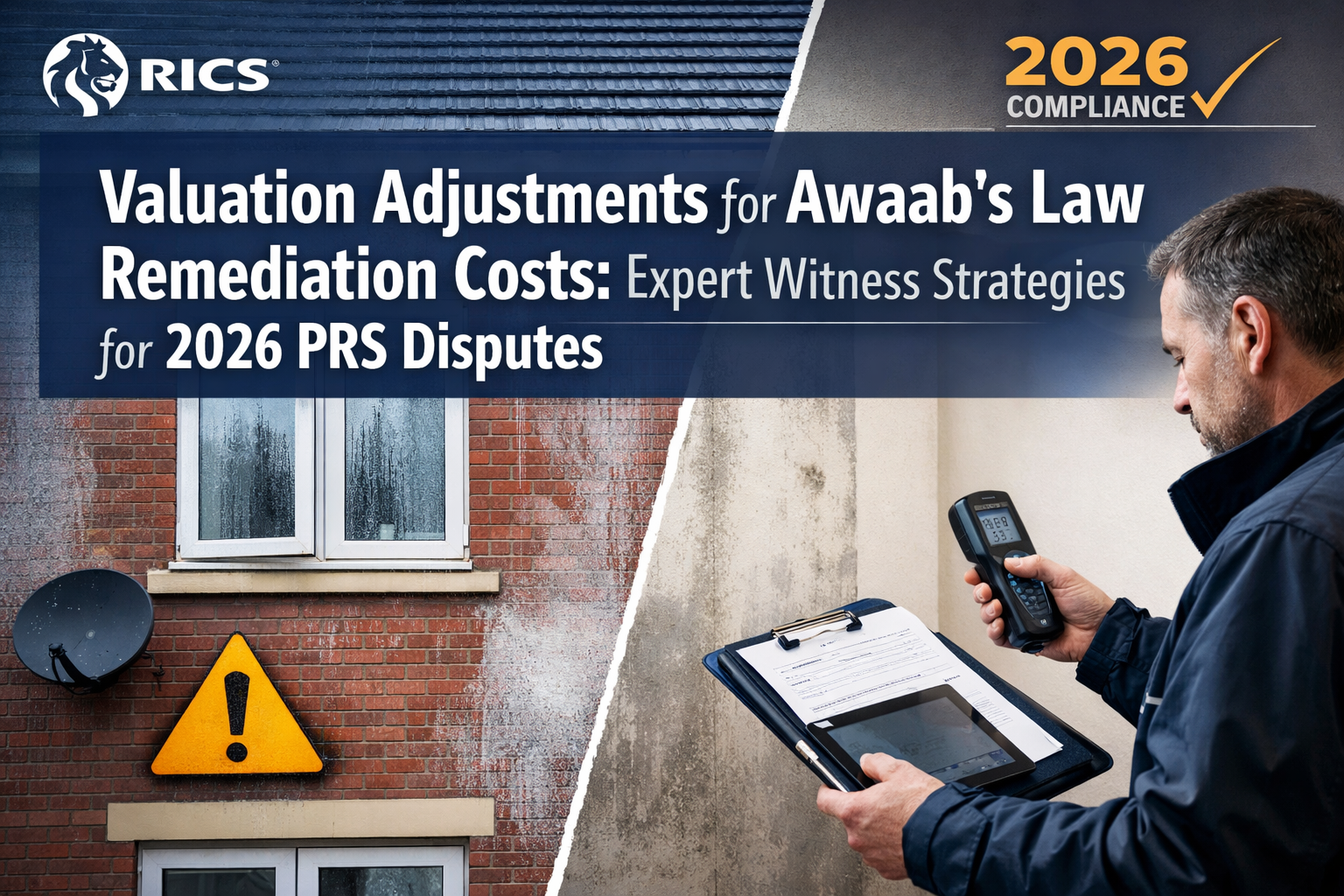
- Statutory timelines create measurable compliance benchmarks: Social landlords must investigate hazard reports within 10 working days and begin remediation within 15 working days, establishing clear timeframes for expert witness assessment [3]
- Remediation costs directly impact rental valuations: Expert witnesses employ standardized methodologies calculating remediation expenses and applying them as rental value adjustments, enabling quantified rent reduction claims [1]
- 2026 expansion triggers dispute surge: Five new hazard categories entering enforcement in 2026-2027 are projected to generate a 40% increase in landlord-tenant disputes requiring professional valuation services [2]
- Renters' Rights Act 2026 compounds complexity: Implementation on 1 May 2026 represents the most significant recalibration of UK rental property valuations in a generation, requiring integrated compliance assessment [4]
- Evidence quality determines tribunal outcomes: Expert witness reports must demonstrate technical competence, methodological transparency, and RICS compliance to withstand cross-examination in formal proceedings
Understanding Awaab's Law Compliance Framework and Remediation Timelines
Awaab's Law emerged from the tragic death of two-year-old Awaab Ishak in 2020, whose prolonged exposure to severe damp and mould in social housing proved fatal. The legislation establishes mandatory investigation and remediation timelines that fundamentally alter how property hazards must be addressed in the rental sector.
Statutory Timeline Requirements
The compliance framework operates on clearly defined timeframes that create measurable benchmarks for expert witness assessment:
| Stage | Timeline | Landlord Obligation | Expert Witness Consideration |
|---|---|---|---|
| Initial Report | Day 0 | Acknowledge tenant hazard report | Establish baseline date for compliance calculation |
| Investigation | Within 10 working days | Complete hazard assessment and severity determination | Review investigation methodology and findings quality |
| Remediation Start | Within 15 working days total (5 days after investigation) | Begin safety work for significant hazards | Assess compliance with statutory deadlines |
| Completion | Reasonable timeframe based on hazard severity | Complete remediation and verify effectiveness | Calculate extended non-compliance periods |
These statutory timelines form the foundation for compliance assessment in expert witness valuations, as delays beyond prescribed periods create quantifiable periods of non-compliance that directly impact rental value adjustments [3].
Expanding Hazard Categories in 2026-2027
While Awaab's Law initially focused on damp and mould hazards in social housing, the 2026-2027 expansion introduces five additional hazard categories that significantly broaden the scope of landlord obligations:
✅ Excess cold – inadequate heating systems and thermal insulation
✅ Excess heat – inadequate cooling and ventilation in summer months
✅ Carbon monoxide exposure – faulty heating appliances and ventilation
✅ Electrical hazards – unsafe wiring and appliance installations
✅ Water supply contamination – unsafe drinking water systems
This expansion creates substantially increased complexity for expert witnesses conducting valuation assessments, as each hazard category requires specialized technical knowledge and distinct remediation cost calculations. The projected 40% increase in disputes reflects this expanded scope, as landlords face compliance obligations across multiple hazard types simultaneously [2].
Social Housing vs. Private Rented Sector Application
Current Awaab's Law provisions apply primarily to social housing landlords, including local authorities and registered providers of social housing. However, the Renters' Rights Act 2026, which becomes effective 1 May 2026, extends similar hazard response obligations to the private rented sector (PRS), creating a unified compliance framework across all rental housing types [4].
This convergence means expert witnesses must prepare for substantially increased demand for valuation services in PRS disputes, where landlords historically faced less stringent statutory timelines for hazard remediation. The integration of Awaab's Law principles into broader rental legislation represents what surveyors describe as "the most significant recalibration of UK rental property valuations in a generation" [4].
Valuation Adjustments for Awaab's Law Remediation Costs: Methodological Framework
Expert witnesses preparing Valuation Adjustments for Awaab's Law Remediation Costs: Expert Witness Strategies for 2026 PRS Disputes must employ rigorous methodologies that translate technical hazard assessments into defensible financial calculations. The valuation framework operates across three interconnected dimensions: remediation cost quantification, rental value impact assessment, and temporal adjustment factors.
Remediation Cost Calculation Components
Professional valuations must itemize all costs associated with bringing a property into compliance with hazard standards:
Direct Remediation Costs:
- Specialist contractor fees for damp treatment, mould removal, or ventilation installation
- Materials costs including damp-proof membranes, anti-mould treatments, and replacement fixtures
- Building works required to address underlying structural causes (roof repairs, window replacement, drainage improvements)
- Post-remediation testing and certification expenses
Indirect Compliance Costs:
- Professional fees for surveyors, environmental health officers, and specialist consultants
- Temporary accommodation costs if property becomes uninhabitable during remediation
- Loss of rental income during remediation period
- Legal costs associated with compliance proceedings
Ongoing Monitoring Costs:
- Regular inspection schedules to verify remediation effectiveness
- Maintenance programs to prevent hazard recurrence
- Tenant communication and reporting systems
A typical Category 1 damp and mould hazard remediation in a two-bedroom rental property might generate costs ranging from £8,000 to £15,000 depending on severity and underlying structural issues. Expert witnesses must provide detailed cost breakdowns supported by contractor quotations, industry standard pricing guides, and comparable remediation projects [1].
Rental Value Adjustment Methodology
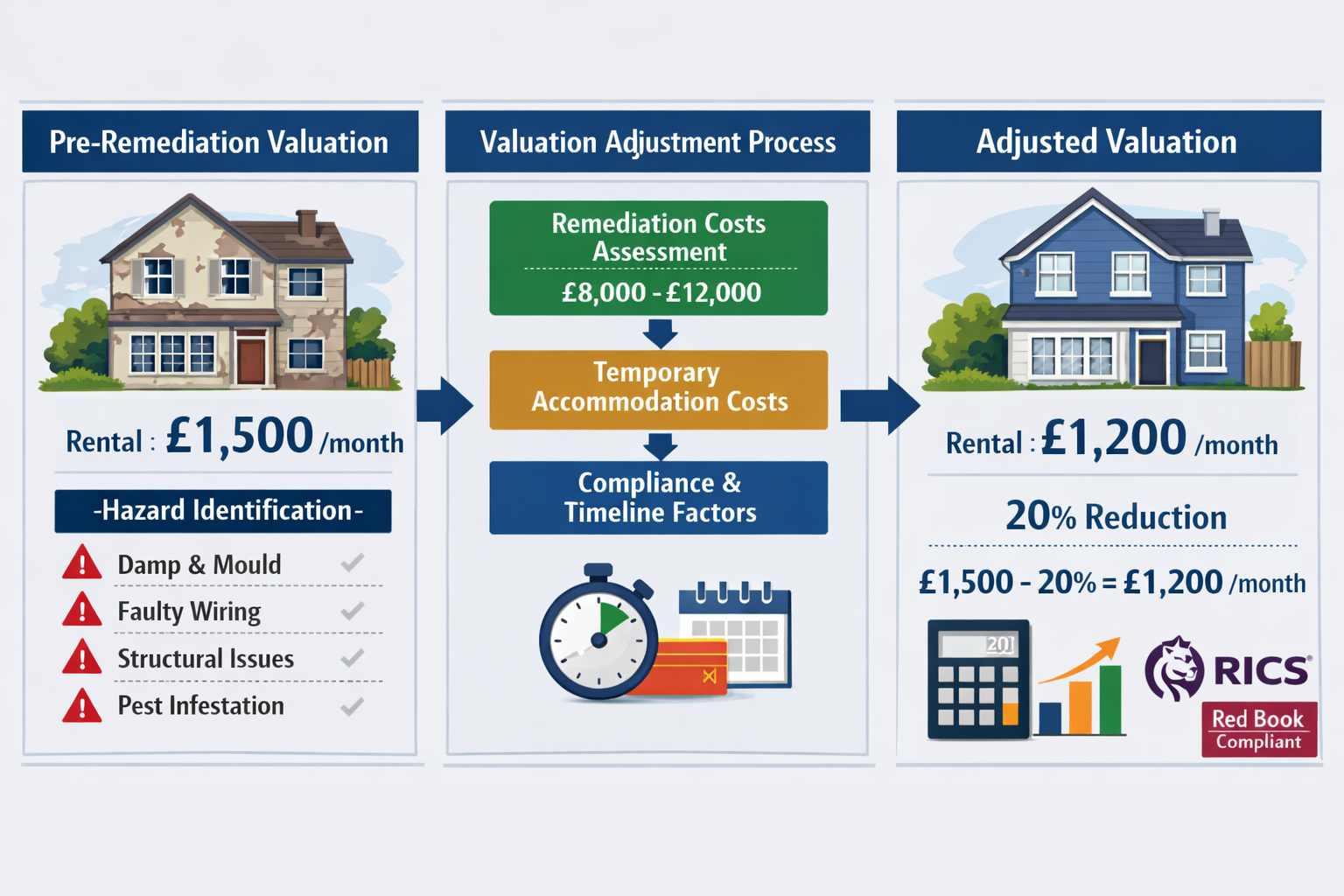
Once remediation costs are quantified, expert witnesses apply these figures to calculate appropriate rental value adjustments. The standardized methodology employed in tribunal proceedings follows this framework:
Step 1: Establish Baseline Rental Value
Determine the market rental value for the property in compliant condition using comparable properties, rental market data, and RICS valuation standards.
Step 2: Calculate Hazard Impact Percentage
Apply reduction percentages based on hazard severity, habitability impact, and health risk factors. Category 1 hazards typically warrant 15-30% reductions, while Category 2 hazards may justify 5-15% adjustments.
Step 3: Factor Non-Compliance Duration
Calculate the period of non-compliance from initial report through remediation completion, applying rental adjustments across this timeframe.
Step 4: Account for Remediation Cost Recovery
Determine whether remediation costs should be reflected as lump-sum adjustments or amortized across extended periods.
"Expert witness valuations employ a standardized methodology that calculates remediation costs and applies them as a rental value adjustment, allowing for quantified rent reduction claims when hazards are identified." [1]
This methodology creates defensible valuation adjustments that withstand cross-examination by opposing counsel and scrutiny from tribunal panels. The approach aligns with Red Book valuation principles while incorporating Awaab's Law-specific compliance factors.
Temporal Adjustment Factors and Compliance Periods
The timing of hazard identification, investigation, and remediation creates complex temporal considerations that expert witnesses must address:
Pre-Report Period:
If evidence demonstrates hazards existed before tenant reporting, expert witnesses may calculate retrospective rental adjustments. Retrospective valuation methodologies become essential when establishing landlord liability for extended hazard exposure periods.
Investigation Period (Days 1-10):
During the statutory 10-day investigation window, rental value typically remains at baseline levels unless hazards create immediate habitability concerns requiring temporary relocation.
Remediation Delay Period (Post Day 15):
Once the 15-day combined investigation and remediation start deadline passes, rental value adjustments typically apply at full rates, reflecting landlord non-compliance with statutory obligations.
Active Remediation Period:
While remediation work proceeds, rental adjustments reflect reduced habitability, noise, disruption, and access limitations. Adjustments typically range from 30-50% of baseline rental value during active construction periods.
Post-Remediation Monitoring Period:
Following remediation completion, expert witnesses may recommend reduced adjustments (5-10%) during verification periods to ensure hazard elimination effectiveness.
These temporal factors create layered valuation adjustments that reflect changing property conditions and compliance status throughout the dispute timeline.
Expert Witness Strategies for 2026 PRS Disputes: Evidence Preparation and Tribunal Presentation
As Awaab's Law provisions expand and PRS disputes surge in 2026, expert witnesses must refine their evidence preparation and presentation strategies to meet heightened tribunal expectations. The quality and defensibility of expert witness testimony often determines dispute outcomes, making methodological rigor and professional presentation critical success factors.
Evidence Collection and Documentation Standards
Robust expert witness reports begin with comprehensive evidence collection that establishes factual foundations for valuation adjustments:
Physical Inspection Documentation:
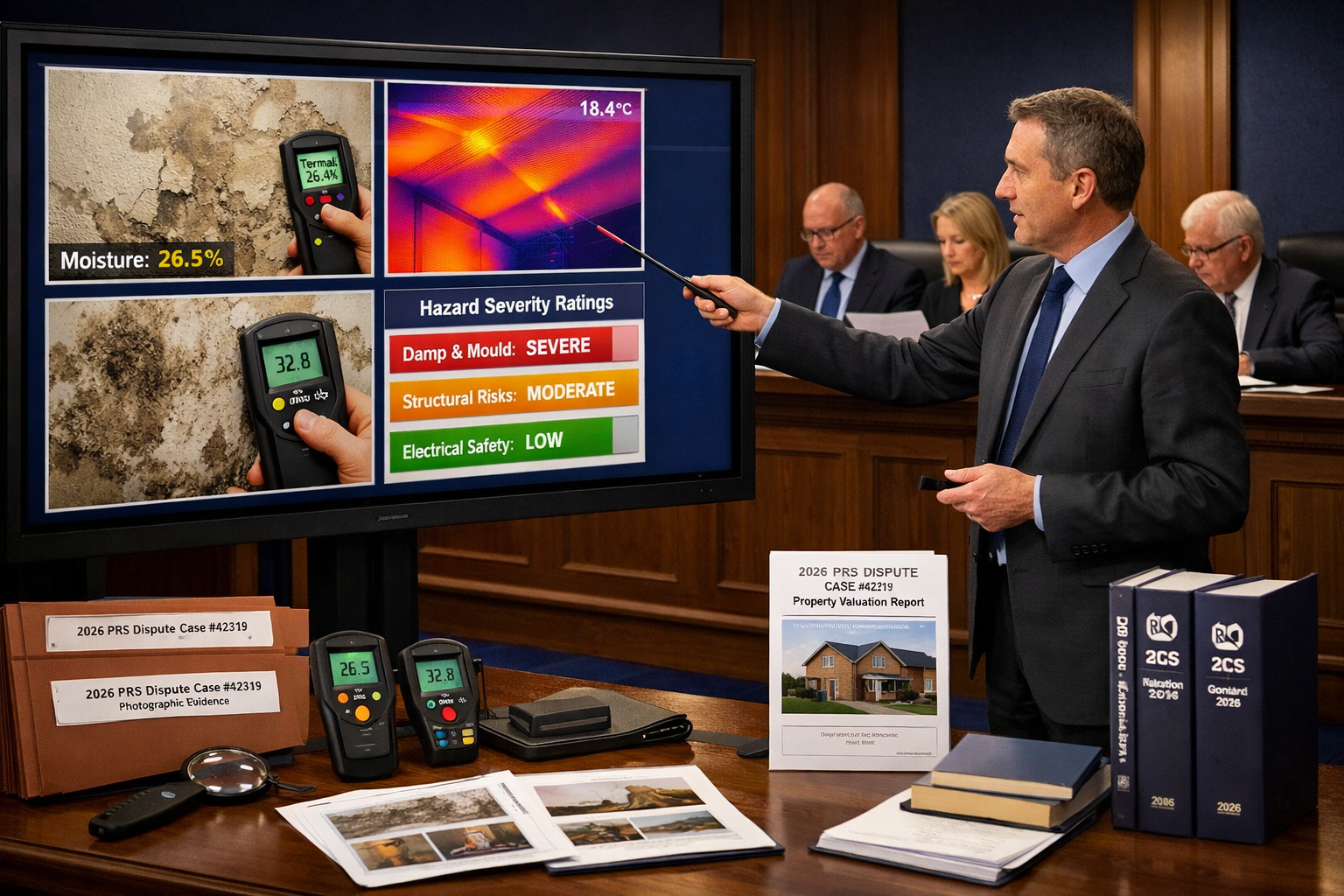
- Detailed photographic evidence showing hazard locations, severity, and surrounding conditions
- Moisture meter readings with calibrated equipment and multiple measurement points
- Thermal imaging data identifying condensation patterns, insulation deficiencies, and temperature variations
- Air quality testing results for mould spore counts and ventilation effectiveness
- Structural assessment findings identifying underlying causes (roof defects, rising damp, plumbing leaks)
Compliance Timeline Verification:
- Documented tenant hazard reports with submission dates and delivery confirmation
- Landlord response communications showing investigation timing and findings
- Contractor quotations and work commencement dates establishing remediation timelines
- Completion certificates and post-remediation testing results
Valuation Support Materials:
- Comparable property rental data from similar properties in compliant condition
- Market rental trend analysis showing seasonal and temporal variations
- Remediation cost quotations from multiple specialist contractors
- Industry standard pricing guides (BCIS, Spons) supporting cost calculations
Professional surveyors preparing expert witness reports must maintain meticulous documentation chains that demonstrate evidence integrity and methodological transparency throughout the valuation process.
RICS Compliance and Professional Standards
Expert witness valuations in Awaab's Law disputes must demonstrate full compliance with RICS Valuation – Global Standards (Red Book) requirements, ensuring professional credibility and tribunal acceptance:
📋 Terms of Engagement: Clear scope definition, fee agreements, and independence declarations
📋 Valuation Approach: Appropriate methodology selection with justification for chosen approach
📋 Assumptions and Special Assumptions: Transparent disclosure of valuation limitations and hypothetical conditions
📋 Valuation Reporting: Comprehensive reports meeting RICS format and content requirements
📋 Professional Indemnity Insurance: Adequate coverage for expert witness services
Expert witnesses must also adhere to RICS Practice Statement and Guidance Note on Expert Witness Work, which establishes specific obligations for surveyors providing litigation support services. These standards emphasize the expert's duty to the tribunal rather than the instructing party, requiring objective analysis regardless of which party commissions the valuation [1].
Tribunal Presentation Strategies
Effective expert witness testimony in 2026 PRS disputes requires strategic presentation approaches that communicate complex technical and financial information to non-specialist tribunal panels:
Visual Evidence Presentation:
Prepare high-quality visual aids including annotated photographs, cost breakdown tables, timeline graphics, and valuation calculation flowcharts that simplify complex information for tribunal comprehension.
Methodological Transparency:
Clearly explain each step of the valuation methodology, demonstrating how raw data (moisture readings, hazard severity assessments, remediation costs) translates into specific rental value adjustments.
Comparable Evidence:
Present compelling comparable property evidence showing rental values for similar properties in compliant condition, establishing market baselines for valuation adjustments.
Cross-Examination Preparation:
Anticipate opposing counsel challenges to methodology, assumptions, and calculations. Prepare detailed supporting documentation for every valuation component that might face scrutiny.
Professional Demeanor:
Maintain objectivity, acknowledge methodology limitations, and avoid advocacy for either party. Tribunals value expert witnesses who demonstrate balanced analysis rather than partisan support.
Common Valuation Challenges and Resolution Strategies
Expert witnesses frequently encounter specific challenges when preparing Valuation Adjustments for Awaab's Law Remediation Costs: Expert Witness Strategies for 2026 PRS Disputes:
Challenge 1: Multiple Concurrent Hazards
When properties exhibit several hazard types simultaneously (damp, electrical defects, excess cold), determining cumulative rental adjustments becomes complex. Resolution: Apply hierarchical assessment prioritizing most severe hazards, then calculate incremental adjustments for secondary hazards, avoiding double-counting of overlapping impacts.
Challenge 2: Pre-Existing Condition Disputes
Landlords often claim hazards resulted from tenant behavior rather than property defects. Resolution: Employ forensic investigation techniques examining building pathology, maintenance records, and comparable property conditions to establish causation evidence.
Challenge 3: Remediation Cost Disputes
Parties frequently challenge remediation cost estimates as excessive or insufficient. Resolution: Obtain multiple contractor quotations, reference industry standard pricing guides, and provide detailed specifications justifying proposed remediation scope.
Challenge 4: Rental Market Volatility
Fluctuating rental markets complicate baseline rental value determination. Resolution: Use time-adjusted comparable evidence, apply rental index adjustments, and establish valuation date-specific market conditions.
Challenge 5: Temporary Accommodation Cost Allocation
Disputes arise over whether landlords must cover temporary accommodation during remediation. Resolution: Reference statutory obligations, tribunal precedents, and proportionality principles balancing tenant protection with landlord liability limits.
Integration with Broader Compliance Assessment
The Renters' Rights Act 2026 implementation creates interconnected compliance obligations that expert witnesses must address holistically. Surveyors preparing valuations for Awaab's Law disputes should also consider:
- Energy Performance Certificate (EPC) requirements and minimum energy efficiency standards
- Electrical safety certification obligations under the Electrical Safety Standards in the Private Rented Sector Regulations
- Gas safety certification requirements and annual inspection obligations
- Smoke and carbon monoxide alarm installation and maintenance standards
- Deposit protection scheme compliance and dispute resolution procedures
This integrated approach ensures expert witness valuations address the full spectrum of landlord compliance obligations rather than isolated hazard-specific issues, providing comprehensive analysis that serves tribunal decision-making needs [4].
Future-Proofing Expert Witness Methodologies
As Awaab's Law provisions continue evolving and PRS regulation intensifies, expert witnesses must develop adaptable methodologies that accommodate changing legislative frameworks:
🔧 Continuous Professional Development: Regular training on emerging hazard categories, updated remediation techniques, and evolving tribunal expectations
🔧 Technology Integration: Adoption of digital inspection tools, thermal imaging equipment, and moisture detection technology enhancing evidence quality
🔧 Precedent Monitoring: Systematic tracking of tribunal decisions establishing valuation precedents and methodological standards
🔧 Industry Collaboration: Engagement with professional bodies, specialist working groups, and peer review networks refining best practices
🔧 Quality Assurance Systems: Implementation of internal review processes ensuring consistency, accuracy, and RICS compliance across all expert witness work
These forward-looking strategies position expert witnesses to navigate the projected 40% increase in 2026 PRS disputes while maintaining the professional standards and methodological rigor that tribunal credibility demands [2].
Conclusion
The convergence of Awaab's Law expansion, Renters' Rights Act 2026 implementation, and heightened tenant awareness of hazard rights has created unprecedented demand for expert witness valuations in the private rented sector. Surveyors preparing Valuation Adjustments for Awaab's Law Remediation Costs: Expert Witness Strategies for 2026 PRS Disputes must master complex methodologies that translate statutory compliance obligations into defensible financial calculations while maintaining the professional standards and evidentiary rigor that tribunal proceedings demand.
The statutory investigation and remediation timelines—10 working days for hazard assessment and 15 working days total for remediation commencement—create measurable compliance benchmarks that form the foundation for rental value adjustments. When combined with expanding hazard categories encompassing damp, mould, excess cold, excess heat, carbon monoxide, electrical defects, and water contamination, these requirements generate multifaceted valuation challenges requiring specialized technical knowledge and sophisticated calculation methodologies.
Actionable Next Steps for Property Professionals
For Landlords and Property Managers:
- Commission proactive hazard assessments identifying potential compliance issues before tenant reports trigger statutory timelines
- Establish preventive maintenance programs addressing common hazard precursors (condensation, ventilation deficiencies, heating system failures)
- Obtain professional RICS valuation services quantifying potential remediation costs and rental value impacts for portfolio risk assessment
- Document all hazard reports, investigation activities, and remediation work creating comprehensive compliance evidence trails
For Tenants and Tenant Representatives:
- Understand statutory rights under Awaab's Law and Renters' Rights Act 2026, including mandatory landlord response timelines
- Document hazard conditions through detailed photographs, written descriptions, and dated communications with landlords
- Seek professional hazard assessments from qualified surveyors when landlords fail to investigate or remediate reported issues
- Consider expert witness valuation services quantifying rent reduction entitlements when disputes proceed to tribunal
For Expert Witnesses and Surveyors:
- Develop specialized expertise in hazard assessment methodologies, remediation cost calculation, and rental value adjustment techniques
- Maintain current knowledge of evolving Awaab's Law provisions, tribunal precedents, and RICS professional standards
- Invest in technical equipment (moisture meters, thermal imaging cameras, air quality testing devices) enhancing evidence collection capabilities
- Establish quality assurance systems ensuring methodological consistency and professional compliance across all expert witness engagements
The 40% projected increase in landlord-tenant disputes requiring expert witness valuations represents both challenge and opportunity for the surveying profession. Those who develop robust methodologies, maintain rigorous professional standards, and deliver compelling tribunal testimony will find themselves essential participants in the fundamental recalibration of UK rental property valuation practices that 2026 has initiated.
As the private rented sector adapts to this new compliance landscape, the role of expert witnesses extends beyond dispute resolution to encompass broader market education, risk assessment, and professional standard-setting. The surveyors who master Valuation Adjustments for Awaab's Law Remediation Costs: Expert Witness Strategies for 2026 PRS Disputes will shape how the industry navigates this transformative period, establishing precedents and methodologies that protect tenant welfare while ensuring landlord obligations remain proportionate and achievable.
References
[1] Expert Witness Valuations In Awaabs Law Disputes Building Evidentiary Cases When Hazard Non Compliance Triggers Rent Reduction Claims – https://nottinghillsurveyors.com/blog/expert-witness-valuations-in-awaabs-law-disputes-building-evidentiary-cases-when-hazard-non-compliance-triggers-rent-reduction-claims
[2] Expert Witness Preparation For Awaabs Law Expansion Disputes 2026 Hazard Assessments In Rental Valuations – https://nottinghillsurveyors.com/blog/expert-witness-preparation-for-awaabs-law-expansion-disputes-2026-hazard-assessments-in-rental-valuations
[3] Awaabs Law – https://www.bwbconsulting.com/insights/awaabs-law/
[4] Valuation Adjustments For Renters Rights Act 2026 How Building Surveyors Must Assess Landlord Tenant Compliance – https://nottinghillsurveyors.com/blog/valuation-adjustments-for-renters-rights-act-2026-how-building-surveyors-must-assess-landlord-tenant-compliance