
A 0.4% monthly uptick in advertised asking prices makes for a reassuring headline. It does not fix a cracked lintel, a failing damp-proof course, or a roof that has three years of useful life left in it. The September 2026 UK property market: why a small asking-price rebound does not remove building survey risk is precisely the question buyers and their advisers need to hold in mind as market commentary turns cautiously optimistic.
Key Takeaways
- RICS surveyor data for August 2026 shows improved forward-looking sentiment, but continued short-term caution on prices and sales volumes [1]
- Mortgage rates have hit a three-year high, meaning any survey-identified defect carries greater financial weight at the point of purchase [8]
- Asking-price indices measure what sellers want, not what a property is physically worth or what a lender will accept
- Regional divergence is wide: a modest national average conceals markets where values are still falling and where survey findings carry the highest negotiating leverage
- A RICS Level 3 building survey remains the most reliable way to separate headline price movement from property-specific condition risk
What the September 2026 Data Actually Show
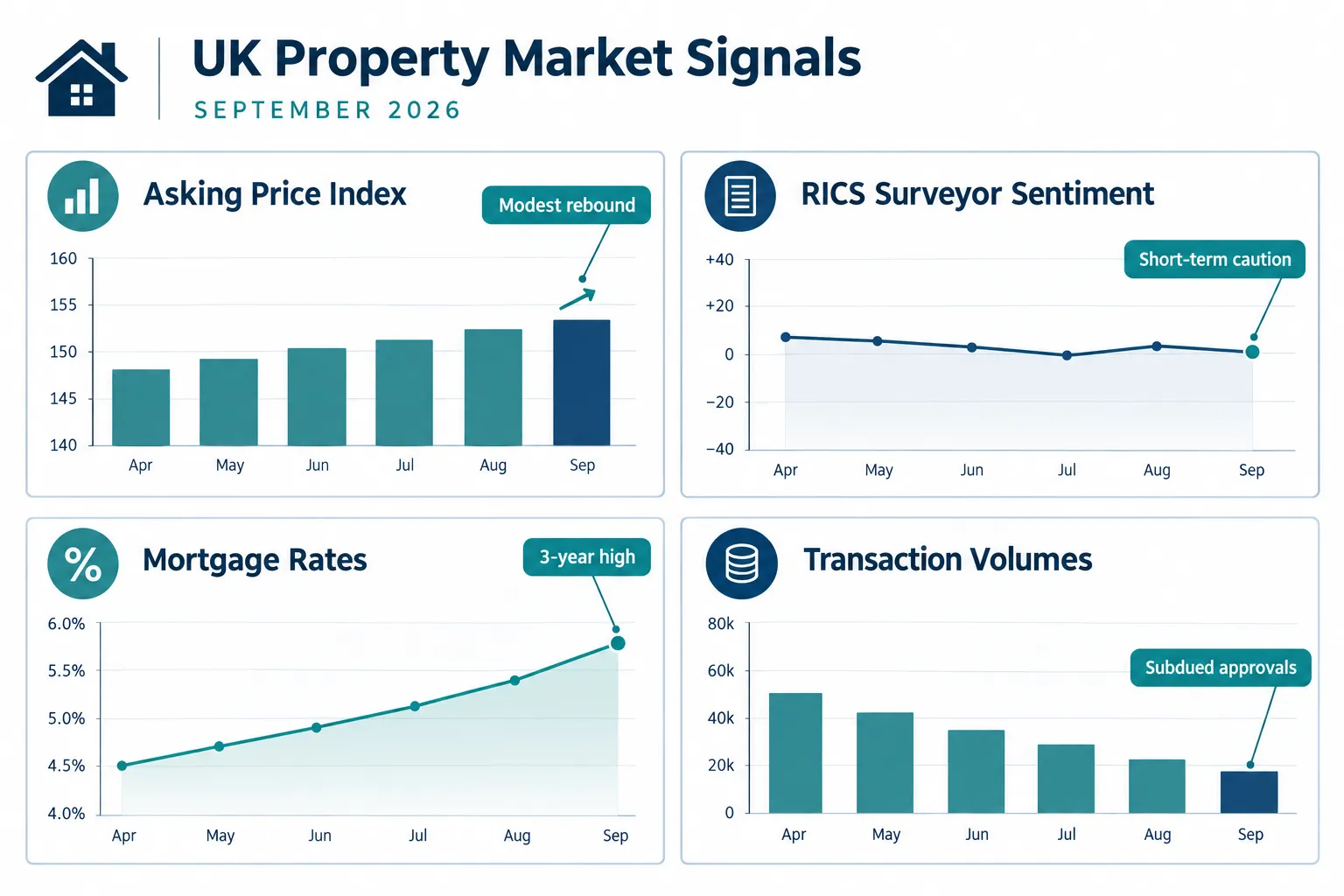
The ONS Private Rent and House Prices bulletin for September 2026 confirms that annual house price growth in England remains thin, sitting in a narrow band that leaves little margin between modest growth and outright decline [7]. The RICS August 2026 UK Residential Market Survey recorded a net balance of -17 for near-term price expectations among surveyors, meaning significantly more respondents expected prices to fall over the following three months than expected them to rise [1]. The headline new buyer enquiries balance improved slightly, but agreed sales remained weak [3].
Mortgage approvals tell a similar story. Guardian reporting from late September 2026 noted that borrowing costs had pushed mortgage demand to its lowest level in months, with lenders tightening affordability assessments in response to gilt market volatility [6]. Separately, mortgage rates reached a three-year high in the same period, directly suppressing the pool of qualifying buyers [8].
Against that backdrop, a small recovery in Rightmove or Zoopla asking-price data reflects seller confidence, or seller reluctance to reduce, rather than a genuine shift in market fundamentals. Asking prices are set by estate agents and vendors. Sold prices, lender valuations, and physical condition are set by the market, the surveyor, and the building itself.
What the data confirm for buyers:
- Transaction volumes are projected to remain subdued through 2026 [9]
- Buyer negotiating power is high in most regions
- Surveyor sentiment has improved for the 12-month outlook, but short-term caution persists [10]
- Rent expectations are strong, which is drawing investor attention away from sales markets [2]
Why Asking-Price Movements and Building Condition Are Separate Questions
The September 2026 UK property market: why a small asking-price rebound does not remove building survey risk becomes clearest when you separate what a price index measures from what a surveyor measures.
A price index tracks the advertised or transacted value of properties. A building survey assesses the physical condition of a specific property on a specific day. These are different things. A Victorian terraced house in Leeds can sit in a postcode where asking prices rose 1.2% last month and simultaneously have:
- Active subsidence from tree root activity
- Failed cavity wall insulation retaining moisture
- A flat roof extension at the end of its serviceable life
- Electrical wiring that predates the 17th Edition IEE Regulations
None of those defects appear in a price index. All of them affect the true cost of ownership and the lender's willingness to advance funds at the agreed price.
The Mortgage Valuation Gap
A mortgage valuation is not a survey. It is a brief inspection carried out for the lender's benefit to confirm the property is adequate security for the loan. It does not assess condition in detail, and it does not protect the buyer. Our guide on mortgage valuation vs full building survey sets out exactly what buyers miss when they rely on the lender's figure alone.
At a time when mortgage rates are at a three-year high [8], the financial consequence of discovering a £25,000 structural repair after exchange is proportionally more severe. A buyer on a 5.4% two-year fixed rate paying for an unexpected roof replacement faces compounding costs that a 2024-era buyer at 2.1% would have absorbed more easily.
Regional Divergence Makes Property-Level Assessment More Important, Not Less
National averages mask sharp regional variation. RICS data show that surveyor sentiment in parts of the South East and East of England remained negative on a three-month price view even as some Northern cities showed modest improvement [1][3]. In a divergent market, the postcode-level and property-level picture matters more than the national headline.
A buyer in a softening postcode who skips a full survey is taking on two layers of risk simultaneously: market-level price risk and physical condition risk. Those risks compound. A Level 3 building survey, the most thorough inspection available under RICS standards, gives the buyer the information to price both.
What a Building Survey Finds That a Price Rebound Cannot Fix
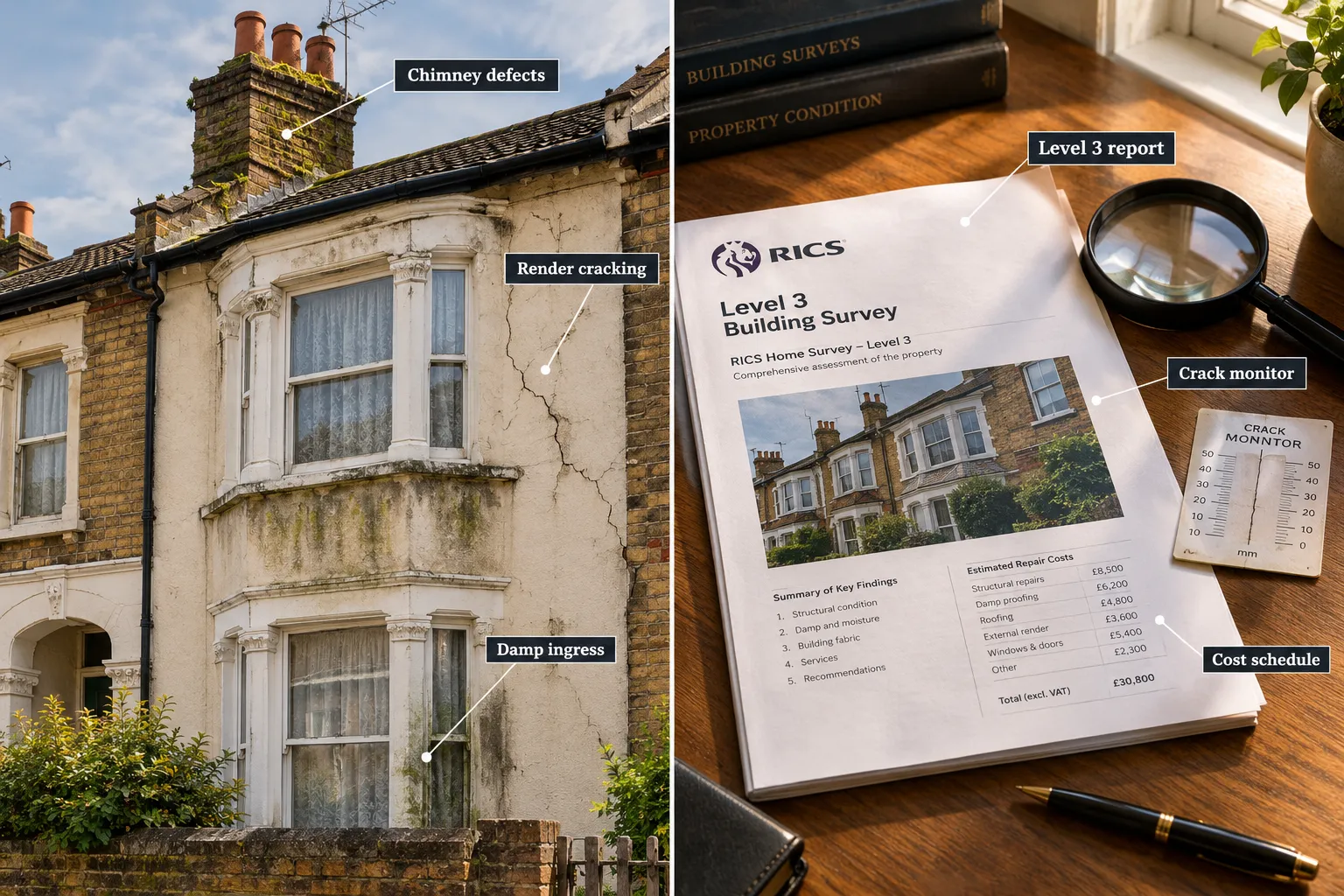
The physical condition of UK housing stock does not improve because asking prices tick upward. The English Housing Survey consistently reports that a significant proportion of owner-occupied homes have at least one category-one or category-two hazard under the Housing Health and Safety Rating System. Older properties, pre-1919 stock in particular, carry the highest prevalence of structural movement, damp, and services deficiencies.
Common findings that affect value and lender decisions include:
| Defect Category | Typical Cost Range (2026) | Lender Impact |
|---|---|---|
| Active subsidence (monitoring required) | £5,000, £50,000+ | Retention or decline |
| Roof covering replacement (standard terrace) | £6,000, £14,000 | Retention possible |
| Damp-proof course failure | £2,500, £8,000 | Retention possible |
| Electrical rewire (3-bed house) | £4,500, £9,000 | Retention possible |
| Structural wall tie failure | £3,000, £12,000 | Retention or decline |
| Flat roof replacement | £3,500, £10,000 | Retention possible |
Cost ranges are indicative for England 2026. A RICS surveyor will recommend specialist reports where costs are uncertain.
A lender retention means the advance is held back until works are completed or re-inspected. In a high-rate environment, a retention delays completion, increases bridging costs, and can collapse a chain. Knowing about these issues before exchange, rather than after, is the practical purpose of commissioning a survey.
For properties with more complex histories, including listed buildings, the gap between asking price and true cost of ownership can be substantially wider. Listed status restricts the materials and methods used for repairs, which drives costs above standard market rates.
Subsidence: The Risk That Asking Prices Cannot Reflect
Subsidence is one of the most consequential findings a surveyor can make. It is also one of the least visible to an untrained eye. Diagonal cracking from window corners, tapering gaps at door frames, and uneven floors are the physical signs, none of which appear in a Rightmove listing photograph.
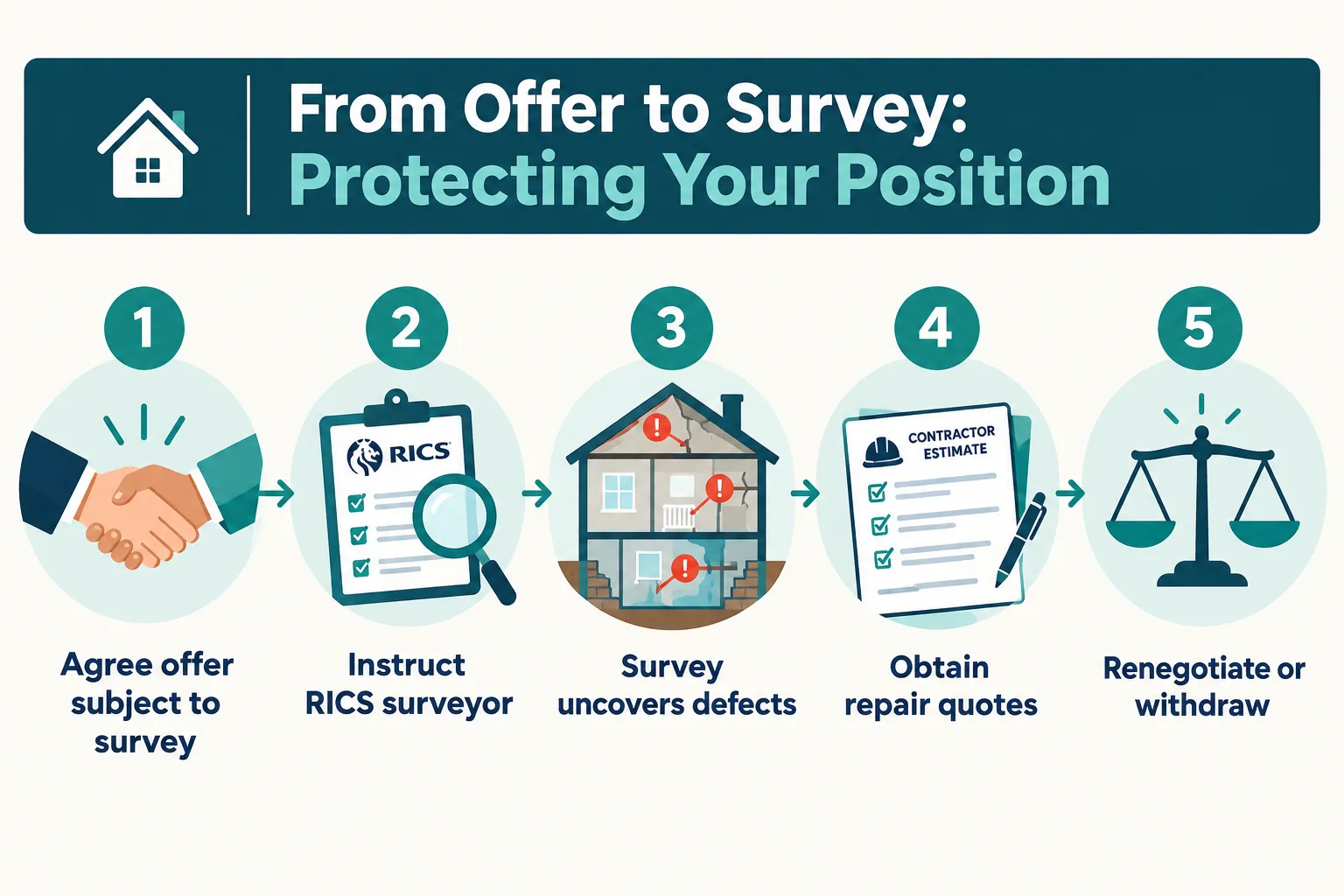
In a market where buyers retain strong negotiating leverage due to subdued demand [6], a confirmed subsidence finding gives the buyer a well-evidenced basis to renegotiate the price or withdraw without penalty. That leverage only exists if the survey has been commissioned before exchange.
Choosing the Right Survey Level in the Current Market
RICS defines three survey levels. Choosing the right one depends on the age, type, and condition of the property, not on whether the market is rising or falling.
Level 1 (Condition Report): Suitable only for new-build or near-new properties in good condition. Provides a basic traffic-light assessment with no advice on repairs.
Level 2 (Homebuyer Report): Covers most standard properties built after 1900 in reasonable condition. Includes a market valuation and insurance reinstatement figure. See our homebuyer report vs building survey comparison for a full breakdown.
Level 3 (Building Survey): Recommended for any property built before 1900, any property that has been significantly altered, any property showing visible defects, or any property where the buyer intends to carry out works. Provides detailed condition assessment, advice on repair options, and an indication of likely costs. Our Level 2 vs Level 3 survey guide helps buyers decide between the two.
In September 2026 market conditions, where transaction volumes are low, mortgage rates are high, and buyer negotiating power is elevated, the cost of a Level 3 survey is modest relative to the potential saving on a renegotiated purchase price or an avoided defective purchase. For context on fees, see our guide on how much a building survey costs.
Buyer Negotiating Power and How Survey Findings Activate It
Weak demand is a buyer's structural advantage. RICS data show that new buyer enquiries, while slightly improved, remain below levels consistent with a healthy market [1][3]. Sellers who have been on the market for more than eight weeks are increasingly open to price adjustments.
A building survey converts that general market leverage into property-specific leverage. Without a survey, a buyer can only negotiate on price based on comparable sales, which in a thin market are few and dated. With a survey, the buyer has:
- A written schedule of defects from a RICS-regulated professional
- Indicative repair costs
- A basis for requesting specialist reports (structural engineer, damp specialist, electrical contractor)
- Documentary evidence to support a price reduction request or a request for the seller to carry out works before exchange
Estate agents are familiar with this process. A well-evidenced survey finding is not a confrontational act, it is standard practice in a market where buyers are rightly cautious.
Frequently Asked Questions
Does a rising asking-price index mean my survey is less likely to find problems?
No. Asking-price indices track what sellers are advertising. They have no relationship to the physical condition of individual properties. A property in a rising postcode can still have serious structural, damp, or services defects.
Will my mortgage lender's valuation pick up defects?
Not reliably. A mortgage valuation is a brief inspection for the lender's security purposes. It is not a condition report and does not protect the buyer. A separate RICS survey is the buyer's own due diligence.
What is the difference between a Level 2 and Level 3 survey?
A Level 2 (Homebuyer Report) covers standard properties in reasonable condition and includes a valuation. A Level 3 (Building Survey) is more detailed, covers all accessible parts of the building, and is recommended for older, altered, or visibly defective properties. See our Level 3 survey guide for full details.
Can I use survey findings to renegotiate the price?
Yes. Survey findings are regularly used as the basis for price renegotiation. The buyer commissions the survey, owns the report, and can share relevant sections with the seller's agent to support a revised offer.
How long does a building survey take?
For a standard three-bedroom house, the inspection typically takes two to four hours on site. The written report is usually delivered within five to ten working days, depending on the surveyor's workload.
What happens if the survey finds subsidence?
The surveyor will typically recommend a specialist structural engineer's report. The buyer can then decide whether to proceed subject to further investigation, renegotiate the price to reflect remediation costs, or withdraw. Mortgage lenders may decline to advance funds on a property with active subsidence until remediation is confirmed.
Is a building survey worth commissioning in a slow market?
A slow market with high mortgage rates makes a survey more valuable, not less. The financial consequences of buying a defective property are amplified when borrowing costs are high and resale liquidity is low.
Conclusion
The September 2026 UK property market: why a small asking-price rebound does not remove building survey risk is not a theoretical concern, it is the practical reality facing every buyer who relies on a headline index rather than a property-specific inspection.
Asking prices have nudged upward. Surveyor sentiment has improved on a 12-month view [10]. Neither of those facts changes the condition of the roof, the integrity of the foundations, or the age of the electrical installation in any individual property.
With mortgage rates at a three-year high [8], transaction volumes subdued [9], and regional price divergence wide [1], the margin for error on a property purchase is narrow. A RICS Level 3 building survey is the most direct way to close the gap between what a price index shows and what a property actually costs to own.
Practical next steps:
- Instruct a RICS-regulated surveyor before exchange of contracts, not after
- Match the survey level to the property: Level 3 for any pre-1919, altered, or visibly defective building
- Use survey findings to obtain specialist reports where defects are identified
- Share the surveyor's cost indications with the seller's agent as the basis for renegotiation
- Do not treat a mortgage valuation as a substitute for an independent building survey
For buyers in London and the South East, chartered surveyors in London are available to carry out Level 2 and Level 3 inspections across all property types, including listed buildings, conversions, and new-build properties where defects are suspected.
References
[1] UK Residential Survey August 2026 – rics.org
[2] UK Residential Market Survey – rics.org
[3] August 2026 UK Residential Market Survey – rics.org
[4] UK House Prices September Mortgage Rates Bonds Stock Markets Manufacturing Latest News Updates – theguardian.com
[5] RICS House Price Balance – tradingeconomics.com
[6] UK Mortgage Demand Borrowing Costs Interest Rate – theguardian.com
[7] Private Rent and House Prices UK: September 2026 – ons.gov.uk
[8] UK Mortgage Rates Hit 3-Year High as Housing Sales Fall – mpamag.com
[9] UK Economy Property Market Update August 2026 – rics.org
[10] UK Housing Market Outlook Improves According to August Survey – global.morningstar.com