
Deposit disputes cost UK landlords and tenants millions of pounds each year, and the single most common reason adjudicators find against landlords is the absence of a properly prepared schedule of condition. A schedule of condition for a residential lease is a formal, contemporaneous record of the physical state of a property at the point a tenancy begins. It sits at the heart of every end-of-tenancy dilapidations claim, and without one, neither party can prove what the property looked like on day one.
This article explains what a schedule of condition is, how it differs from a standard inventory, what it must contain to carry evidential weight, and how photographs and video footage affect the outcome of disputes before deposit scheme adjudicators and the courts.
Key Takeaways
- A schedule of condition records the physical state of a property before a tenancy begins, room by room, in writing and with photographs.
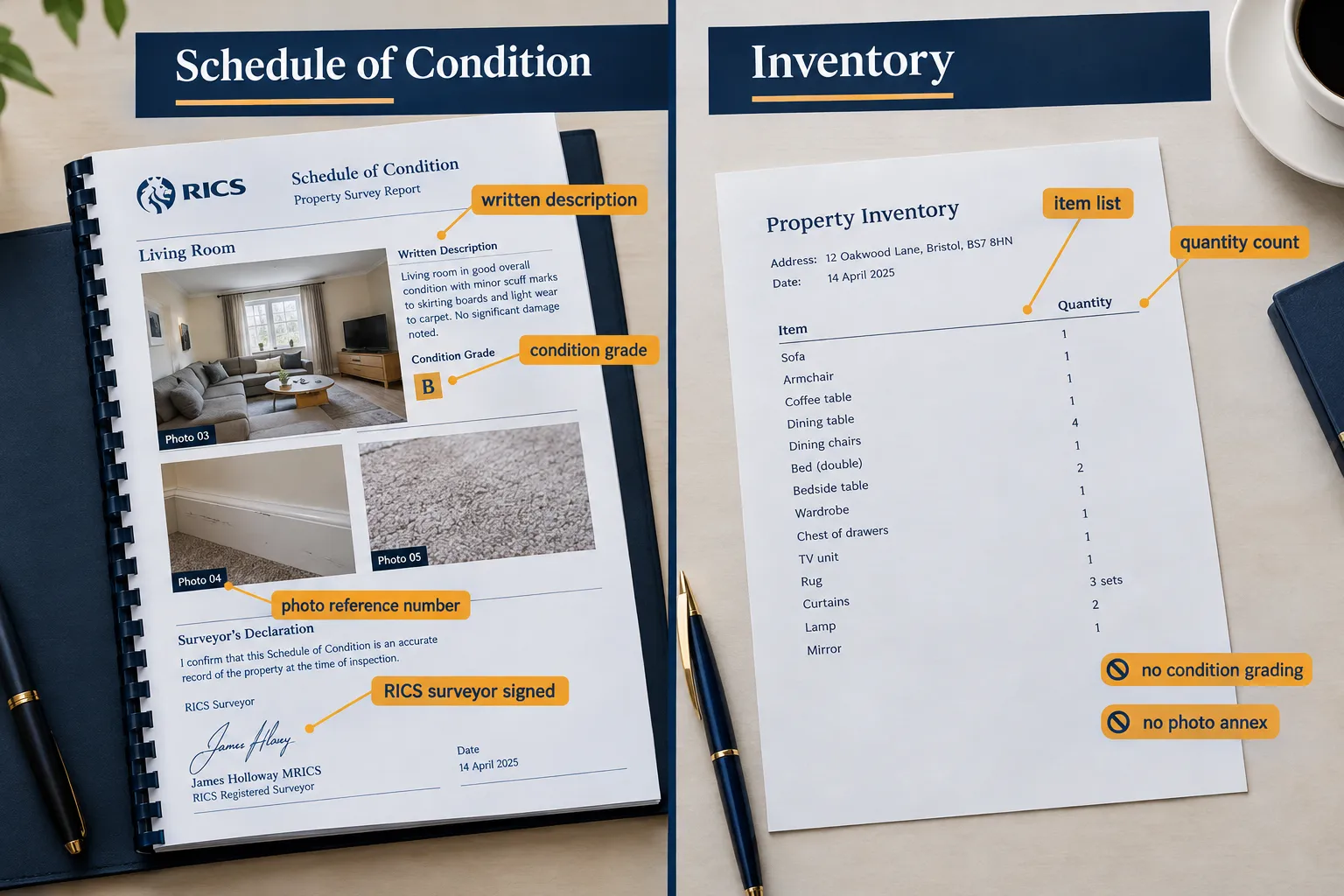
- It differs from an inventory: an inventory lists contents and chattels; a schedule of condition records the fabric and finish of the building itself.
- Lease wording must explicitly reference the schedule, otherwise it may not limit the tenant's repairing obligations.
- Timestamped, geotagged photographs and video walkthroughs are now regarded as the evidential gold standard by UK deposit scheme adjudicators.
- From 1 July 2025, pre-tenancy photographic evidence has become a regulatory expectation under emerging best-practice guidance, and its absence weakens any deposit claim.
Defining a Schedule of Condition for a Residential Lease
A schedule of condition is a written and photographic record prepared before a tenant takes occupation. It describes, room by room and element by element, the existing state of the property, cracks in plaster, scuffs on paintwork, worn carpets, dripping taps, so that the baseline is fixed in writing and images [4].
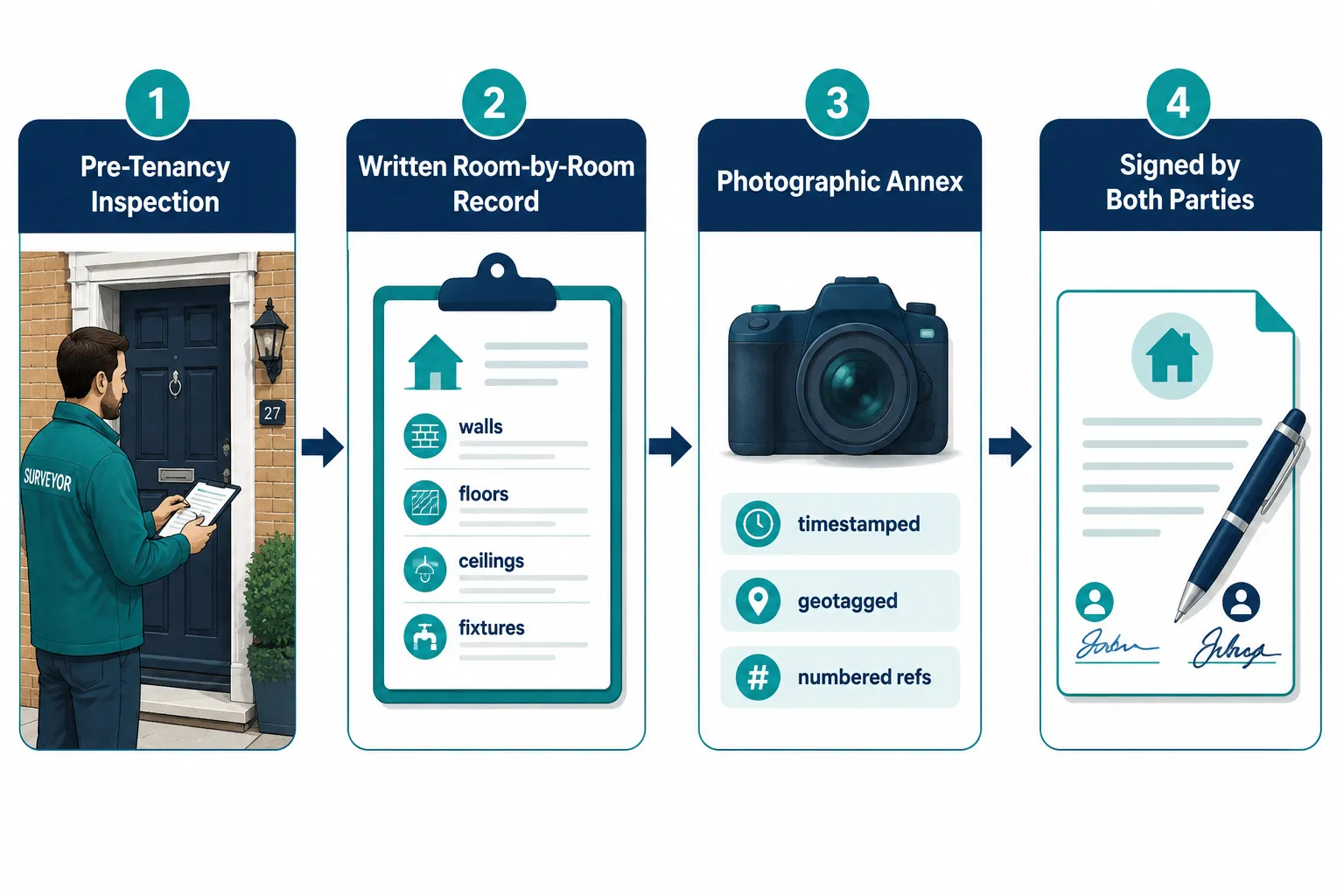
The document is not a snagging list and it is not a valuation. It records facts: what was there, what condition it was in, and what defects already existed. A RICS-qualified surveyor preparing one will note each room systematically, assign condition references to photographs, and produce a bound report that both parties sign [3].
Why the distinction from an inventory matters
An inventory records the contents of a property, furniture, appliances, crockery. A schedule of condition records the fabric: walls, floors, ceilings, windows, joinery, fixtures and the structure itself. Many landlords and letting agents conflate the two, and that confusion is precisely what drives disputes. An inventory that notes "two sofas, one dining table" tells an adjudicator nothing about whether the kitchen wall was already cracked before the tenant moved in [2].
A schedule of condition can stand alone or be appended to an inventory, but it must address the building fabric separately and in sufficient detail to be useful.
Who prepares it
A RICS-qualified building surveyor is the appropriate professional for a thorough schedule of condition, particularly on older properties or where the lease imposes a full repairing obligation. For shorter assured shorthold tenancies, a professional inventory clerk may prepare a combined document, but the standard of photographic and written evidence must still meet the expectations of deposit scheme adjudicators [8].
For a broader understanding of what a surveyor examines during a formal inspection, the room-by-room building survey guide sets out the elements a professional will assess.
How Lease Wording Interacts with a Schedule of Condition
The schedule of condition has no legal effect unless the lease expressly refers to it and limits the tenant's obligations accordingly [9]. The standard drafting approach is to qualify the repairing covenant so that the tenant is only required to return the property in no worse condition than that recorded in the schedule.
A clause along the following lines is typical in practice:
"The tenant shall keep and yield up the premises in repair, having regard to the condition of the premises at the commencement of the term as evidenced by the Schedule of Condition annexed hereto."
Without that qualification, a full repairing obligation requires the tenant to put the property into good repair regardless of its state at the start, a potentially severe liability if the property was in poor condition when the lease was granted [5].
Three common drafting errors
| Error | Consequence |
|---|---|
| Schedule prepared but not annexed to the lease | Adjudicator or court may disregard it as extrinsic evidence |
| Lease refers to a schedule that was never signed | Authenticity disputed; evidential weight reduced |
| Inventory used in place of a schedule of condition | Fabric defects not recorded; landlord claims for pre-existing damage succeed by default |
Tenants taking on a long residential lease, particularly a leasehold flat, should ensure their solicitor reviews both the repairing covenant and the annexed schedule before exchange. The FAQ on lease extensions and the wider leasehold guidance on this site cover how repairing obligations interact with lease term.
Photographs, Video and the Evidential Standard in 2026
The question of what evidence carries weight in a deposit dispute has shifted materially over the past two years. UK deposit scheme adjudicators, operating under the three government-authorised schemes, consistently treat timestamped, geotagged photographs and video walkthroughs as the primary evidential record [7].
What makes a photograph evidential rather than decorative
A photograph taken on a smartphone and uploaded to a cloud service is not automatically reliable evidence. To carry weight, photographic evidence should meet the following criteria [8]:
- Timestamped, the file metadata or an on-screen date stamp shows when the image was taken
- Geotagged, location data confirms the photograph was taken at the property address
- Referenced, each image is numbered and cross-referenced to the written schedule
- Comprehensive, every room, every wall elevation, every floor area, every fixture
- Condition-specific, close-up shots of defects with a scale reference (a ruler or coin) alongside wide shots for context
Video walkthroughs narrated by the surveyor or inventory clerk add a further layer of authenticity. A continuous recording that moves through each room, naming defects as they appear, is very difficult to challenge on authenticity grounds [8].
The July 2025 regulatory shift
From 1 July 2025, pre-tenancy photographic evidence became an expected component of best practice under guidance issued by the property industry's professional bodies. Landlords and agents who fail to produce photographic evidence at the start of a tenancy now face a significantly higher burden of proof when claiming for damage at the end. Adjudicators from the Deposit Protection Service and similar schemes have indicated that unsubstantiated written claims, unsupported by pre-tenancy photographs, will generally fail [7].
Tenant-submitted evidence
Tenants have always been entitled to submit their own photographic and video evidence in a dispute. The practical advice from housing advisers is that a tenant should conduct their own photographic walkthrough within 24 hours of moving in, document any pre-existing damage, and notify the landlord in writing [1]. That evidence, submitted alongside the official schedule of condition, can rebut a landlord's claim for damage that pre-dated the tenancy.
Shelter's guidance on deposit disputes confirms that photographic evidence submitted by either party will be considered by the adjudicator, and that the quality and contemporaneity of the images are the critical factors [1].
End-of-Tenancy Disputes: How the Schedule Is Used
At the end of a tenancy, the landlord or their agent conducts a check-out inspection and produces a report comparing the current state of the property against the schedule of condition prepared at the start [6]. Any deterioration beyond fair wear and tear may be the subject of a deduction from the deposit.
The fair wear and tear principle
Fair wear and tear is not defined in statute but is well established in case law. It covers the gradual, reasonable deterioration that results from ordinary occupation, faded paintwork, minor scuffs, carpet wear along traffic routes. It does not cover damage caused by negligence, misuse or failure to report a defect that then worsened [2].
A schedule of condition that records the starting condition precisely makes the fair wear and tear assessment straightforward. Without one, the landlord must prove the property was in better condition at the start, and the tenant must prove it was not, a circular argument that adjudicators resolve against the party with the weaker evidence [6].
The deposit dispute process
All deposits on assured shorthold tenancies in England must be protected in a government-authorised scheme within 30 days of receipt. Where the landlord and tenant cannot agree on deductions, either party may raise a dispute with the scheme. The adjudicator reviews the evidence bundle, schedule of condition, check-in and check-out reports, photographs, invoices for repairs, and makes a binding decision [7].
The National Residential Landlords Association reports that landlords who produce a professional inventory and schedule of condition at the start of a tenancy are significantly more likely to succeed in deposit disputes than those who rely on informal records [2].
For a detailed breakdown of what dilapidations surveys cost and what they cover, the dilapidation survey costs guide is a useful reference for both landlords and tenants budgeting for end-of-tenancy processes.
Submitting an evidence bundle
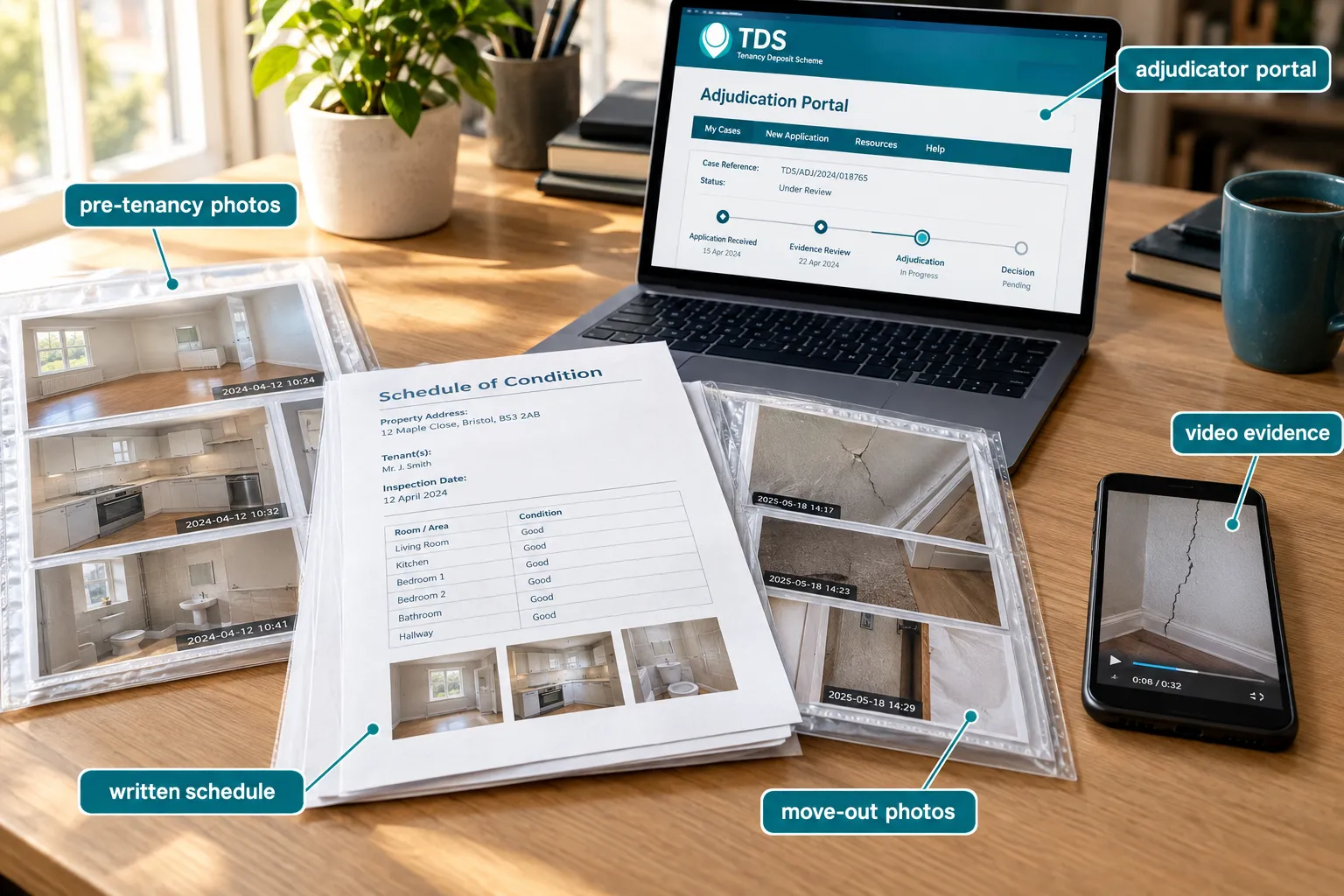
When raising or defending a deposit dispute, the evidence bundle should include [10]:
- The signed schedule of condition from the start of the tenancy
- The check-out report with photographs taken at the end of the tenancy
- Any correspondence between landlord and tenant about condition during the tenancy
- Invoices or quotes for repairs, showing the scope of work
- Any tenant-submitted photographs taken at move-in or during the tenancy
The adjudicator will not visit the property. The decision is made entirely on the documentary and photographic record submitted [7]. A well-prepared schedule of condition, properly annexed to the lease and supported by comprehensive photographs, is the foundation of a credible evidence bundle.
Landlord, Tenant and Surveyor Responsibilities
A schedule of condition creates obligations and protections for all three parties.
Landlord responsibilities
- Commission or prepare a schedule of condition before the tenancy begins
- Ensure it is signed by both parties and annexed to the lease or tenancy agreement
- Retain the original signed document and all associated photographs
- Conduct a check-out inspection using the same format as the schedule
Tenant responsibilities
- Read and check the schedule before signing, raise any omissions in writing before moving in
- Conduct an independent photographic walkthrough on the first day of occupation
- Notify the landlord promptly of any new defects that arise during the tenancy
- Retain copies of all correspondence about condition
Surveyor responsibilities
- Prepare the schedule to a standard that would withstand scrutiny in adjudication or litigation
- Reference every photograph to the written text
- Note the precise location, extent and nature of each defect
- Confirm whether the document has been signed by both parties and annexed to the lease
Where a dispute escalates beyond the deposit scheme to the county court, a RICS-qualified surveyor may be instructed as an expert witness. The valuation dispute expert witness service covers the standards that apply to expert evidence in property disputes.
FAQ
Does a schedule of condition have to be prepared by a surveyor?
No. There is no statutory requirement for a RICS surveyor to prepare it. However, a professionally prepared schedule carries more evidential weight, particularly if the dispute reaches the courts. For high-value properties or long leases with full repairing obligations, a RICS surveyor is strongly advisable.
What is the difference between a schedule of condition and a dilapidations schedule?
A schedule of condition records the state of the property at the start of a tenancy. A dilapidations schedule is prepared at or near the end of the tenancy and sets out the alleged breaches of the repairing covenant. The schedule of condition is the baseline against which the dilapidations schedule is measured.
Can a tenant rely on their own photographs in a dispute?
Yes. Deposit scheme adjudicators accept photographic evidence from both parties. Tenant photographs taken at move-in, provided they are timestamped and clearly show the property, can be highly effective in rebutting a landlord's claim for pre-existing damage [1].
What happens if there is no schedule of condition?
Without a schedule of condition, both parties must rely on other evidence, correspondence, photographs taken informally, witness statements, to establish the starting condition. Adjudicators and courts will draw adverse inferences against the party who had the greater opportunity and obligation to produce a record and failed to do so. In practice, that is usually the landlord [6].
Does a schedule of condition cover contents as well as the building fabric?
It can, but its primary purpose is the fabric. A combined schedule of condition and inventory is acceptable, provided the two elements are clearly distinguished and the fabric condition is recorded in sufficient detail.
Is a schedule of condition required by law?
There is no statute that mandates a schedule of condition for residential tenancies in England and Wales as of 2026. However, the requirement to protect deposits and the adjudication process effectively make a contemporaneous condition record a practical necessity for any landlord wishing to make deductions.
Conclusion
A schedule of condition for a residential lease is not a bureaucratic formality. It is the evidential foundation on which every end-of-tenancy claim rests. Prepared carefully before occupation, signed by both parties, annexed to the lease with appropriate wording, and supported by comprehensive timestamped photographs, it protects the landlord's legitimate interests and the tenant's right not to be charged for damage they did not cause.
The steps worth taking before any tenancy begins are straightforward: instruct a qualified professional to prepare the schedule, ensure the lease wording limits the repairing obligation to no worse than the recorded condition, photograph every room and every defect systematically, and retain the signed originals securely. At the end of the tenancy, repeat the process and compare like with like.
Tenants should conduct their own photographic walkthrough on day one and report any omissions from the schedule in writing immediately. That record, kept safely throughout the tenancy, is the most effective protection against an unjustified deposit deduction.
For properties where structural condition, damp or alterations are a concern, a professional building survey before the lease is signed will identify issues that should be recorded in the schedule. The what survey do you need guide sets out the options available.
References
[1] Evidence Deposit Dispute – england.shelter.org.uk
[2] Why Inventory Reports Are Your 1 Defence In Deposit Disputes – nrla.org.uk
[3] Schedules Of Condition – bradley-mason.com
[4] Schedule Of Condition – augustapp.com
[5] What Is A Schedule Of Condition – bhwsolicitors.com
[6] Disputes Over Tenancy Deposits – housingrights.org.uk
[7] Common Dispute Questions – depositprotection.com
[8] Tenant Inspection Photos Videos Deposit Dispute Evidence – rapideyeinspections.com
[9] Schedule Of Condition Lease Wording – loudwater-bc.com
[10] Guide To Submitting Evidence When You Have A Tenancy Deposit Dispute With Your Landlord Or Letting Agent – justicefortenants.org