Around 5.7 million homes in England sit within 100 metres of the operational rail network, yet most buyers instruct a survey without any specific checklist for railway-related risk. Surveying a property beside a railway, covering vibration, cracks, noise and valuation evidence, requires a structured approach that goes well beyond a standard Level 2 check. Get it right, and a client can buy with confidence, negotiate a fair price, and understand what they are actually purchasing. Get it wrong, and they face years of uncertainty over cracks they cannot explain, a lender nervous about value, or an insurance claim with no supporting evidence.
Key Takeaways
- True structural damage from railway vibration is rare, but cosmetic cracking, perceived risk and buyer stigma create real price discounts that a surveyor must address separately.
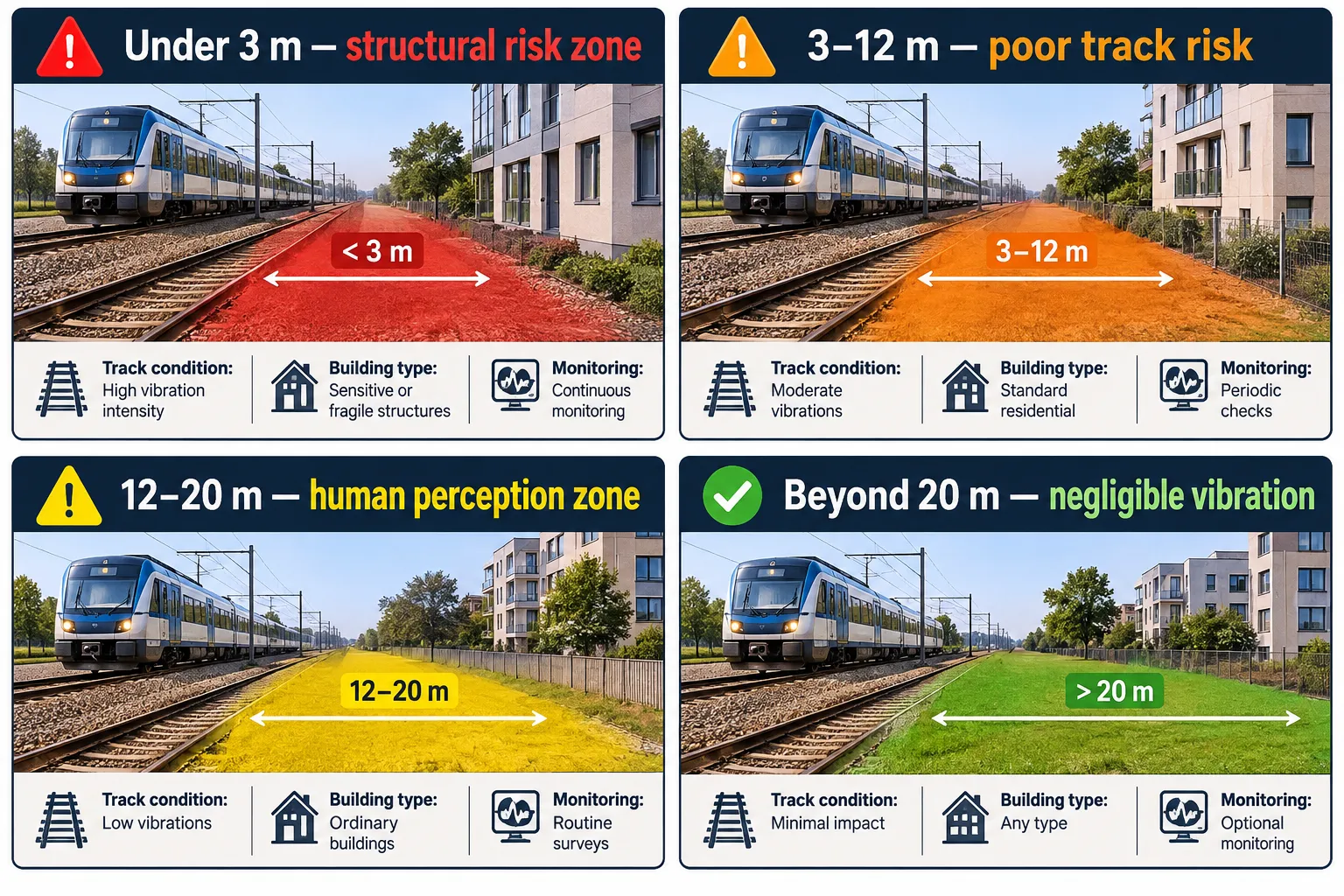
- Vibration amplitudes from typical train operations exceed human perception thresholds up to roughly 20 metres from the track; structural damage thresholds are only exceeded up to 3-12 metres depending on track condition.
- Rail noise can reduce residential property values by around 4% for every 10 dB(A) increase above 45 dB(A), but proximity to stations can generate a 10.5% or greater accessibility premium that partly offsets this [1][2].
- Network Rail does not accept liability for settlement or damage to adjacent developments arising from normal railway operations, so independent survey evidence is the foundation of any claim [3].
- A thorough inspection records exact distance to track, track condition, crack morphology, foundation type, maintenance history and any existing or planned acoustic mitigation, all of which feed directly into valuation evidence.
What Makes a Railway Survey Different
A property adjoining a railway line sits within an environment that combines ground-borne vibration, airborne noise, exhaust particulates, and planning constraints that do not apply elsewhere. The surveyor's job is to separate the physical evidence from the perceived risk, because buyers frequently conflate the two, and the valuation consequences are different in each case.
Network Rail's guidance to developers is explicit: noise and vibration from normal railway use are expected environmental conditions, and the railway will not accept liability for settlement, disturbance or damage to adjacent developments [3]. That single fact changes the advice a surveyor gives. Rather than directing a client toward a compensation claim, the report should establish a factual baseline from which decisions can be made.
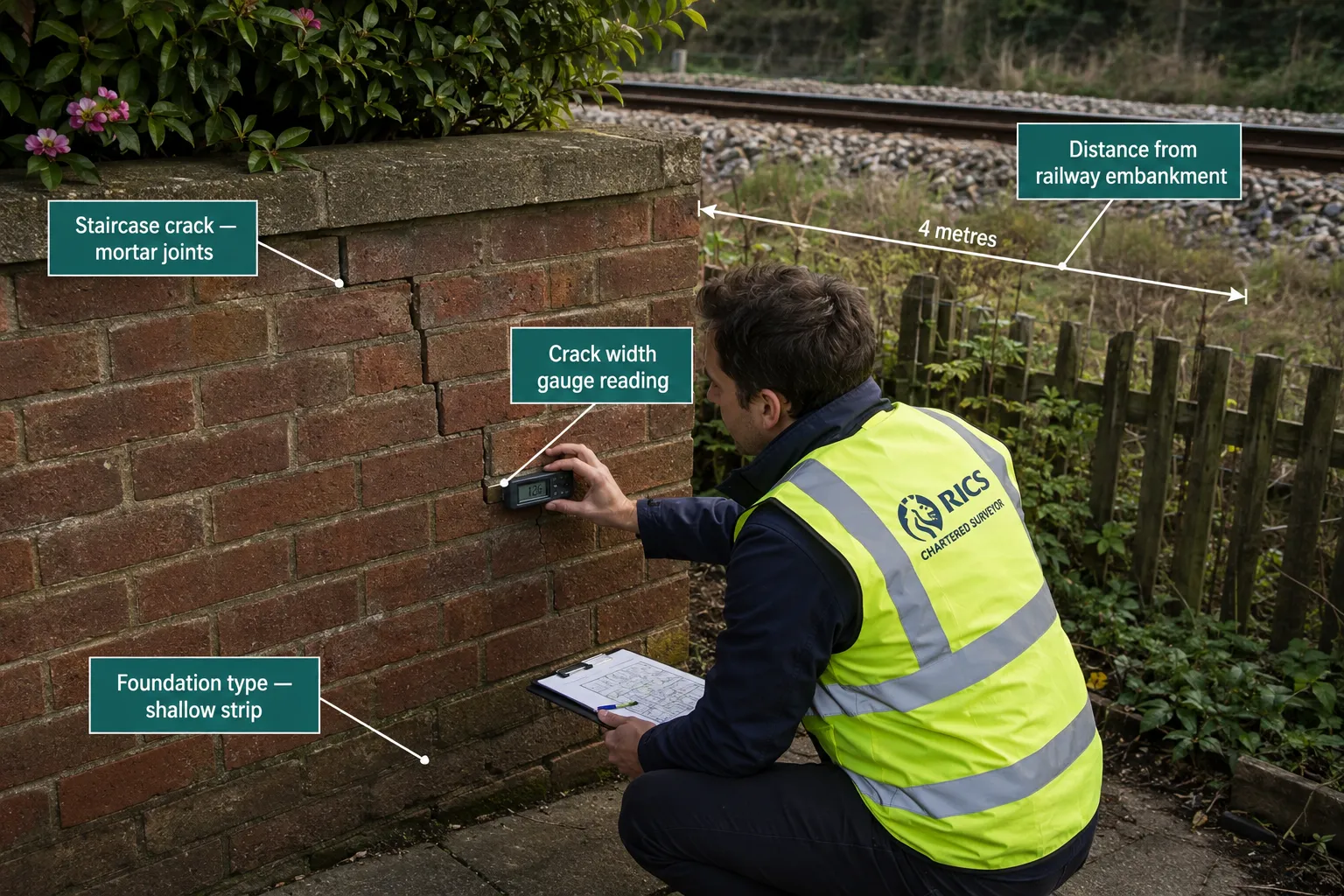
Distance to the track matters more than most buyers realise. Research using integrated 3D modelling of train-induced ground vibrations found that vibration amplitudes exceed human perception thresholds up to about 20 metres from the track under typical operating conditions. Structural damage thresholds, by contrast, were only exceeded up to roughly 3 metres for well-maintained track, rising to about 12 metres where track condition was poor, with visible irregularities in the rail or ballast. A surveyor should therefore pace out or measure the precise distance from the nearest external wall to the nearest rail, record whether the track appears well-maintained, and note any visible defects such as uneven sleepers, corrugated rail surface, or missing ballast.
Reading the Clues During Inspection
Several inspection points distinguish railway-related movement from other causes:
- Crack morphology. Railway vibration, if it causes cracking at all, tends to produce fine, repetitive hairline cracks in plaster and render rather than wide structural fractures. Staircase cracking in brickwork along mortar joints, taper-shaped cracks wider at the top, or cracks that change width seasonally are more consistent with differential settlement or thermal movement than with vibration fatigue [4].
- Crack mapping relative to direction. Cracks running perpendicular to, or directly toward, the railway embankment may warrant closer attention, but always compare with crack patterns in similar properties away from the line.
- Foundation type and age. Shallow strip foundations in pre-1930 terrace housing are more susceptible to long-term fatigue effects than modern raft or piled foundations. Historic masonry buildings, even where measured vibration levels remain within regulatory limits, can show signs of gradual degradation over time [5].
- Maintenance history. Ask the vendor or managing agent for records of any crack repairs, repointing, underpinning or structural investigations. Repeated repairs in the same location are a material flag.
- Evidence of mitigation already in place. Double or triple glazing fitted to track-facing elevations, acoustic fencing along the boundary, and anti-vibration matting beneath ground-floor slabs are all indicators that previous owners or developers acknowledged the proximity of the line.
A specific defect report can be commissioned alongside or after a full Level 3 building survey to focus monitoring on crack patterns that remain unexplained after the primary inspection.
Vibration, Structural Risk and the Monitoring Evidence
Forensic engineering analysis consistently finds that genuine structural damage from railway vibration is uncommon. One technical review concluded that ground-borne vibration from railways is "exceedingly rare" as a cause of building damage, and that minor cosmetic cracking is far more likely to arise from natural settlement, seasonal clay shrinkage or poor construction than from train movements [4]. That does not mean the risk is zero, it means it must be proportionate.
Where concern persists after visual inspection, vibration monitoring over a representative period (typically four to eight weeks, spanning both daytime and night-time operations and any freight windows) provides defensible evidence. The monitoring report should record:
| Parameter | Why it matters |
|---|---|
| Peak particle velocity (PPV) | Standard threshold measure; BS 7385-2 sets guidance values |
| Vibration dose value (VDV) | Relates to human comfort under repeated exposure |
| Dominant frequency | Low-frequency, high-amplitude events affect older masonry differently |
| Train type and frequency | Passenger, freight, high-speed have distinct vibration signatures [6] |
| Distance and track condition | The primary predictors of amplitude at the building |
A schedule of condition report produced before exchange of contracts creates a photographic and written baseline. If cracks widen or new ones appear post-purchase, that baseline is the evidence the owner needs if they later seek a contribution from Network Rail or mount an insurance claim.
Historic and Sensitive Structures
For listed buildings or properties with fine historic fabric, the threshold for concern is lower. Field studies on a 1,000-year-old masonry pagoda in Beijing, located about 130 metres from a major railway, found signs of vibration-induced degradation despite measured levels remaining within regulatory limits [5]. Vibration-related fatigue in aged lime mortar, fragile render or decorative plasterwork can accumulate over decades without ever producing a single dramatic crack event. Buyers of listed properties near a railway should read the listed building survey guide on RICS standards and heritage risks alongside any railway-specific inspection notes.
Noise, Valuation Evidence and the Price Discount Question
Surveying a property beside a railway for vibration, cracks, noise and valuation evidence ultimately comes down to one question for most clients: what is the price actually worth? The answer requires the surveyor to handle two opposing forces, a noise or vibration discount and an accessibility premium, and to present evidence for each.
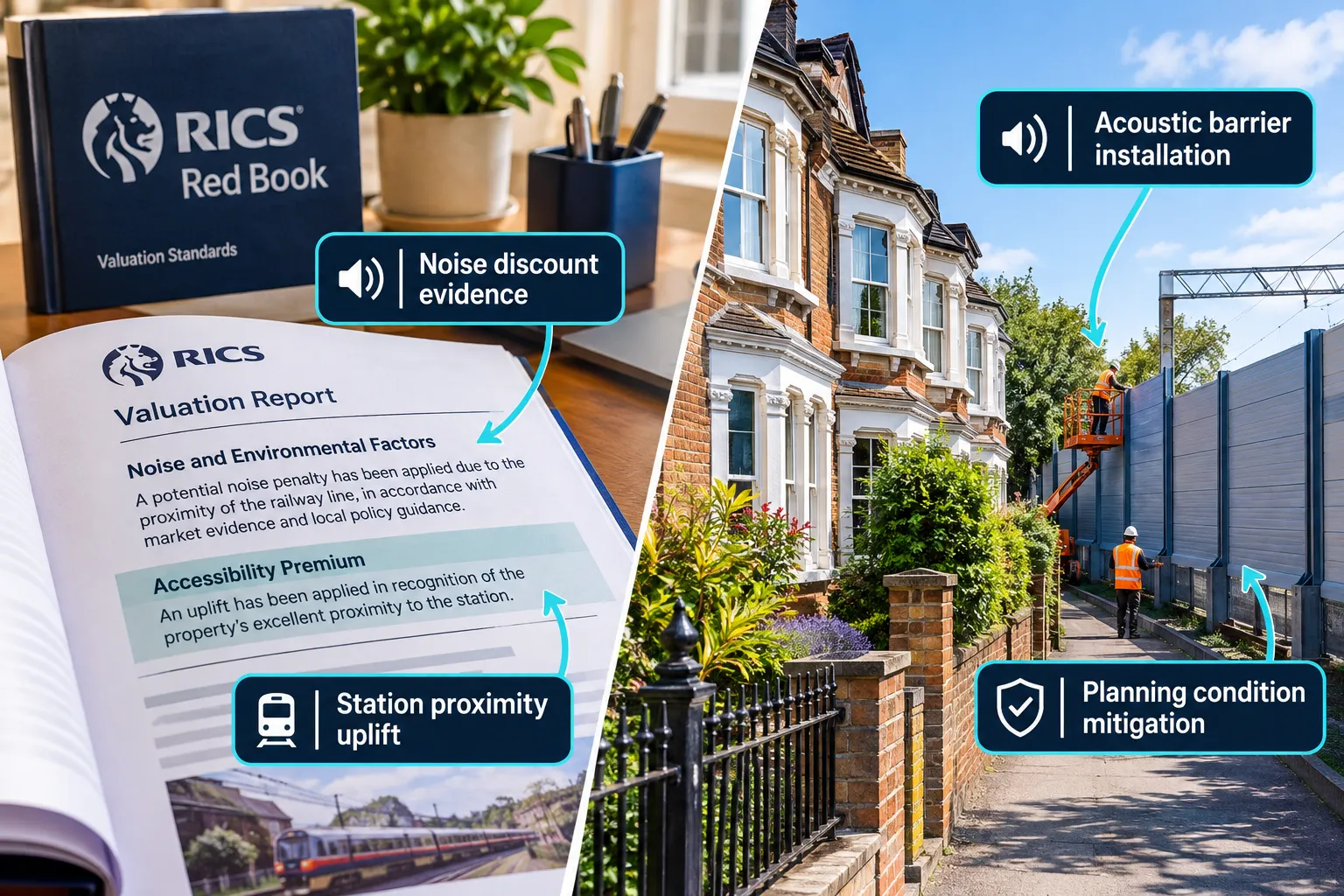
The noise discount. Research integrating detailed transport-noise data into automated valuation models found an average 4% decrease in residential property value for every 10 dB(A) increase in railway noise above approximately 45 dB(A), after controlling for the accessibility benefit of living near a station [1][7]. Freight rail lines with louder, less frequent events tended to show larger negative impacts than commuter lines [1]. In complex transport corridors, railway noise often attracts higher mitigation priority than road noise because of its distinct temporal pattern, sudden, rhythmic intrusions that residents find more disruptive than continuous background noise [8].
The accessibility premium. Properties within 500 metres of a London Underground station carry roughly a 10.5% price premium compared with otherwise similar homes one kilometre away [2]. Around the 41 Elizabeth line stations, prices were projected to rise by approximately 25% more than the central London average in inner areas and 20% more in suburban zones, largely due to connectivity improvements [2]. An RICS Red Book valuation report must weigh both effects explicitly; a desktop estimate will rarely capture the nuance.
For guidance on when a full Red Book report is required rather than a desk-based estimate, see the Red Book valuation versus desktop estimate guide.
Resident perception and stigma. Even where engineering evidence suggests limited structural risk, buyer perceptions can drive real price discounts. Survey-based research found that respondents strongly agreed that vibrations cause structural damage and reduce house prices, with particular concern about high-speed trains and older buildings [6]. Residents near high-speed lines reported significant impacts on sleep and daily functioning from combined vibration and noise, even where formal measurements complied with limits [9]. A valuation report that records subjective disturbance, complaint history, vendor disclosures, local forum evidence, alongside measured noise levels will better explain observed market discounts than one that cites dB(A) readings alone.
Planned mitigation and future schemes. Acoustic barriers along selected rail segments have been associated with nearby property value increases of around 2-3%, with total housing wealth gains in some projects exceeding construction costs many times over. Documenting whether barriers, acoustic glazing, or track dampers are already in place, or are required by planning condition, is therefore material valuation evidence. Conversely, proposed new rail routes or significant capacity increases can affect prices years before construction begins, as seen near the HS2 route where selling difficulties and price impacts emerged long before spades entered the ground [2]. A surveyor instructed on a property near a proposed line should obtain the current planning status, consult the local noise map, and flag the uncertainty in the report.
A Practical Valuation Framework
The table below summarises the main factors and their typical direction of effect on market value:
| Factor | Typical effect on value | Evidence to cite |
|---|---|---|
| Railway noise above 45 dB(A) | Negative (~4% per 10 dB(A)) | Local noise map, BS 8233 assessment |
| Heavy freight line | Larger negative than passenger | Operational timetable, dB(A) readings |
| Walking distance to station | Positive (up to 10.5%+) | Transport for London or ATOC data |
| Elizabeth line / major new service | Further positive premium | Published catchment analysis |
| Acoustic barrier or triple glazing | Partially offsets discount | Planning condition, as-built drawings |
| Proposed new route or HS2 proximity | Negative uncertainty discount | Planning portal, safeguarding maps |
| Unexplained structural cracking | Risk premium, affects mortgageability | Schedule of condition, monitoring data |
For full guidance on how RICS valuers present comparable evidence in contested cases, the expert witness property valuation guide for UK courts explains the standard of proof required.
Insurance, Disclosure and Practical Steps Before Exchange
Several practical matters fall outside the structural inspection itself but belong in any thorough advisory note to a buyer.
Insurance. Some insurers apply exclusions or increased excesses for properties within a defined distance of a railway line, particularly for subsidence cover. The buyer's solicitor should check the policy wording before exchange. Where a surveyor has noted unexplained cracking and recommended monitoring, flagging the potential insurance implication is good practice.
Vendor disclosure. The TA6 property information form asks sellers to disclose disputes, complaints and notices. A buyer should ask whether any vibration complaints have been made to Network Rail, whether any crack repairs have been carried out, and whether any structural engineer has inspected the property in the past ten years.
Planning restrictions. Properties within the railway safeguarding zone may face restrictions on extensions, basement excavations or other works. The surveyor should check the local planning authority's adopted safeguarding map and note any constraints in the report. For advice on party wall implications of works near a boundary shared with railway land, the party wall survey cost guide for London covers related boundary and notifiable works considerations.
Mortgage lender requirements. Lenders have differing policies on properties directly adjoining railway land. Some require a specific structural engineer's report before they will lend at the standard loan-to-value ratio. The building survey cost versus valuation fee guide explains what each report type covers and what lenders typically require.
Frequently Asked Questions
Does Network Rail compensate owners for cracks caused by train vibration?
Network Rail's published guidance states that noise and vibration from normal railway operations are expected environmental conditions and that it will not accept liability for settlement, disturbance or damage to adjacent developments [3]. Claims are therefore difficult to sustain without independent monitoring evidence demonstrating that measured vibration exceeded relevant damage thresholds and that those exceedances directly caused the defects in question.
How far from the track should I be concerned about vibration?
For well-maintained track, structural damage thresholds are only exceeded within roughly 3 metres of the rail. For poorly maintained track with visible irregularities, that zone extends to about 12 metres. Human perception of vibration can extend to around 20 metres. Beyond those distances, vibration is unlikely to be a primary cause of cracking, though noise impact may persist further.
Can I get a mortgage on a house next to a railway?
Most mainstream lenders will lend on residential properties adjacent to railways, but policies vary. Some require a structural engineer's report if cracking is present, or apply revised conditions where the property adjoins operational land. Confirm the lender's position before commissioning surveys, as the type of report required will affect cost and timing.
Will being near a station increase the property's value?
Proximity to a well-connected station often generates a meaningful accessibility premium, around 10.5% within 500 metres of a London Underground station in research cited by major agents [2]. That premium can offset the noise discount for properties on busier lines. Whether it does so in a specific case depends on the balance of noise exposure, the quality of the service, and buyer demand in that micro-location.
What survey type should I commission?
A Level 3 building survey (formerly a full structural survey) is the minimum appropriate instruction for any property directly adjoining a railway. Where unexplained cracking is present, a separate specific defect report or structural engineer's report may be warranted. Where the purchase is contested or a compensation claim is contemplated, an RICS Red Book valuation providing formal valuation evidence will be required.
Does new acoustic glazing fully solve the noise problem?
Acoustic glazing and specialist ventilation can substantially reduce internal noise levels and may restore comfort to habitable standards under BS 8233. However, external amenity, garden, terrace, open windows in summer, remains affected. The planning conditions requiring acoustic design also confirm that the line is a material constraint on the property, which a surveyor should note in any valuation.
Conclusion
Surveying a property beside a railway for vibration, cracks, noise and valuation evidence demands a more structured approach than a standard residential inspection. The physical evidence, crack morphology, distance to track, foundation type, monitoring data, must be assembled before any conclusion about causation is reached, because forensic analysis consistently shows that genuine structural damage from rail vibration is far less common than buyers fear [4]. The valuation evidence must then weigh a noise discount, an accessibility premium, and the effect of existing or planned mitigation on the same property.
Practical next steps for buyers and their advisers:
- Instruct a RICS Level 3 building survey and specify in writing that the railway proximity is a material concern requiring explicit comment.
- Measure or confirm the exact distance from the nearest wall to the nearest rail, and record visible track condition at the time of inspection.
- Commission a pre-exchange schedule of condition if the property shows cracking, to establish a dated photographic baseline.
- Ask the vendor to complete full disclosure on any structural investigations, crack repairs, or complaints to Network Rail.
- Check the local noise map, confirm the planning safeguarding zone, and obtain a copy of any planning conditions requiring acoustic mitigation.
- Ask the conveyancing solicitor to confirm the lender's specific requirements and check insurance policy exclusions before exchange.
- Request an RICS Red Book valuation rather than a desktop estimate where the noise discount or accessibility premium is material to the purchase price negotiation.
References
- Proptrack and Ambient Traffic Noise Insights. proptrack.com.au.
- How New Transport Infrastructure Affects Property Prices and Saleability. struttandparker.com.
- Developer Guidance Town Planning Level Crossings. networkrail.co.uk.
- Understanding Ground Vibration and Noise From Railways Key Insights and Future Directions. hawkins.biz.
- S40534 025 00406 3. link.springer.com.
- d-nb.info.
- New Study Reveals Impact of Traffic Noise on Property Values in Victoria. brokernews.com.au.
- Pdf. iopscience.iop.org.